
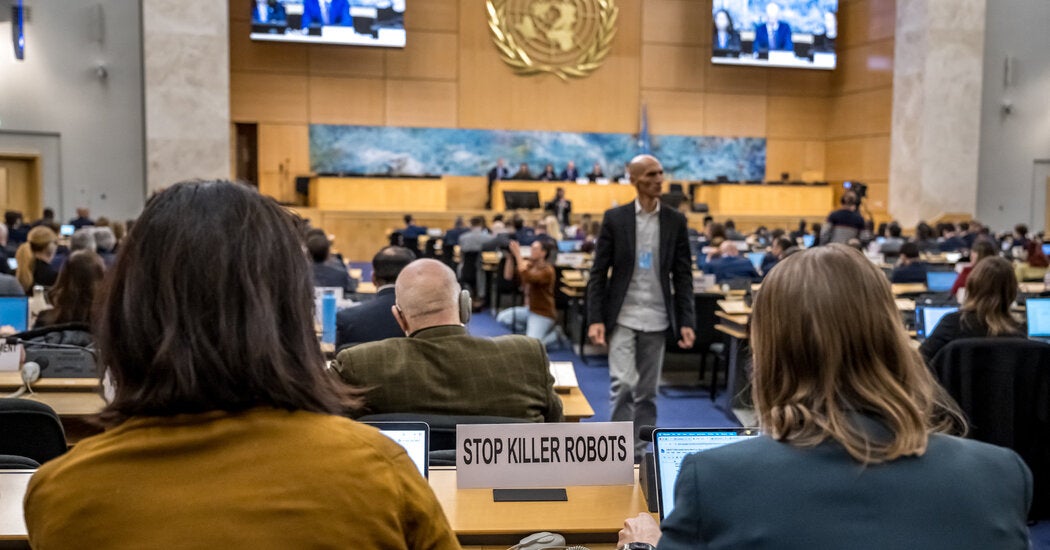
AdvertisementSKIP ADVERTISEMENTDelegates met in Geneva to discuss guardrails for such systems even as their development grows. Russia and the United States have resisted the efforts.Delegates attending a conference to discuss lethal autonomous weapons at the United Nations in Geneva on Monday.Credit...Fabrice Coffrini/Agence France-Presse — Getty ImagesNov. 16, 2026, 9:47 a.m. ETGlobal efforts to limit the use of lethal autonomous weapons reached a crossroads this week as countries gathered to decide whether to negotiate binding restrictions on the technology, despite strong resistance from the United States and Russia.Delegates of 128 states met at the United Nations in Geneva on Monday for a weeklong conference to determine whether to draft a treaty that would ban lethal autonomous weapons and require meaningful human control of such systems.“The longer the international community waits, the more difficult it will become to establish meaningful safeguards — and it may be too late,” Volker Türk, the U.N. human rights chief, said before the conference.Artificial intelligence and its military uses are developing at breakneck speed, as seen on the battlefields of Ukraine and the Middle East. That has deepened international alarm and prompted calls for action by many countries, global leaders and activist groups, even as top military powers balk at attempts to curb their ability to develop new weapons.“Decisions affecting human life, freedom and the use of force must always remain subject to effective, informed and responsible human oversight,” Pope Leo XIV said in a statement last month that urged those at the Geneva conference to take “concrete “steps” to ban lethal autonomous weapons. Artificial intelligence, he said, “must be ‘disarmed.’”Russia and Ukraine have already deployed fully autonomous drones to carry out attacks. Disarmament experts fear that the low cost and easy availability of such technology could lead to its rapid spread to law enforcement, nonstate armed groups and organized crime.Mirjana Spoljaric, the president of the International Committee of the Red Cross, said last week that states had to “ensure that the future of warfare is not handed over to machines.”It is unclear, however, how much progress will be made in Geneva.Much of the groundwork needed for a new convention was covered in three years of discussions by governmental experts that ended in September. Those talks aligned states on a working definition of lethal autonomous weapons and on the need to comply with international humanitarian law.In a move that angered many countries, the United States and Russia intervened in the closing hours of those talks to remove elements that many considered essential. That included language on the need for autonomous weapons to be reliable, predictable and traceable to whoever develops or uses them, and on the need for “a responsible chain of human command and control.”The final document was still accepted by states and humanitarian organizations as a reasonable basis for negotiating a binding agreement — a process that most countries support. A resolution to that effect was backed by 163 states in the U.N. General Assembly in October, facing opposition from the United States, Israel, Russia, Belarus and North Korea. Nine countries abstained, including China, Iran and Saudi Arabia.But the format of this week’s discussions in Geneva — which are proceeding under the U.N. Convention on Certain Conventional Weapons — could make it harder to successfully negotiate a binding treaty. The convention’s rule of decision-making by consensus gives every state an effective power of veto on further talks.States could sidestep that by pursuing negotiations in the U.N. General Assembly or through an independent process, as they did for earlier treaties banning land mines and cluster munitions. But key military powers like the United States would probably pull out of any such process — meaning they would not be bound by any resulting agreement.There was disagreement about how to proceed before the conference in Geneva had even started.The Peruvian chair of the discussions on autonomous weapons has proposed giving countries a mandate to negotiate a new protocol within two years. The United States has instead proposed discussing a nonbinding instrument over five years. Autonomy in weapons can enhance compliance with international law, the United States said in a working paper, arguing that it would be contrary to the humanitarian objectives of the convention to “hamper responsible innovation.”There were also signs of stalling from Russia, which has challenged the way observers can participate in the Geneva talks, leaving it unclear how they will proceed.Maria Zakharova, a spokeswoman for Russia’s foreign ministry, told reporters last week that it wanted to resolve “all organizational matters” before the conference began. In any case, she added: “We consider it premature to argue that the time has supposedly come to develop restrictive or prohibitive measures concerning such systems.”Proponents of new rules say the talks need to produce a firm commitment to quickly drafting a protocol. Otherwise, they argue, military efforts to develop lethal autonomous weapons will outpace efforts to ban them.“This is genuinely a do-or-die moment,” said Beatrice Fihn, a disarmament activist who received the 2017 Nobel Peace Prize on behalf of the International Campaign to Abolish Nuclear Weapons. “If we don’t start negotiating, and quickly, then we are accepting autonomous weapons will kill people on the battlefields in the next few years.”Related ContentAdvertisementSKIP ADVERTISEMENT
U.N. Starts Uncertain Effort to Regulate Lethal Autonomous Weapons
Full Article
Original Source
Read the full article at Nytimes →KhanList aggregates and links to publicly available news content. We do not host full articles from third-party sources. Always verify important information with original sources.