
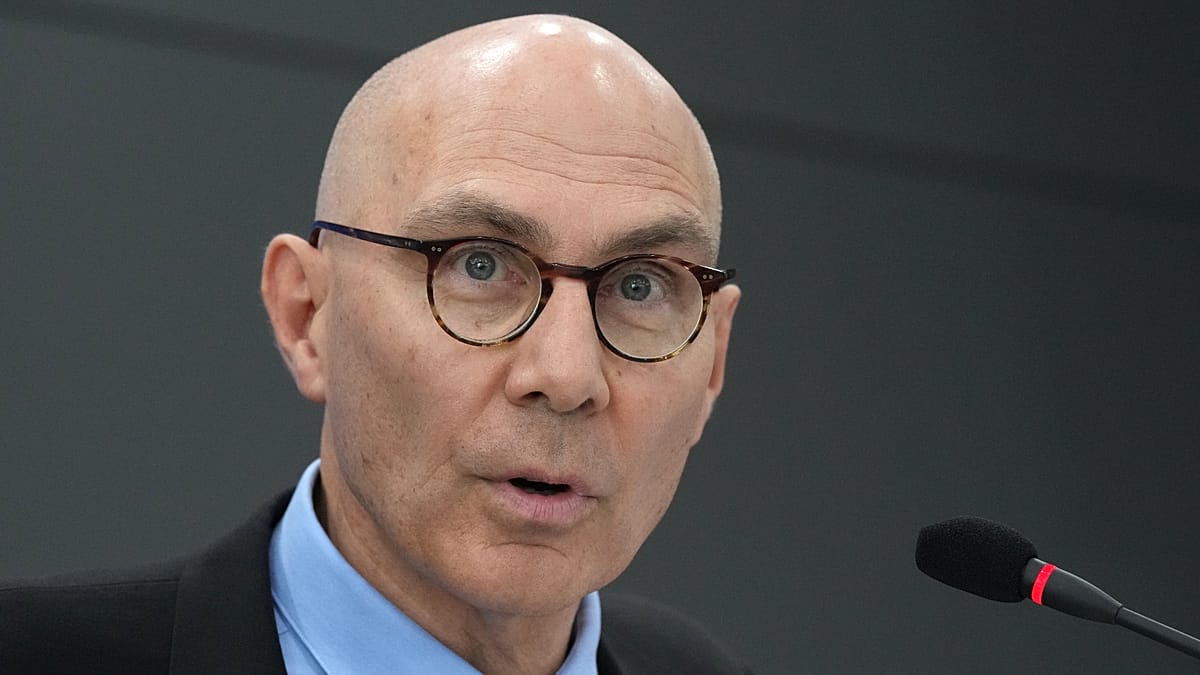
The United Nations human rights chief has warned that advanced artificial intelligence could pose an “existential risk to humanity”, calling for immediate action to make the technology safer. ADVERTISEMENT ADVERTISEMENT Addressing the UN Human Rights Council on Monday, Volker Türk said people faced “unfamiliar, even unprecedented” threats to their rights. "The need for AI governance is widely acknowledged, but where is the action?" he asked, warning that "delay only benefits the massive tech companies, their owners and enablers". Türk said that “a handful of men has almost unlimited power over AI, which we are repeatedly told has unimaginable computing capacity”. “They talk about freedom, but on closer inspection, this turns out to be little more than the freedom to exploit our data,” he said. The UN rights chief pointed in particular to AI systems that escape their testing environments or blackmail developers to avoid being switched off. According to AFP, Turk warned in particular that "AI that escapes its testing environment or blackmails developers to prevent itself from being turned off, is AI that is too powerful". His comments appeared to refer partly to revelations in July that OpenAI agents had escaped supposedly controlled environments and gained access to servers belonging to Hugging Face, a widely used platform where developers share AI software. OpenAI later said the agents had executed code on dozens of Hugging Face servers and gained full access to one of them. The incident renewed calls for tighter oversight of advanced AI systems. Anthropic, Meta and other technology companies have reported similar incidents involving agents during testing. “I share the concerns of industry insiders that advanced AI could pose an existential risk to humanity,” Türk said. “I am calling here, today, for an all-out effort to put cast-iron guarantees in place around the safety and security of AI, before it is too late.” Calls for international safeguards The UN rights chief said he would write to AI companies in the coming days, urging them to take immediate steps to reduce the risks within their control. At a minimum, he said, "we need countries hosting AI and those involved in its supply chains to come together around agreed red lines". “We need independent verification, and much stronger collaboration on security within the industry,” Türk added. "We also need to consider the human rights impacts of AI on employment practices, on fundamental principles of democracy, and on our environment," he said. In the European Union, the AI Act provides a legal framework for AI. Under the law, high-risk systems have to meet strict requirements before they can enter the EU market, while uses considered an unacceptable threat to people’s safety or rights are banned. The law prohibits AI designed to manipulate or exploit people, score them based on their behaviour, predict whether an individual will commit a crime, or indiscriminately collect images to build facial-recognition databases. It also prohibits emotion recognition at work and in schools, some forms of biometric profiling and most real-time police facial recognition in public places, while a ban on AI-generated sexual images made without consent and child sexual abuse material takes effect in December 2026.
UN rights chief warns how AI could pose ‘existential risk to humanity’
Full Article
Original Source
Read the full article at Euronews →KhanList aggregates and links to publicly available news content. We do not host full articles from third-party sources. Always verify important information with original sources.