
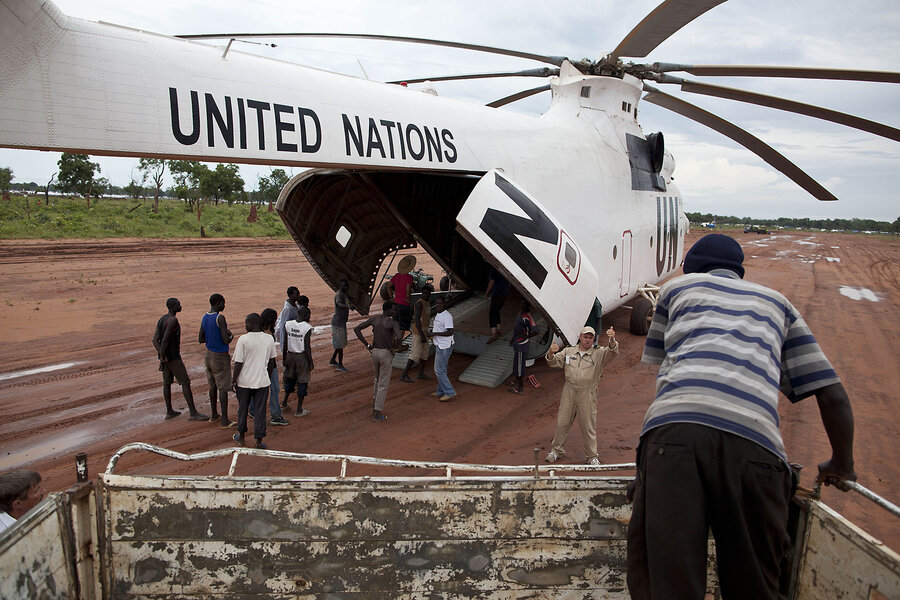
In Sudan, site of the world’s largest humanitarian crisis, funding cuts mean only a quarter of the 20 million people facing hunger are now receiving food assistance.In Afghanistan, cuts are having an impact on the number of mothers and newborns dying. And in Haiti, the lack of funding has been seen in a reduction of hot meals and rations during a food shortage.Why? The United Nations is receiving far less money from the United States and some of Europe’s richest nations to distribute to countries in need. The cash-strapped body is being forced to operate on a much tighter budget. World leaders are meeting this week in New York for the U.N. General Assembly under the theme “Restoring Trust, Managing Transformation.”Tom Fletcher, the United Nations' humanitarian affairs chief, has described the cuts as “the most severe funding shortfall in the history of humanitarian aid.” He told Spanish newspaper El País in June, “Our teams have to make brutal decisions: the cuts force us to choose which lives to save and which lives not to save, which programs to fund and which to drop.” Odelyn Joseph/APAntoine Guerdy prepares food at a shelter for families displaced by gang violence in Port-au-Prince, Haiti, April 16, 2026. The U.N. finds itself facing a defining test as it transforms into a smaller, leaner organization. The General Assembly is having to tackle questions about whether it can make the reforms needed or whether the depth of the cuts makes that mission impossible.“Lower-income countries, donor countries, and multilateral organizations are having to adapt and adapt very quickly to this new reality,” says Sam Loewenberg, a journalist specializing in international development and global health. But, he adds, “there is an opportunity here for developing countries to take more control and increase their own spending in these areas, and to have a stronger voice in foreign assistance so it fits their needs in a more sustainable way.” In response to international aid cuts, the African Union has urged its member states to strengthen self-reliance and regional economic cooperation. Relatively wealthy developing countries, such as South Africa, have started coming up with much of the funding for their own HIV programs. Poorer nations, however, do not have the same option and are being hardest hit by the defunding, experts say.“It’s an important lesson that we should focus assistance where it’s really needed,” says Charles Kenny, a senior fellow at the Center for Global Development in Washington.In January, President Donald Trump signed an executive order to withdraw the United States from 66 international organizations, many of them related to the U.N., stating they “no longer serve American interests.” The U.S. pledged to contribute a total of $3.8 billion in U.N. humanitarian aid this year, down from a high of $17 billion in recent years.The world’s largest economy has historically been the biggest foreign aid donor. However, some of the U.N.’s wealthiest patrons – including the United Kingdom, Germany, France, and Japan – have also reduced their international aid as they face increased defense spending needs and tight financial conditions. Angelina Katsanis/AP/FileU.S. President Donald Trump addresses the 80th session of the United Nations General Assembly, in New York, Sept. 23, 2025. Together with the U.S., those countries accounted for 95.7% of the total drop in funding, according to figures from the Organisation for Economic Co-operation and Development.The deepest recent cuts have targeted some of the U.N.'s most effective humanitarian agencies, says Dr. Kenny. Funding for the World Food Programme went down by almost half to $2.3 billion, while financial support for the U.N. High Commissioner for Refugees sank from about $2 billion to $868 million. UNICEF’s budget dropped from roughly $1.2 billion to $447 million.Long before the change in funding began, though, there had been calls for U.N. reform.“The often unpredictable and short-term funding, along with other structural problems, led to inefficiencies, overlaps, and gaps within the U.N. So, reform was needed,” says Mr. Loewenberg. “But suddenly yanking away such a huge percentage of these humanitarian and other life-saving agencies’ budgets has had terrible consequences for millions of people.”U.N. agencies are trying to bolster efficiency and do more with less in different ways, from sharing logistics to reducing staff and merging some agencies.Challiss McDonough, an international development consultant and former U.N. aid worker, says having rigorous reporting systems to ensure accountability and transparency is the kind of bureaucracy that is essential but at first glance might be mistaken for waste. Deepen your worldviewwith Monitor Highlights.Politics with respectGet political stories with respectful analysis.There‘s a world of new ideas in everyBooks newsletter.There‘s more to life, enrich yours withCulture & Learning weekly.Follow humanity‘s discoveries withScience & Nature stories in your inbox.Gain a spiritual perspectivefrom the stories in your inbox.Want to understand the deeper impact of critical events? Learn the Monitor‘s insight.Already a subscriber? Log in to hide ads. “There are a lot of guardrails to prevent fraud and abuse, and you cannot sacrifice that,” she says.Among the top agenda items of the General Assembly are climate change, ongoing wars, hunger, pandemics, and rising alarm over artificial intelligence – all of which demand a multilateral approach, says Mr. Loewenberg. “The world is interconnected, and to pretend otherwise is absurd. It’s a losing strategy.” ALREADY A SUBSCRIBER? LoginReal news can be honest, hopeful, credible, constructive.The Christian Science Monitor was founded in 1908 to lift the standard of journalism and uplift humanity. We aim to “speak the truth in love.” Our goal is not to tell you what to think, but to give you the essential knowledge and understanding to come to your own intelligent conclusions. Join us in this mission by subscribing.
UN faces defining test as its aid funding is cut
Full Article
Original Source
Read the full article at Csmonitor →KhanList aggregates and links to publicly available news content. We do not host full articles from third-party sources. Always verify important information with original sources.