
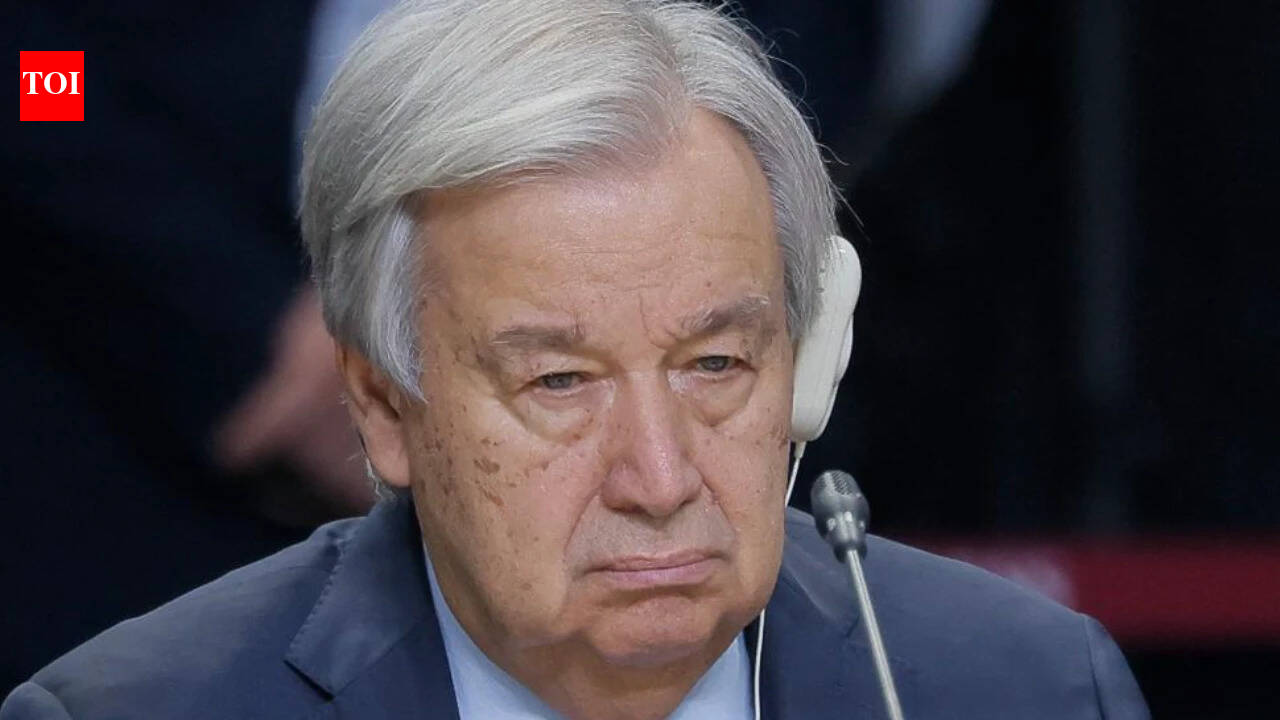
UN chief António Guterres is due to leave office at the end of 2026.'If you ever feel useless, remember; the United Nations exists,' goes a viral meme, reflecting the growing frustration over the organisation's inability to resolve major global conflicts.As usual, the ongoing 81st UN General Assembly has seen a succession of mostly monologues, with many of the world's major leaders already taking their turn at the podium, against the familiar backdrop of green serpentinite, in New York.In the competitive and chaotic world order, ranging from the multilateral to bipolar, sides have been chosen and the usual calls for peace, cooperation and a "rules-based international order" have been made. Including the walkouts.Nonetheless, the demanding question is how much the UN, in its current state, can accomplish? After a month into the 81st session, which of today's wars or conflicts is actually "listening" to the UN?Missiles and drones have devastated communities in Iran, Israel, Russia and Ukraine, while civil conflicts burn on in Myanmar and Sudan. The Security Council has repeatedly struggled to act, with China, Russia or the United States, three of its five veto-wielding powers, blocking action on major conflicts.Five nations have veto-wielding powers in the UN.These divisions have exposed the limits of the UN and its Security Council, which has struggled to act when the interests of its five permanent members collide.The Trump administration also halted much of its funding for UN activities last year, forcing cuts to peacekeeping and relief work. The bigger concern is whether the UN can still translate its words and resolutions into meaningful action on the ground.The paradox of promisesCreated in 1945 after two devastating world wars, the United Nations was designed to prevent another global catastrophe, provide a forum where countries could resolve disputes and give weaker countries a voice in an international system dominated by powerful nations. Eight decades later, that system is under severe strain.The global platform once strongly voiced in the support of decolonisation, delivered humanitarian assistance, facilitated peace operations and provided a platform where even the smallest countries can speak.In 1962, UN third secretary general U Thant acted as a key neutral mediator during the Cuban Missile Crisis, helping the US and Soviet Union pull back from nuclear war.Thrid UN chief U Thant acted as a key neutral mediator during the Cuban Missile CrisisHowever, against the ambitions of sixth secretary general Boutros Boutros-Ghali, who after the end of the Cold War, had thought to achieving the "rule-based order", the world witnessed Rwandan genocide in 1994 and the Srebrenica massacre in Bosnia in 1995, bone-chilling atrocities that blue helmet peacekeepers failed to prevent.Over 2 million people were displaced in the Rawandan GenocideLater, seventh secretary general Kofi Annan rebuilt some faith with peace operations in Kosovo and Timor-Leste starting in 1999, and with fresh goals on poverty and AIDS. Then the American-led war in Iraq in 2003 split the security council and derailed his agenda. His successors, Ban Ki-moon and António Guterres, inherited the Syrian civil war, which divided the Council for over a decade.More than 8,000 men and boys were killed in Srebrenica.In 2026, the deeper problem is that the organisation increasingly appears incapable of dealing with the most consequential crises of the day and external affairs minister S Jaishankar has put the problem bluntly."Where the UN is concerned, I think it's obvious to everybody by now that the UN is gridlocked. That if you look at the big issues of the day, whether you look at the conflict in the Gulf, whether you look at the conflict in Ukraine, whether you look at other issues in Africa, whether you look at Covid, actually, the United Nations has been largely irrelevant to the decision making," EAM S Jaishankar said, however noting that the UN should not disappear."We don't need no UN. The idea is not to throw away the UN, but to fix the UN," Jaishankar said."The United Nations has been largely irrelevant to the decision making," EAM S Jaishankar said.India's stand, along with other nations actively seeking an overhaul of the United Nations, gets legitimacy from the fact that the organisation has invariably remained obdurate in tackling the menace of terrorism.Pakistan, which has been a breeding ground for terrorists was recently praised by UN chief Antonio Guterres for "being a source of solidarity"."For over two decades in different roles, I have seen Pakistan as a source of solidarity and solutions. Pakistan has shown that, even in difficult circumstances, compassion and responsibility must go hand-in-hand," Guterres said, ironally adding: "We stand with Pakistan in confronting this threat of terrorism".Antonio Guterres remark on Pakistan and terrorism.A veto frozen in 1945The UN's original architecture reflected the balance of power at the end of World War II. Five countries, the United States, Russia, China, Britain and France, were given permanent seats on the security council and the power to veto substantive decisions.That arrangement was, by and large, understandable in 1945. However, it is increasingly difficult to defend as a permanent settlement for the world of 2026.The UN's original architecture reflected the balance of power at the end of World War II.UN membership has expanded from 51 founding members to 193, with most of the growth coming from newly independent and smaller states. Yet the central political structure of the organisation has barely adapted to this transformation.The result is an uncomfortable contradiction as almost every country has an equal vote in the general assembly, but five countries retain an extraordinary ability to prevent collective action in the security council. The veto has repeatedly become an instrument of national interest rather than a mechanism for preserving international peace. When one of the permanent members is directly involved in a conflict, or regards an issue as strategically important, the council is rendered paralysed.The consequences are particularly serious because the nature of global insecurity has also changed. Conflict is no longer confined to battlefields. Choking Strait of Hormuz and Bab al-Mandeb has disrupted energy supplies, food prices, shipping routes, financial markets and global trade. Russia and Ukraine war impacted hugely the grains supply.After the quarter of the 21st century, cyberattacks on infrastructure and banking systems, technological competition, nuclear modernisation, climate shocks and transnational crime increasingly cross borders. The UN therefore faces a world in which the consequences of conflict travel faster and further, while the institution responsible for managing those consequences seems crumbling under the beuraucratic bagage.Smaller states with bigger problemsThe most watched 81st assembly speech on YouTube is of Balendra Shah, Nepal's Prime Minister, who attended the meeting to narrate the world about the horrific flash flood that claimed lives of over 1,000 people in the Himalyan nation.The world watched him the most, at least three times more than Donald Trump, who belives climate change is "the greatest con job ever perpetrated on the world". Consquently, America, under Donald Trump, has cut $4 billion in outstanding US pledges to the UN’s Green Climate Fund, immediately vacating its board seat.A presidential memorandum completely defunded and ordered withdrawal from 66 international organisations, including 31 UN entities like the United Nations Framework Convention on Climate Change (UNFCCC), Intergovernmental Panel on Climate Change (IPCC), and the Paris Climate Agreement.The US, responsible for roughly 20% to 25% of all global cumulative CO₂ emissions, also exited the UN's "loss and damage" climate disaster board. While Nepal suffers and US runs amok, UN remains helpless.President Donald Trump points toward United Nations Secretary-General Antonio Guterres, after speaking to the United Nations General Assembly, Tuesday, Sept. 22, 2026, at the UN headquarters. These incidents, therefore, brings back to how UN's erosion of international restraints has been particularly dangerous for smaller states. The post-1945 system gave them something that military or economic power could not provide, a rules-based framework in which sovereignty and territorial integrity carried weight.As former Estonian President Lennart Meri quipped in the late 1990s: “The nuclear weapon of small states is international law.”That protection, however, has now dangerously weaken, with great-power rivalry has increasingly encouraged unilateral action, economic pressure and competing diplomatic blocs. Alternative groupings such as the G7 and Brics providing useful platforms, but their rise also risks shifting decision-making away from the universal system in which smaller states have a seat.ALSO READ | Trump's 48 F-35 jets for Saudi Arabia: Why is Israel uneasy and China a key concern"Institutions that cannot explain where they add value become vulnerable to indifference, and indifference in the current climate is not a passive condition — it is actively eroding the UN’s finances and political will. The UN has a liquidity crisis, which, at its core, is a crisis of confidence in the institution by its member states," said Rafael Grossi, IAEA chief, who is in the race to be the next UN chief.What the next UN chief must fixAntónio Guterres is due to leave office at the end of 2026, leaving his successor to restore confidence in a financially constrained and politically divided UN.The leadership change at the UN later this year could also offer an opportunity to reset the institution. The contenders for the UN chief post include senior UN trade official Rebeca Grynspan, International Atomic Energy Agency chief Rafael Grossi and Guyana's Ambassador to the UN Carolyn Rodrigues-Birkett. Whoever gets the post, the focus must be on the conflict prevention, quiet diplomacy and making the organisation more accountable and efficient.The next UN chief is likely to declared by the end of 2026.The UN also needs to address overlapping agencies and focus resources on peace, humanitarian work and achievable development goals. But no reform can avoid the Security Council's outdated structure.India and Brazil have gained far greater global importance since 1945, yet remain outside permanent membership. Reforming representation and the veto will be difficult, but necessary if the UN is to remain relevant in a changed world.ALSO READ | Bombs without brakes? Why the US-China AI race may be harder to control than the nuclear one
UN-doing the United Nations: Can its next chief fix a system under strain?
Full Article
Original Source
Read the full article at Timesofindia →KhanList aggregates and links to publicly available news content. We do not host full articles from third-party sources. Always verify important information with original sources.