
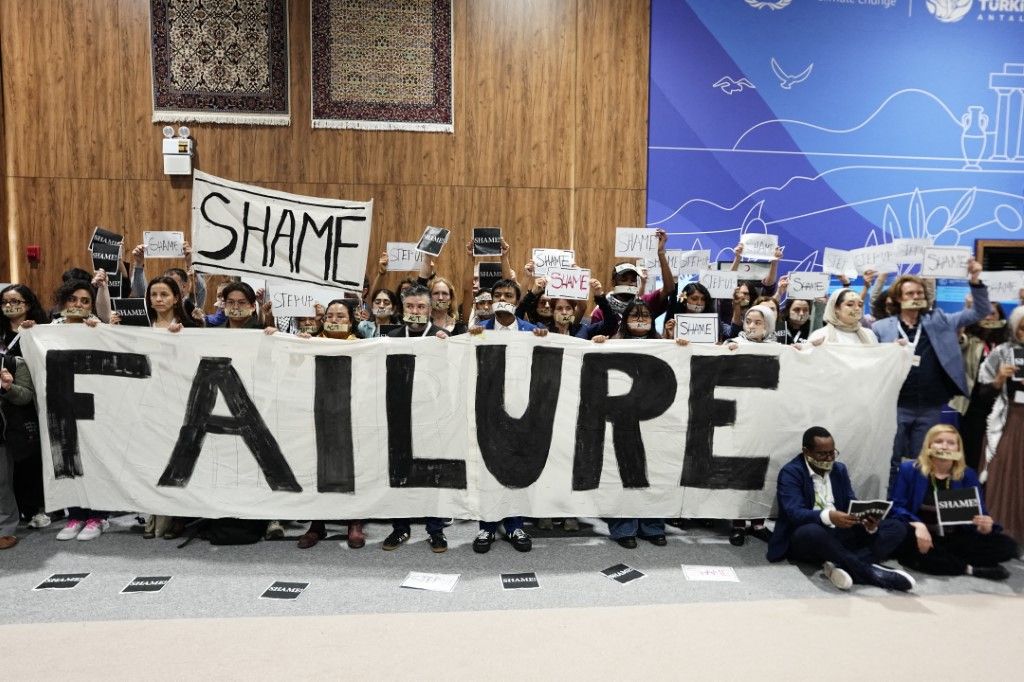
It hasn't happened since 2009: International talks to fight climate change ended without any new pledges and commitments. (CN) — For only the second time ever, annual international talks to combat climate change collapsed without an agreement late Sunday amid deep divisions between the European Union and oil-producing nations.The summit, held this year in Antalya, Turkey, and known as COP31, was overshadowed by geopolitical tensions and wars, the withdrawal of U.S. President Donald Trump from the United Nations process to tackle climate change and growing alarm over the accelerating pace of global warming.On Sunday, with the faltering talks already in overtime, the EU delegation walked out of the negotiations and said it could not accept a final declaration that did include language over the need to transition away from fossil fuels. The United Kingdom and many developing nations also rejected the proposed text as unacceptable.During the two-week summit, criticism was leveled at EU countries too after they failed to live up to promises to provide developing nations with substantial new funding to deal with climate change.The last time a U.N. climate summit failed to deliver a final agreement was in Copenhagen, Denmark, in 2009.U.N. climate negotiations operate on a consensus-based decision-making mechanism and any agreement must be accepted by all 196 countries.Darragh O’Brien, Ireland’s climate minister who spoke on behalf of the EU, said the summit failed because it was “hijacked by some oil states.”He said the EU could not endorse a final declaration “that does not even mention fossil fuels, the key driver of climate change.”Wopke Hoekstra, the EU’s climate commissioner, said the bloc wanted to “draw a line in the sand” with its refusal to sign onto an agreement that avoided a commitment to move away from fossil fuels.“When an outcome falls so far short, there is always a temptation to muddle through,” he said on social media. “But our assessment was clear: Both in the short and long term, climate action required us to draw a line in the sand.”Attendees walk near a warning that reads "don't fall for fossil fuels" at the COP31 U.N. Climate Summit, Friday, Nov. 20, 2026, in Antalya, Turkey. (AP Photo/Khalil Hamra)Russia and Saudi Arabia defended their position by arguing fossil fuels remain critically important.Sergei Kononuchenko, a Russian delegate, said Russia could not agree to phasing out fossil fuels because that would only worsen poverty around the world. Saudi Arabia said “climate change requires all solutions on the table.”In 2023, a climate summit in Dubai called for moving away from fossil fuels, but since then the climate talks largely have avoided the topic.Instead, the proposed Antalya agreement put emphasis on boosting electrification around the world and supporting technologies to remove carbon dioxide from the atmosphere.The text called for increasing electricity’s share of global energy use from 23% to 35% by 2035. But even this pledge was criticized for not saying renewable energy sources should be favored over fossil fuels in the electrification drive.The text’s support for carbon capture and storage technology also was a source of contention because many scientists say it is an unproven means of reducing greenhouse gases and is promoted by fossil fuel companies.Last week, developing nations were angry at EU countries for offering paltry sums to help developing countries fight climate change.Richer countries pledged only about $50 million into a fund to help countries adapt to climate change. That amounted to only one-sixth of an annual target of $300 million agreed to at last year’s climate summit in Belém, Brazil, and fell well short of a broader goal to mobilize $1.2 billion from 2026 to 2029.Murat Kurum, Turkey’s environment minister and co-president of the summit along with Australia’s environment minister, defended not including mention of fossil fuels by saying it had already been dealt with at the Dubai summit.“Unfortunately, some countries became fixated on a word or a phrase and brought other issues, unrelated to climate, into the discussions, preventing the process from moving forward,” Kurum said.António Guterres said he was “deeply disappointed” by the summit, his last as the U.N. secretary-general. He has criticized powerful fossil fuel interests for obstructing climate action.Climate activists blasted the summit as a massive failure.“This was the worst COP ever,” said Tasneem Essop, the head of Climate Action Network, a global coalition of climate groups.She said richer countries “systematically blocked measures” to provide finance to “protect people’s lives and address the climate crisis.”She denounced the EU. “By rejecting the text because it does not include language on fossil fuels is the height of hypocrisy,” she said in a statement.She accused the EU of both failing to phase out its own use of fossil fuels and not meeting “obligations to provide finance to developing countries.”The Climate Action Network added that the summit was “hijacked” by energy companies, carbon capture promoters and the energy-hungry artificial intelligence industry.The summit’s proposed text “rolled out the red carpet for technologies that risk prolonging fossil fuel production,” the group said. “A summit convened to tackle the climate emergency became a trade fair for polluters.”Courthouse News reporter Cain Burdeau is based in the European Union.Subscribe to our free newslettersOur weekly newsletter Closing Arguments offers the latest about ongoing trials, major litigation and rulings in courthouses around the U.S. and the world, while the monthly Under the Lights dishes the legal dirt from Hollywood, sports, Big Tech and the arts.Additional Reads
UN climate summit collapses without agreement
Full Article
Original Source
Read the full article at Courthousenews →KhanList aggregates and links to publicly available news content. We do not host full articles from third-party sources. Always verify important information with original sources.