
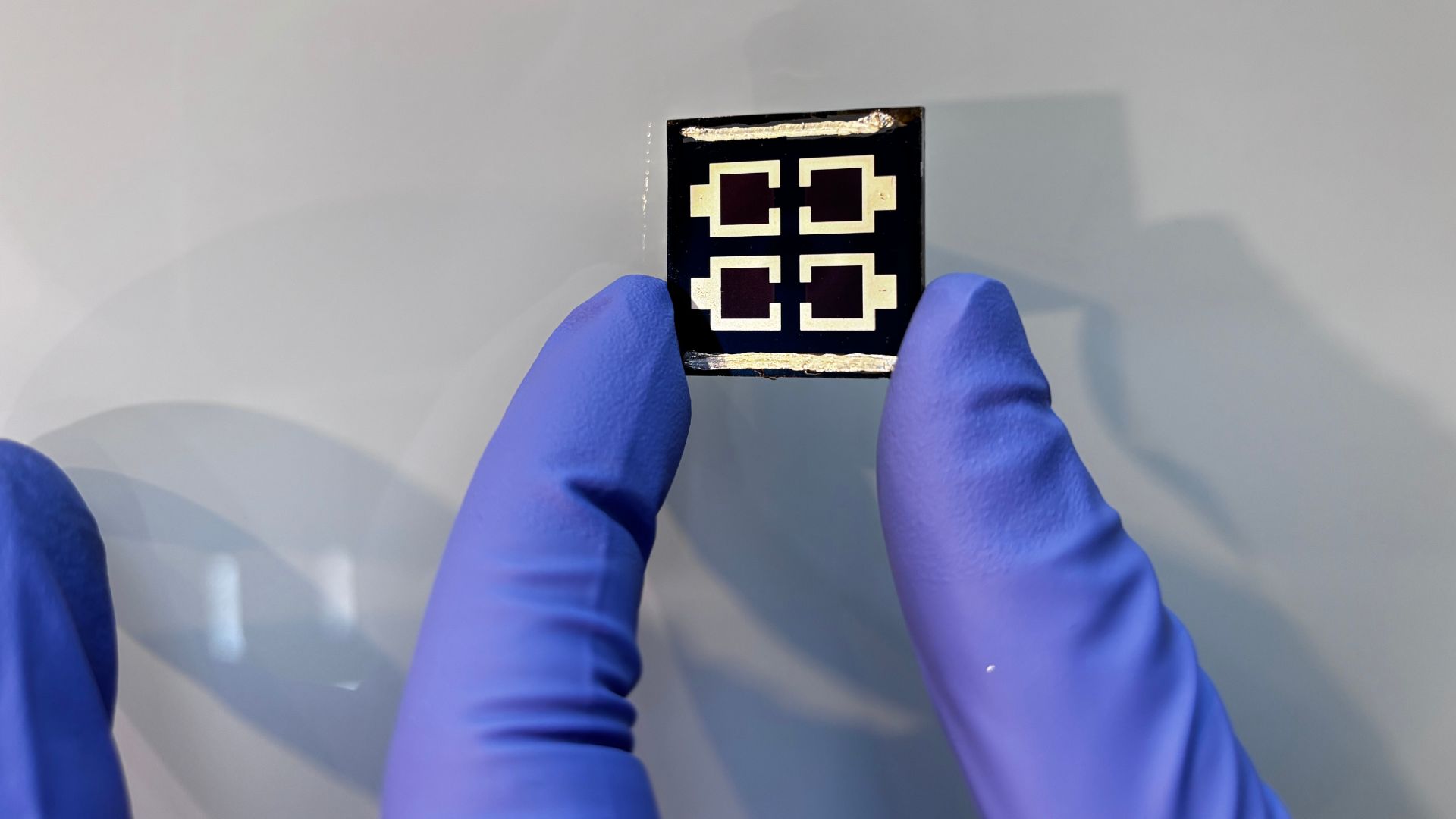
Tandem solar cells are emerging as the leading next-generation photovoltaic solution. The technology could help future satellites and space data centers run on ultra-lightweight solar power. In this vein, researchers at the Korea Institute of Energy Research (KIER) have set a new world record for perovskite/CIGS tandem solar cell efficiency, advancing next-generation, high-efficiency thin-film solar technology. KIER achieved a laboratory-measured efficiency of 27.0 percent and an officially certified efficiency of 26.7 percent. Germany’s Fraunhofer Institute for Solar Energy Systems officially certified the result. It is now listed in the U.S. National Laboratory of the Rockies’ Best Research-Cell Efficiencies Chart. The tandem solar cell stacks a perovskite layer over a CIGS layer to capture different sunlight wavelengths simultaneously, creating a light, flexible, and efficient thin-film device. “This achievement is significant in that both cell efficiency and stability can be enhanced by minimizing potential interfacial and optical losses during the integration of perovskite and CIGS. The resulting efficiency was also officially certified by a world-renowned institute and recognized as a world-record performance, underscoring Korea’s technological competitiveness,” said Inyoung Jeong, a senior researcher at KIER, who led the research. Tandem architecture To overcome the physical efficiency limits of silicon solar panels, scientists stack a top perovskite layer and a bottom copper indium gallium selenide (CIGS) layer to capture different wavelengths of light without adding extra weight. Perovskite and CIGS form an ideal scientific pairing for tandem solar cells because their complementary bandgaps allow them to divide and absorb the solar spectrum with minimal energy loss. The top perovskite layer absorbs high-energy blue and ultraviolet light while allowing longer wavelengths to pass through to the bottom CIGS layer, which efficiently captures the remaining low-energy near-infrared light. Although combining these delicate thin films usually causes damage and blocks light, special protection layers and modified electrodes overcome these assembly issues to maximize power output. The KIER team solved this by inventing an advanced interfacial protection layer and re-engineering the transparent top electrode. This reduced both electrical damage and unwanted light absorption simultaneously, pushing raw laboratory tests up to 27 percent. “The developed technology is expected to increase electricity generation per unit area and thereby expand the potential applications of photovoltaic power generation,” the researchers stated. Surpassing previous records The development shows South Korea’s strong competitiveness in next-generation thin-film solar technology. By reaching 26.7 percent, KIER surpassed the previous record of 26.3 percent set just a year prior by a joint team from Seoul National University and KIST. Reportedly, this 26.7% record applies to small-area laboratory research cells (sub-1 cm²). Earlier, Germany’s Helmholtz-Zentrum Berlin (HZB) and Humboldt-Universität held the world-record efficiency at 25.5 percent for perovskite-CIGS tandem solar cells with an active area of over 1 cm². Formally verified by the European Solar Test Installation (ESTI), this benchmark shows the technical progress in scaling up high-efficiency thin-film architectures beyond sub-centimeter laboratory devices. Thanks to their flexible and lightweight thin-film design, these cells are ideally suited for integration into buildings and vehicles, as well as weight- and space-constrained space applications such as small satellites and orbital data centers. KIER is now working with industry partners to scale these tiny lab samples into large commercial modules. Get the latest in engineering, tech, space & science - delivered daily to your inbox.Mrigakshi is a science journalist who enjoys writing about space exploration, biology, and technological innovations. Her work has been featured in well-known publications including Nature India, Supercluster, The Weather Channel and Astronomy magazine. If you have pitches in mind, please do not hesitate to email her.
Ultra-lightweight thin-film tandem solar cells set new world record at 26.7% efficiency
Full Article
Original Source
Read the full article at Interestingengineering →KhanList aggregates and links to publicly available news content. We do not host full articles from third-party sources. Always verify important information with original sources.