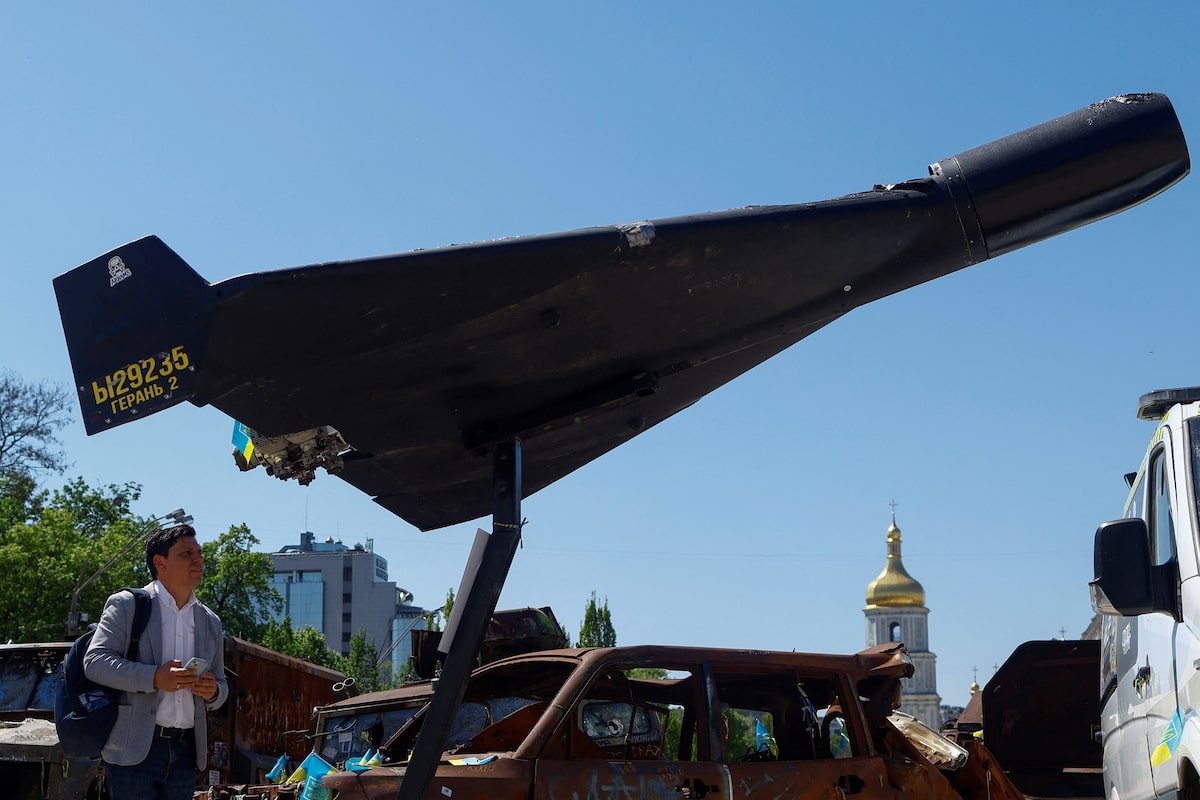
Open this photo in gallery:A Russian-Iranian Shahed drone is displayed in Kyiv. Tehran began supplying Moscow with the first batches of the explosive drones in 2022.Valentyn Ogirenko/ReutersIt could have been the start of World War Three. For now, the Ukrainian drones that struck an Iranian ship in the Caspian Sea on Saturday have only further blurred the line between the world’s two big continuing wars.The worst-case scenario almost unfolded in recent days, as Iran – according to a report in The New York Times – prepared to retaliate by launching a ballistic missile at an unnamed Ukrainian port city. It now seems that Iran’s leadership, which initially declared on social media that the Ukrainian strike “CANNOT GO UNANSWERED,” has been persuaded to seek another form of retribution. The climbdown was a rare ray of good news (albeit one followed hours later late Tuesday ET by Iran launching a surprise missile attack on U.S. bases in the Middle East, ending several days of relative calm). Few could predict what would happen next if Iran launched one or more missiles toward a city in Europe.Fighting escalates in Gulf as U.S. and Saudi strike Iran’s allies in IraqThe war in Ukraine and the struggle in the Middle East have been intertwined since early in the Russian invasion of Ukraine. Tehran began supplying Moscow with the first batches of the Shahed explosive drones in the fall of 2022. The buzzing Shaheds have terrorized Ukrainian cities on a near-nightly basis ever since.The two conflicts have burned dangerously closer together over the five months since the start of the U.S.-Israeli war against Iran. Russia has reportedly provided its ally Iran with intelligence and satellite imagery to aid its targeting of U.S. military bases around the Middle East. Ukraine has sent its homegrown anti-drone systems, and teams of experts, to help bolster the air defences of the Gulf Arab states and other U.S. allies in the region.More than any other party, Ukraine would probably welcome a widening of the conflict. After almost four and a half years of fighting the larger Russian army on its own, gaining the United States and Israel as allies would represent a strategic success for Kyiv, which already sees Iran (along with North Korea, which has sent soldiers and artillery shells to aid the Russian invasion) as an enemy state.It would also fit with Ukraine’s perception of what the two wars are about. The Globe and Mail visited Kyiv in late 2023, shortly after the Middle East was set on its current course by the Oct. 7, 2023 attacks by Hamas – an Iranian-backed Palestinian militia – on southern Israel. Opinion: Trump sincerely wants to wash his hands of the Iran war. But he doesn’t have the cardsOne of the officials The Globe met with was Mykhailo Podolyak, then a key voice in Ukrainian President Volodymyr Zelensky’s office. Mr. Podolyak discussed the horrors of Oct. 7 and the war that had just begun in Gaza – which he predicted would divert the world’s attention away from what was happening in his country. The Globe probed Mr. Podolyak for his feelings on the wider Israeli-Palestinian conflict.Did Ukraine share common cause with the Palestinians (as in the Palestinian Authority, not Hamas) in seeking to end a military occupation, and looking for the world to uphold international law?Mr. Podolyak recoiled at the idea. Ukraine had nothing in common with the Palestinians, he said. Ukraine saw itself the same way Israel did – as a lonely democracy, with dangerous, authoritarian neighbours. Now was the time to fight and destroy those neighbours, he said, or else the cycle of violence would continue indefinitely.Ukraine has remained one of the most pro-Israel states in the world through the years of war in Gaza, Lebanon and Iran – and it has all but confirmed that it intentionally targeted the Iranian cargo ship on Saturday, an attack that killed one sailor. Yevgen Korniychuk, the Ukrainian ambassador to Tel Aviv, told Israel’s Channel N12 on Sunday that the Iranian vessel was a legitimate military target because it was carrying missile and drone parts bound for Russia. “This is not the first time we’ve struck military targets like these, and of course you can expect us to strike them again,” Mr. Korniychuk said, adding that Ukraine and Israel were fighting “the same enemy and different sides of the same axis of evil.”It’s language that has been used before to divide the world into blocs, into groupings of countries that are either “with us” or “with them.” And if Iran had taken the bait and launched a direct attack on Ukraine, it would have erased many of the qualms that Canada, the European Union and other countries have about U.S. President Donald Trump’s war against Iran. An Iranian strike on Ukraine, particularly one that caused significant civilian casualties, could conceivably have forced Canada and the EU to more firmly pick sides. The world could well have found itself divided between the “axis” Mr. Korniychuk referred to, and those who oppose it – with both sides possessing large nuclear arsenals. China would have to assess how far its “no limits” partnership with Russia really goes. As of Tuesday, when Mr. Trump held White House meetings first with Mr. Zelensky and then, separately, Israeli Prime Minister Benjamin Netanyahu, that hadn’t happened. There was no public talk of an alliance to counter the Moscow-Tehran “axis.” Trump, Netanyahu meet for first time since start of Iran warInstead – after what The New York Times described as “a flurry of diplomacy” – Ukrainian Foreign Minister Andriy Sybiha held an emergency phone call with his Iranian counterpart Abbas Araghchi. Mr. Sybiha later posted on social media that Ukraine “never intended to target civilian vessels or people.” Mr. Araghchi switched from threatening attacks to talking about “restitution for losses.”In other words, cooler heads prevailed – and the wars in Europe and the Middle East continue to burn separately. For now.
Ukrainian strike on Iranian cargo ship blurs line between two wars
Full Article
Original Source
Read the full article at Theglobeandmail →KhanList aggregates and links to publicly available news content. We do not host full articles from third-party sources. Always verify important information with original sources.