
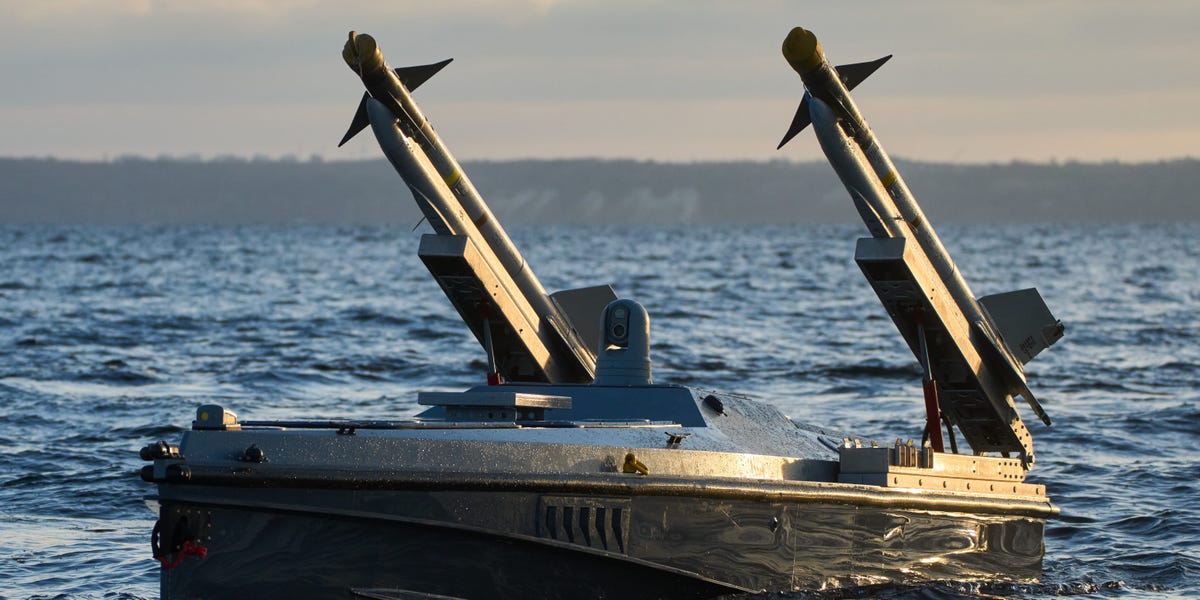
Ukraine’s Magura drone boats have downed Russian helicopters and taken out air defenses. The maker didn’t see that coming. AP Photo/Efrem Lukatsky Ukraine's Magura naval drones have used missiles and drones to hit targets in the air and on land. Ukraine's Magura naval drones have taken out Russian targets at sea. They've also taken out helicopters in the air and air defense systems on land, proving to be a versatile platform.That came as a surprise to their primary manufacturer."I didn't expect it," Oleg Rogynskyy, the founder and CEO of UFORCE, told Business Insider."It's the ingenuity of Ukrainian engineers and Ukrainian soldiers that really drives this," he said. "Where this gets more interesting is I keep on being surprised."UFORCE, founded in Ukraine and headquartered in London, makes the Magura drone, which has been central in combating Russia's Black Sea Fleet. Without warships but equipped with an unconventional uncrewed navy, Ukraine has damaged and destroyed Russian ships and driven them away from a key port in occupied Crimea.Ukraine says Magura drones armed with missiles have also shot down Russian helicopters as well as Russian fighter jets, while other mothership designs have been used to launch FPV drones against air defense targets.After a strike in August, a GUR commander said this "marks a fundamental shift in the nature of the conflict." Ukraine's Main Intelligence Directorate, the GUR, said Magura naval drones have destroyed Russian helicopters. YouTube/Defence Intelligence of Ukraine "That's the definition of asymmetric warfare right there," Rogynskyy said, "when a $40,000 drone can take out a $400 million" Russian air defense system." Ukraine has reported that FPV drones launched from Magura naval drones have taken out S-400 launchers and other expensive equipment. "The more use there is," he predicted, "the more creative outcomes we're going to see." Ukraine's soldiers are encouraged to experiment with, find new uses for, and modify their weaponry. Units often have R&D elements near the front lines, and companies work closely with combat units to design systems toward those ends. Soldiers surprise makersMakers have repeatedly told Business Insider they've been caught off guard by how soldiers used their products. Achi, the CEO of Ukrainian defense firm Ark Robotics, said that when it comes to soldiers using his robots and technology, "there are some really crazy ideas I would never imagine in my life."Oleg Fedoryshyn, director of R&D at Ukrainian ground-robot and weapons maker DevDroid, shared that the company was surprised to see Russian soldiers surrender to one of its robots.Meanwhile, an executive at Ukrainian drone maker TechEx, said that the company was surprised by how much explosive weight Ukrainian soldiers can pack on its drones.Kuldar Väärsi, the founder and CEO of Estonian ground robot maker Milrem Robotics, another company surprised by the ways that Ukrainian soldiers use the company's robots, said previously that "Ukrainian troops are really creative, and they really find very simple ways how to get even more out of the equipment." Milrem Robotics is among the companies that have been surprised at how Ukrainian soldiers use their gear. Mykhaylo Palinchak/SOPA Images/LightRocket via Getty Images Soldiers often come up with modifications that manufacturers then help develop and scale. Fedoryshyn said Ukrainian troops first proposed mounting RPGs on robots, and then the company helped make it happen.Western firms with products in Ukraine are seeing it, too.Germany's ARX Robotics supplies Ukraine with ground robots. David Roberts, CEO of ARX Robotics UK, told Business Insider that "the Ukrainian armed forces are the absolute consumer innovators.""As soon as they get a system," he said of the Ukrainians, "the first thing they'll do is they'll think about whether they can mash it together with another system they have to create something that's bigger and better than the sum of parts."Naval drones have been a key area of innovation helping Ukraine win at sea without a conventional naval force. Drone boats can still execute one-way explosive attacks, but they do so much more now. They launch missiles and drones, they've been used to deploy uncrewed ground vehicles for amphibious assaults, and they are also engaging Russian naval drones in maritime gun battles.Sea drones are not new, but Ukraine is advancing the technology and using it at scale and with a coordination not seen before, while also demonstrating new uses regularly.Global navies have long recognized the potential of naval drones and invested in their development, but the war in Ukraine has spurred new urgency to build this capability.Military officials have signaled that crewed fleets may not be enough on their own. Gen. Sir Gwyn Jenkins, the UK's first sea lord and chief of the naval staff, said in September that "it is that it is no longer possible to defend a vast, contested ocean with crewed warships alone." The UK is currently pursuing a hybrid fleet in which traditional warships command maritime drones and other naval assets.Other militaries are also building similar capabilities.Rogynskyy predicts that "pretty much every navy on the planet is going to be scaling itself using cheap, attritable, unmanned assets that are AI-controlled." Time will tell. Read next Business Insider tells the innovative stories you want to know Business Insider tells the innovative stories you want to know Business Insider tells the innovative stories you want to know Business Insider tells the innovative stories you want to know Sinéad Baker is a Military and Defense Correspondent based in Business Insider's London bureau, writing about Russia's invasion of Ukraine and NATO actions.Sinéad most often covers soldiers' experiences, military strategy, battlefield developments, weapons systems, the defense industry's response, and the impact on NATO and European security, and geopolitical decisions that surround the Ukraine war. She has reported from NATO’s frontlines and around Europe, has interviewed multiple prime ministers and defense ministers, has appeared on BBC News and The Guardian's politics podcast, and has been cited by Congressional hearings.Sinéad has also extensively covered US politics and previously led Business Insider's breaking news coverage from London.Sinéad previously completed a master's degree in investigative journalism at City, University of London, and has written for The Guardian, The Observer, and TheJournal.ie. Sinéad is the former editor of the multi-award-winning The University Times in Dublin.ExpertiseExperiences of soldiers in Ukraine, including battlefield developments and tacticsWestern military responses to the war, and lessons they should learnNew weaponry built for and in response to the war Email Sinéad at sbaker@businessinsider.com or find her on X. Ukraine Russia
Ukraine’s Magura drone boats have downed Russian helicopters and taken out air defenses. The maker didn’t see that coming.
Full Article
Original Source
Read the full article at Businessinsider →KhanList aggregates and links to publicly available news content. We do not host full articles from third-party sources. Always verify important information with original sources.