
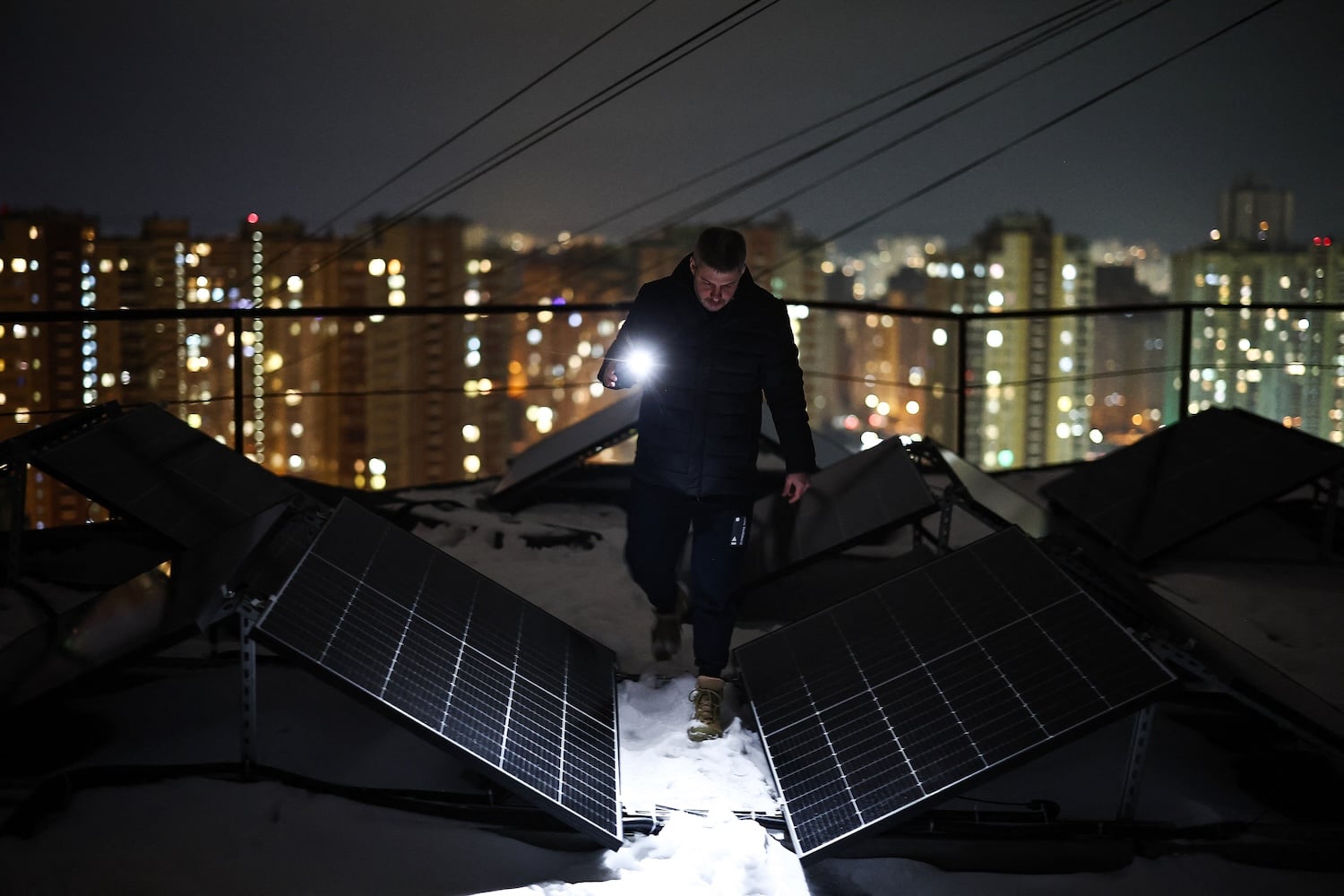
Russian strikes are pounding the conventional energy infrastructure that Ukrainians depend upon to survive the winter, raising fears that some cities, among them the capital, Kyiv, could become uninhabitable. With exactly this horror scenario in mind, Ukraine raced this spring and summer to expand decentralized energy systems—mostly small gas-fired power plants and renewable energy systems—to replace its bulky, big-target coal-fired plants as a way of better ensuring energy supply for critical infrastructure. Government officials and most analysts in Ukraine concur that renewables and nuclear will underpin the country’s energy and national security, and that natural gas is required to steady the grid. But despite record rollouts of decentralized generation systems this year, the shift to a resilient energy grid is moving far more slowly than the winter and the war demand. Under unusually dire wartime conditions, Ukraine expanded its total renewable generation capacity by roughly 16 percent by mid-2026 compared to early 2025. The country added 70 wind turbines in the first half of the year, mostly in the Mykolaiv and Odesa regions, and is presently bringing online a wind power plant close to the Black Sea, the largest wind farm ever built in a country at war. Ukraine also added enough of solar generation to its supply this year to power roughly 600,000 to 800,000 European households, with European countries bankrolling rooftop solar-plus-battery systems for over 100 healthcare facilities. Ukraine’s battery storage rollout in 2025 outpaced every EU member state save Germany and Italy while homeowner and business investment helped make Ukraine Europe’s fourth-largest battery storage market, a fivefold increase over 2024. “Decentralized energy resources,” Maxim Timchenko—the CEO of DTEK, Ukraine’s largest utility—told the World Economic Forum earlier this year, “like wind, solar and energy storage. … are not only clean technologies, but they are also more resilient infrastructure. Smaller, distributed assets are harder to target, quicker to repair and more capable of stabilizing the grid during emergencies.” While DTEK operates coal-fired power plants, too, Timchenko argued that renewable energy and battery storage will be the pillars of Ukraine’s long-term energy security and national defense—and the sooner that it builds them out, the better. And yet, DTEK commits more resources to restoring thermal plants and mining coal than to renewable or gas-fired systems. “Restoring the existing conventional heating supply is a much simpler and faster solution, especially in the current circumstances,” said Ukrainian energy expert Mykhailo Lukianyk. “A larger makeover of Ukraine’s energy sector requires more investment, planning, and time.” Nobody thinks a single energy source fits for a Ukraine at war. “It’s close to impossible,” said Andriy Martynyuk, director of Ecoclub, an energy NGO in Ukraine, “to find a single all-purpose solution that handles our harsh winters, delivers both heat and electricity, and can withstand jet-powered drones.” Although Kyiv’s grim plight captures the headlines, just about every urban center in Ukraine is facing a desperate winter. In the northwestern region of Rivne, emergency outages this month have darkened whole districts, although the region’s periodic stoppages have been less painful than the rolling blackouts elsewhere. The lights of Rivne’s City Center Hospital, for example, haven’t ebbed or flickered this fall: a testament to the work that renewables do in Rivne and in more than 300 other healthcare centers across the country. The hospital’s 214 panels cover two roofs and, paired with storage batteries in the cellars—courtesy largely of the German government—keep critical lifesaving operations humming during blackouts, even when Russian strikes hit transformer stations and upend the grid. None of Ukraine’s hospitals, however, boast renewable-powered systems that do more than back up operating rooms, intensive care, and elevators. In Rivne this year, the city bolted as much battery-supported solar power as it could onto roofs or mounted it in yards. When they’re full, the City Center Hospital’s batteries give it with enough energy to operate critical stations for four hours without grid power. When the batteries run out, more costly and less reliable diesel-fueled generators spring on, as they do in hospitals across the country. Another Rivne institution, the Regional Clinical Hospital, has been equipped with solar and battery installations since 2025 and survived last winter without going dark or cold once. “The entire city is better prepared this winter,” said Artem Hanushchak, Rivne’s deputy mayor, who noted that last year, electricity was so tight that city hall urged owners of solar energy systems to clear the snow from their panels. “The system needed every bit of extra energy after Russian strikes,” he told Foreign Policy. Rivne now also boasts an intelligent energy monitoring system that tracks energy use across 188 public buildings. Built by local and international IT specialists with $1 million in EU funding, it collects meter data to give city managers a real-time picture of electricity, heating, water, and gas use; supports the city’s emissions-reduction planning; and generates recommended energy upgrades. In addition to security, renewables’ huge advantage, Hanushchak said, is their low cost, particularly with the price of gas remaining so high. Studies show that healthcare facilities with solar and batteries cut energy costs by as much as 70 percent —and the more panels and the bigger the battery, the more they save. November is a particularly difficult month for Ukraine’s hospitals and solar energy alike. Solar panels produce only a fraction of their capacity during overcast Ukrainian days and, of course, produce nothing over the long nights. Hospitals require copious heat, which solar panels can’t easily supply at scale. Solar can heat buildings with heat pumps, which are ever more common across Ukraine, but not yet in the Rivne hospitals. The other pillar of Ukraine’s energy security stratagem is small, modular, gas-fired cogeneration plants, which produce electricity and district heat simultaneously. Hanushchak argued that despite their vulnerability to attack—harder to hit than conventional thermal plants but larger targets than renewables—gas plants are key for Rivne and all of Ukraine. The Rivne region erected eight new cogeneration plants this year that burn natural gas to generate electricity while channeling excess heat into local district heating grids. As impressive as Ukraine’s renewables rollout has been, it falls far short of its energy security ambitions. The Euromaidan Press wrote that Volodymyr Kudrytskyi, the former head of the grid operator Ukrenergo and currently head of a decentralized energy infrastructure company, called the distributed generation program “effectively a failure” at the required scale. Rather than endlessly repairing 10 to 15 aging, easily targeted power plants, he has argued, Ukraine needs a balanced network of flexible gas, renewables, and storage—which is “dozens of times harder to scout and destroy.” Even though hospitals and health centers were prioritized, fewer than half of Ukraine’s healthcare facilities own panels and batteries, and not one of them is completely independent of the grid, even for a matter of hours. In June, the Razumkov Center pointed to a wide gap between Ukraine’s big plans for 2026 and what is getting done. While international partners have donated 2.4 billion euros to the Ukraine Energy Support Fund since 2022 (including nearly 800 million euros in new contributions so far this year), the funding still falls short of the scale of destruction. “A larger makeover of Ukraine’s energy sector requires more investment, planning, and time,” said Lukianyk, the energy expert. “Quite simply,” he added, “the demand for distributed solutions far outpaces our capacity to build or afford them.” Ukraine’s plans to outfit all hospitals, water utilities, and communication networks this year with distributed energy—the large part of a “new resilience architecture,” with an estimated cost of about $6.3 billion—fell short. The trouble began, as it did last year, when financing dried up. The Rivne hospitals’ green energy technology cost about $1 million per institution. The municipality chipped in, but never could have covered the cost—and cannot substantially upgrade it—without assistance from European donors. Ecoclub estimates that a $4.5 million investment in solar systems, batteries, and heat pumps would cover half of the Central City Hospital’s energy requirements. On their own, Ukrainian developers struggle to raise international capital because war-risk insurance and guarantees remain limited. Moreover, many European firms are reluctant to finance or build projects in an active war zone, according to EUobserver. On the domestic market, companies face steep interest rates and punitive, short-term repayment schedules that render major wind and solar builds financially unviable. As the Razumkov Center noted, local banks remain deeply risk-averse, which effectively locks smaller players out of the market altogether. The International Energy Agency (IEA) has commended Ukraine’s push to deploy solar, wind, and battery storage as a vital strategy for wartime energy resilience. But it, too, underscored in a new report that this year’s build-out was a fraction of what’s called for. Ukraine’s go-to strategies to keep the lights and heat on and the water running this winter, the IEA argued, are energy imports and local cogeneration. In the end, the IEA concluded, “Air defence remains essential for maintaining the energy system.”
Ukraine’s Energy Plan Was Too Little, Too Late
Full Article
Original Source
Read the full article at Foreignpolicy →KhanList aggregates and links to publicly available news content. We do not host full articles from third-party sources. Always verify important information with original sources.