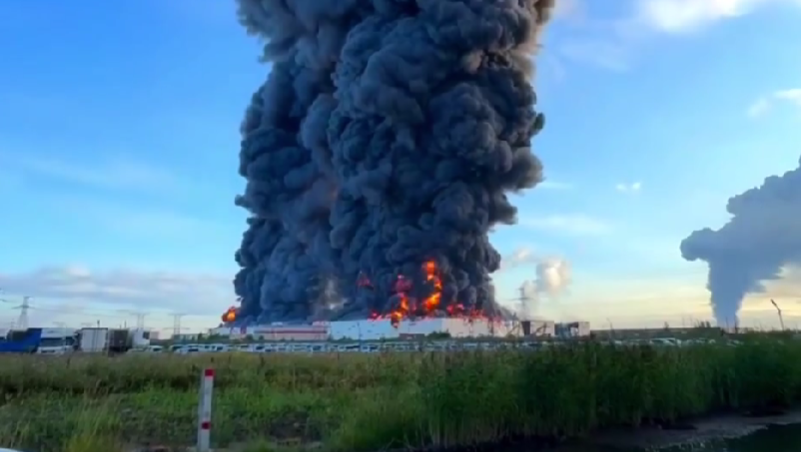
Every day, the Ukraine Battlefield update newsletter offers a clear look at how the war is unfolding on the ground. Subscribe for free here to get the full text delivered to your inbox. Ukraine’s 40-day campaign ended quietly. With what results? Ukrainians are not slowing the pace of attacks on refineries and lorries. Russians are defending themselves just as fiercely. The war has moved into “a phase of destroying civilisations”. Seven people died on a beach in a Russian city. They were killed by a Ukrainian drone, apparently shot down by Russian air defences. Charts of the day: Russians suffered their heaviest equipment losses since March. Map of the day: Russian units are moving closer to Kramatorsk. Videos of the day: A Russian drone chases and strikes a Ukrainian civilian; how future Russian soldiers are trained; a comparison of Ukrainian drone speeds. What results did Ukraine’s 40-day campaign achieve? At the end of June, Ukrainian president Volodymyr Zelensky announced a 40-day campaign aimed at “influencing Russia to end the war”. The president did not provide details, but Ukrainian officials later said that it involved strikes on Russian logistics, industry, refineries and shipping. Even then, some argued that forcing the Russians to agree even to a ceasefire within 40 days was an unrealistic task — as proved to be the case. The deadline passed quietly on Monday, or rather Tuesday, depending on which day counted as the first. Zelensky made no comment on the campaign’s success. However, journalists caught up with Kyrylo Budanov, head of the presidential office, who said that the attacks would continue. “Do not be distracted by all these discussions about 40, 100 or 15 days. The result is what matters. It is not so much about how we enter this process. Far more important is what we emerge from it with. If we want to achieve the desired result, we must be strong,” Budanov said on Monday. Let us assess exactly what Ukraine has achieved. Over those 40 days, Ukrainians accomplished something that would have been unimaginable just a year ago. They repeatedly struck Russian targets as far as 2,500 km from the border — including a refinery in Omsk — and decimated both military and civilian vessels in the Black and Azov Seas. Refineries. Although they receive less attention than a month ago, with reporting focusing instead on attacks on the large warehouses of Russian online retailer Wildberries, Ukrainians have not stopped attacking Russian refineries. On Monday, for example, they again attacked the Syzran refinery in the Samara region. Bloomberg journalists assessed Ukraine’s campaign in July. According to them, Ukraine struck a record 18 refineries — one more than the previous record in May. It is not only the number of strikes that matters, but also the damage they caused. According to calculations by EA Analytics, Russian refineries processed 3.6 million barrels of oil per day in July. That was the lowest level since 2002. The July average between 2020 and 2025 was 5.3 to 5.6 million barrels per day. Russia is therefore processing a third less oil than usual. This is also clearly visible in the chart published by Bloomberg. Even during the attacks on refineries last autumn, there was no such drop in production. ❗️Russian oil refining fell to 3.6 million barrels per day in July, down 150,000 barrels per day from June, according to Bloomberg. The report says this is Russia's lowest monthly refining rate since May 2002. For comparison, Russian refineries processed about 5.59 million… pic.twitter.com/G4C5hJcpZk— NOELREPORTS 🇪🇺 🇺🇦 (@NOELreports) August 3, 2026 The fuel crisis affected ordinary Russians, who in some places had to wait for hours at petrol stations. Last week, it was reported that the crisis had eased slightly as some refineries resumed operations. According to The Moscow Times, some regions were lifting limits on the amount of fuel that could be purchased. However, Ukraine has not stopped attacking refineries. Wildberries. Ukrainian attacks on Wildberries have received more media attention. Ukrainians began them more than two weeks ago and have not stopped. During the overnight into Tuesday, attacks on Wildberries warehouses in the Leningrad region and the Moscow region were again reported. The Ukrainian OSINT account cyber_boroshno published an infographic showing the 25 largest warehouses of the online retailer, which accounts for almost half of the country’s online trade. According to it, 12 large warehouses have burned down — accounting for 56 percent of the total area of the 25 largest warehouses — five were damaged, and only eight have so far been spared by Ukrainians. Ще одна ніч - ще один рубіж пройдено. Після сьогоднішніх прильотів наша графіка ключових складів Wildberries у Росії розрослася до ТОП-25, і більшість із них уже або згоріли, або уражені.Найбільша ціль доби - Ленінградська область: знищено розподільчий центр Wildberries у… pic.twitter.com/ZMAZX1ypCr— Cyber Boroshno (@cyber_boroshno) August 4, 2026 However, it is not entirely clear what the Ukrainians are seeking to achieve. Wildberries has a strategic partnership with VTB Bank, Russia’s second-largest bank, and some believe the aim may be to trigger a banking crisis in the country. But it is unclear to what extent this is Ukraine’s actual plan or whether it is feasible. Others believe the main purpose is psychological: bringing the war home to ordinary Russians. Burned-out Wildberries warehouse in Samara region: Logistics: Ukrainian attacks on Russian logistics in occupied southern Ukraine have also received less coverage. Ukraine has not eased off in this respect either. In July, it struck a similar number of lorries as in June. This is confirmed by data from the Ukrainian general staff, the Unmanned Systems Forces, commanded by Robert Brovdy, known as Magyar, as well as French OSINT analyst Clément Molin. According to Molin, the Russians verifiably lost 656 lorries, slightly more than in June. Despite 21 trucks being hit every day on average, Ukraine failed to double the number of mid-range strikes against Russian logistics.However, we can still see the large number of undocumented vehicles hit on the roads, which are now nearly 1 500 in 3 months. pic.twitter.com/ogWum1aPHv— Clément Molin (@clement_molin) August 1, 2026 At the same time, it cannot be said that this has significantly disrupted logistics at the front — at least not as far as Russian attacks are concerned. “Contrary to the expectations of part of the public, the several-month intensification of medium-range strikes has still not led to a reduction in fighting at the front. On the contrary, pressure from the Russian air force increased to some extent in July, and this trend may continue in August,” analysts at the independent Russian think tank Conflict Intelligence Team (CIT) wrote. Russia’s response. This brings us to Russia’s response to Zelensky’s 40-day campaign. Despite the problems Ukrainian attacks have caused Russia, nothing so far suggests that Vladimir Putin is seeking a ceasefire, including with regard to aerial attacks, which Ukrainians continue to propose.
Ukraine’s 40‑day offensive and Russia’s missile attacks push the war into a phase of ‘destroying civilisations’ (Ukraine Battlefield update, Day 1,622)
Full Article
Original Source
Read the full article at Euobserver →KhanList aggregates and links to publicly available news content. We do not host full articles from third-party sources. Always verify important information with original sources.