
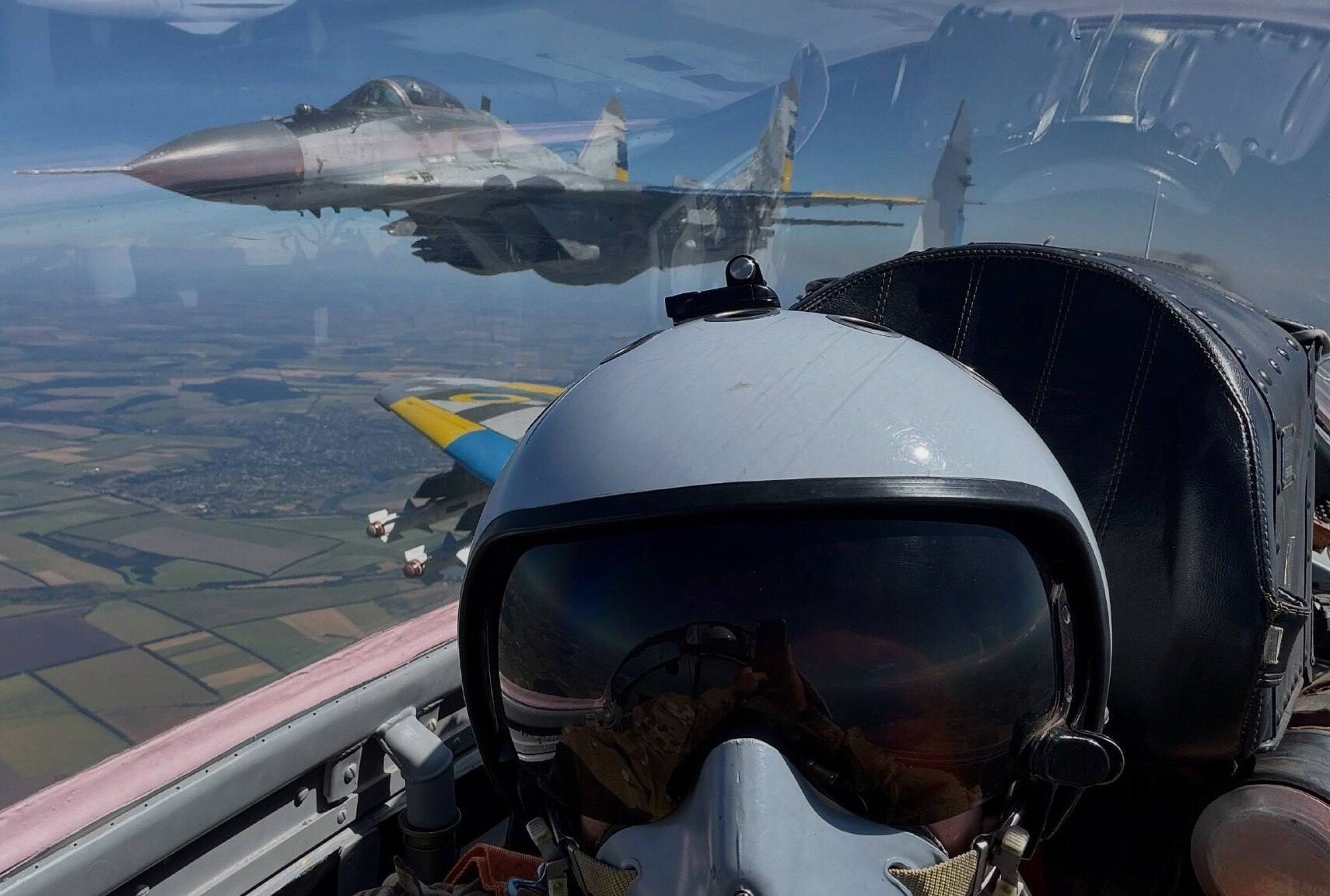
Every day, the Ukraine Battlefield update newsletter offers a clear look at how the war is unfolding on the ground. Subscribe for free here to get the full text delivered to your inbox. A new detailed photograph and fresh information have emerged on the missions of former Slovak MiG-29s. Large Nato manoeuvres took place near Kaliningrad. A unique electronic warfare aircraft also took part. The Russians are approaching Dobropillia and will also try to encircle it. The Kupiansk sector is “close to catastrophe”, according to a Ukrainian analyst. Maps of the day — where former Slovak aircraft are also attacking Russian bridges; Kupiansk; the battle for Dobropillia. Videos of the day — an attack on a Russian bridge, of the kind also carried out by former Slovak MiG-29s; a shot-down drone fell onto an apartment block in Moscow; a whiff of the First World War in aerial warfare; a petrol station in Belgorod region wrapped in an anti-drone net. The information in this text is a summary of events on Tuesday (18 August). The situation may have changed since then. A new detailed photograph and fresh information have emerged on the missions of former Slovak MiG-29s. Last week, Ukraine’s air force lost one aircraft of this type. However, it is not known whether it was an original Ukrainian aircraft or one of those donated. On Tuesday, the Russians also said they had shot down another MiG-29 in the Donetsk region. Since Ukrainians openly report losses of their aircraft and pilots, and have so far confirmed nothing in this case, it is more likely that the Russian claims are incorrect. Of course, it cannot be ruled out that they will be confirmed later, but that is not currently the case. Even without this, Ukrainian MiG-29 losses in this war have been high. Since the start of the invasion, they have reached 38 destroyed or damaged aircraft of this type, according to the Oryx project. In addition to combat losses, wear and tear from intensive deployment must also be taken into account. Keeping decades-old combat aircraft in the air must be becoming increasingly difficult. Nevertheless, aircraft supplied by Slovakia are still fighting. In spring 2023, the Slovak army sent 13 aircraft to Ukraine. Four flew there under their own power, while the rest were probably transported by land. From time to time, a photograph appears on Ukrainian social media showing that some are still flying — a very welcome surprise given Russia’s substantial air superiority and the length of their deployment. Today, a Ukrainian pilot who uses the name Air Fighter on social media published a new image. It shows an aircraft that carried the number 3709 in Slovak air force service. The appearance of the fields below and the sentence, “Photograph from recent flights,” show that this is not an old photograph. The pilot took the photograph from the cockpit of an aircraft bearing the typical Ukrainian “pre-invasion” camouflage. It is therefore an original Ukrainian MiG-29. The second aircraft in the image came from Slovakia. In front of the cockpit, it has distinctive IFF antennas in the form of five small plates immediately behind the radar cover — a system used by Nato to identify aircraft in the air. Our former aircraft are also characterised by a black flat antenna behind the cockpit. Both types of antennas are the result of the modernisation after which our aircraft were designated MiG-29AS. However, Polish aircraft donated to Ukraine had the same equipment as well. The former Slovak aircraft 3709 can be identified by the camouflage pattern beneath the cockpit. You can find a photograph of it from 2018, when it was still in Slovak service, for example, here. Further important details can be gleaned from Air Fighter’s recent photograph. His aircraft (presumably this is a selfie) is armed with short-range air-to-air missiles, meaning that it was carrying out a fighter mission. The former Slovak 3709, however, carries pylons under its wings fitted with US GBU-39 SDB precision-guided bombs. Ukrainians therefore use this particular MiG-29 for bombing missions, such as the one in the following video. Of course, there is no evidence that the bridge shown in the footage was destroyed by an aircraft formerly operated by the Slovak army, but it is highly likely that it is among the aircraft used for the same tasks. The Ukrainian Air Force continues its summer campaign to knock out Russian bridges behind the frontline.Seen here, a Ukrainian Air Force MiG-29 Fulcrum drops a quartet of GBU-39 SDB glide bombs on the Russian bridge over the Seym River at Zvannoe. pic.twitter.com/DgJ4jT2wsj— OSINTtechnical (@Osinttechnical) August 19, 2026 OSINT analysts geolocated the previous attack in Russia’s Kursk region, close to Ukraine’s Sumy. This is part of a wider Ukrainian air force effort to destroy Russian bridges close to the front line. The following map marks the locations where this occurred during the summer. It is almost certain that some of the crosses on it are the work of former Slovak aircraft 3709. Large Nato manoeuvres took place near Kaliningrad. A unique electronic warfare aircraft also took part. For almost the whole of Tuesday, numerous military analysts commented on extensive activity by Nato air forces, particularly over north-eastern Poland and the Baltic states. Around 50 military aircraft of various categories took part, operating also in the immediate vicinity of Russia’s Kaliningrad exclave. Given the location, the event naturally received intensive coverage in Poland. Defence24, a Polish military website, cited a Nato statement saying that the exercise had been planned in advance and was unrelated to Russian activity. Unofficial speculation suggested that it was prompted by Russian movements in the Baltic Sea, intelligence warnings of allegedly impending Russian provocations, and a Nato show of force intended to prevent them. Citing his sources, Polish military analyst Jaroslaw Wolski said that more than 50 aircraft took part in the operation. He noted that the exercise had not been preceded by the usual announcements and said it was the largest so far. It was also accompanied by the deployment of a Danish battalion to the Baltic states, which resembled a convoy operation escorted by warships, five Poseidon reconnaissance aircraft and Gripen fighter jets. AWACS early-warning aircraft, tanker aircraft and the latest F-35s also took part in the exercise. However, the presence of a US Air Force EA-37B drew the most attention. The United States only introduced the first aircraft of this type into service in 2024. It is designed to carry out offensive electronic operations, including the jamming of radar, communications and other electronic equipment. Source: Wikipedia — US Air Force EA-37B. The flight paths of the EA-37B, AWACS and tanker aircraft can be seen on this map from another Polish account: 📅 18.08 🕘 11:29LT - 🇺🇸✈️⛽️ Piąty tankowiec w rejonie ćwiczeń W rejon gdzie odbywają się dzisiaj duże ćwiczenia sojusznicze, doleciała właśnie kolejna latająca cysterna ✈️ Boeing KC-135R Stratotanker "60-0353" Sił Powietrznych Stanów Zjednoczonych #USAF 🇺🇸, który wystartował z… pic.twitter.com/Kqb91p30hn— Polish Military Radar 🇵🇱📡✈️ (@PolishMilRadar) August 18, 2026 Wolski saw the operation as a “clear signal to the Russians ... should anything enter Polish or Baltic airspace”. He believed Russia had first received a political message that Nato was aware of the planned provocations, and that the exercise was a deterrent display of strength. “An exercise of this scale was not announced in advance, so what we are seeing is a sudden deployment of the so-called Allied support forces to the area of operations,” Wolski wrote, echoing other analysts in Poland. The Kupiansk sector is “close to catastrophe”, according to a Ukrainian analyst. “The Kupiansk sector is one of those areas that does not receive enough attention. The left bank of the Oskil is hell on earth,” Bohdan Myroshnykov wrote. He considered the situation near Kupiansk comparable to, if not worse than, that in Kostiantynivka. The Russians even claimed to have again penetrated Kupiansk itself, but Ukrainian sources did not confirm this. The fact remains, however, that units south-east of the city, on the eastern bank of the Oskil river, are in a critical position: under constant bombardment and with the river behind them, greatly complicating movement and logistics. “Withdrawing from positions is a special operation in itself, and it is far from always successful,” Myroshnykov said. “The situation in this sector can be described as close to catastrophic,” he said, adding that there was little point in drawing maps here, as all of them were merely indicative. Petrenko acknowledged the presence of Russians in Kupiansk’s left-bank suburbs, in the villages of Kupiansk-Vuzlovyi and Kivsharivka: This is consistent with the map by the Finnish OSINT project Black Bird Group. More for amusement than information, we are also including a map by the Russian state agency Ria Novosti, according to which Kupiansk has been captured and the Ukrainian bridgehead on the Oskil no longer exists. The Russians are approaching Dobropillia and will also try to encircle it. Most recently, the aggressor’s soldiers reached the village of Krasnopillia, less than three km from the city’s southern boundary. Their presence was recorded by the Ukrainian Telegram channel Petrenko, whose map is below. It is not yet known whether this was a “flag operation” or whether the Russians managed to hold the village. A Russian Telegram channel also recorded an advance in Krasnopillia. Its map, however, is traditionally considerably more dramatic than Ukrainian and independent ones. Videos of the day Even the simplest solutions can work. It is well known that Ukrainians also use old Yak-52 training aircraft to repel drone attacks. The following compilation shows how they do it. This method of fighting is a return to the beginning of the First World War. Military aircraft were still primitive at the time, and the first aerial duels took place in exactly this way: aviators fired rifles at each other from unarmed aircraft. In 2026, shotguns have replaced them, but the principle is the same. Tuesday saw the largest attack on Moscow since the start of the war. It is generally considered to have been unsuccessful. However, images of a damaged apartment block in the Russian capital circulated online. Footage from a nearby building shows that a shot-down Ukrainian drone fell onto the damaged building. A Russian petrol station in Belgorod region is literally wrapped in an anti-drone net. What are the losses No change on Tuesday morning. By Monday (17 August), Russia had verifiably lost 24,005 pieces of heavy equipment (23,982 on Monday, 10 August). Of these, Ukrainians destroyed 18,977 (18,957), 997 (995) were damaged, crews abandoned 1,193 (1,193), and the Ukrainian army captured 2,838 (2,837). This includes 4,437 (4,437) tanks, of which 3,343 (3,343) were destroyed in combat. Ukraine lost 11,916 (11,828) pieces of equipment, of which 9,333 (9,286) were destroyed, 695 (695) damaged, 692 (691) abandoned, and 1,196 (1,196) captured. This includes 1,450 (1,450) tanks, of which 1,111 (1,111) were destroyed in combat. Note: Neither side regularly reports its own deaths or destroyed equipment. Ukraine publishes daily figures for Russian casualties and destroyed equipment, but these cannot be independently verified. This overview uses data from the Oryx project, which has compiled a list of equipment losses documented exclusively by photographs since the start of the war.
Ukraine using Slovak MiG-29s to destroy Russian bridges (Ukraine Battlefield update, Day 1,637)
Full Article
Original Source
Read the full article at Euobserver →KhanList aggregates and links to publicly available news content. We do not host full articles from third-party sources. Always verify important information with original sources.