
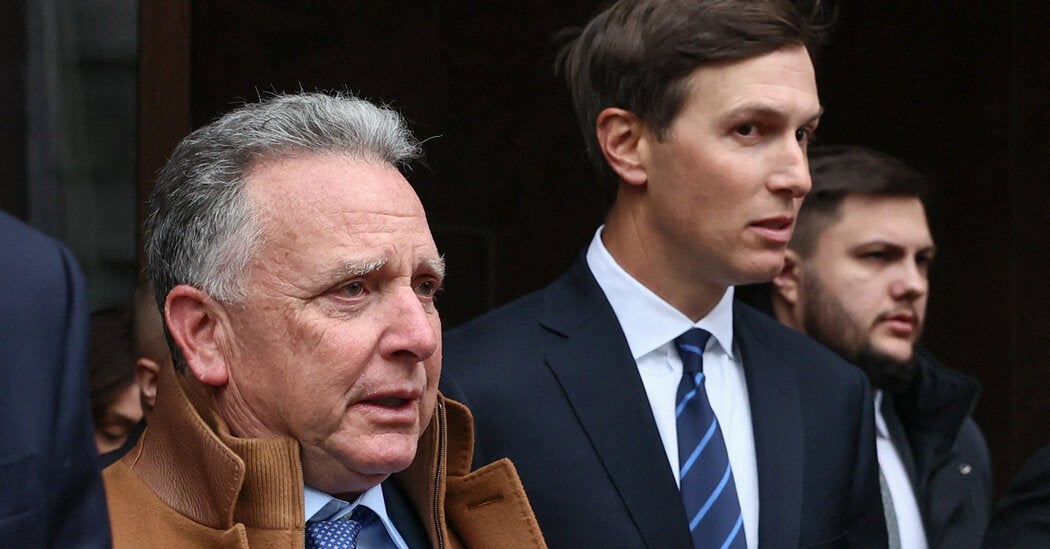
AdvertisementSKIP ADVERTISEMENTPresident Trump’s envoys are trying to overcome Russian hostility and European suspicion to craft a postwar security agreement in Europe that could end the war in Ukraine.Steve Witkoff and Jared Kushner on their way to a meeting with a Russian delegation in Moscow last week.Credit...Yulia Morozova/ReutersNov. 17, 2026, 2:19 p.m. ETWhen President Trump’s envoys met with President Vladimir V. Putin at the Kremlin last week, the Russian leader questioned whether Europe actually wanted to end the war in Ukraine, according to two people with knowledge of the meeting.As evidence, Mr. Putin referred to a frequent Russian talking point about a moment early in the conflict, according to one of the people: the claim, denied by Ukraine’s leader, that European countries blocked a peace deal negotiated in Istanbul in March 2022. The Americans — Jared Kushner, Mr. Trump’s son-in-law, and Steve Witkoff, the president’s special envoy — pushed back, describing the Europeans as constructive in seeking peace, the person said.As Mr. Witkoff and Mr. Kushner push on in their marathon diplomacy to resolve the nearly five-year-old war, their task has been complicated by Mr. Putin’s deep hostility toward Europe, and Europe’s intense suspicion of Russia.Having Russia and Europe agree on a postwar security arrangement on the continent, the Americans have argued, could lay the groundwork for Mr. Putin to end his war. But the prospect of achieving such an agreement appears tenuous, at best — particularly after Russia opened the current talks with an aggressive demand that NATO pull back forces from its eastern flank.Mr. Witkoff and Mr. Kushner are not expected to participate in Mr. Trump’s scheduled meeting on Thursday with Mr. Putin and Xi Jinping, China’s leader, in the Chinese city of Shenzhen, even though the two envoys have spearheaded U.S. diplomacy with the Russian leader.Instead, according to a U.S. official familiar with the plans, Mr. Witkoff and Mr. Kushner will travel to Berlin to meet with an eight-member negotiating team on Thursday that European countries recently designated to represent them in talks with Russia and Ukraine. The official, like others with knowledge of the negotiations, spoke on condition of anonymity because of the sensitivity of the talks.ImageA photo provided by Russian state-run media from last week shows Mr. Putin greeting Mr. Kushner and Mr. Witkoff, during their meeting at the Senate Palace of the Kremlin, Moscow, Russia.Credit...Pool photo by Vyacheslav ProkofyevThe Trump administration has been heavily criticized for its diplomacy, even by the president’s own party. Senator Tom Cotton, Republican of Arkansas, said that Moscow’s demands showed again that Mr. Putin was “not serious about a negotiated peace.”“Further talks are a farce at this point,” Mr. Cotton said on social media. “Putin will only agree to stop the war when he knows he can’t win. We need to help Ukraine prove that point.”Administration officials say they are making progress, coordinating closely with Ukraine and Europe, and need to engage Russia to eventually end the war.“The press has reported some of the maximalist positions proposed by both sides,” Mr. Kushner said on social media over the weekend. “In our private discussions, both sides understand that practical compromises will be necessary to end this war.”Mr. Putin’s enmity toward Ukraine’s allies in Europe — governments that have become that country’s primary financial and political backers after Mr. Trump dialed back U.S. support — runs so deep that it is not clear whether he is even prepared to allow his negotiators to sit down with the European team. Mr. Putin’s foreign policy adviser, Yuri Ushakov, said Monday that “a great deal would have to be done” before Europe could join the talks among Russia, Ukraine and the United States.Officials from the three countries met face-to-face last week for the first time since February in Abu Dhabi, the United Arab Emirates. In those negotiations, Russian officials made clear that they sought a fundamental revision of what they called Europe’s “security architecture,” or reducing NATO’s presence on the continent and granting Moscow a region of influence akin to the Cold War era.In addition to demanding a Western military rollback, Russia said the European Union and NATO needed to cease classifying Russia “as an adversary or threat,” according to a copy of a paper outlining Russia’s position that was obtained by The New York Times. It also called on NATO and European Union countries to officially renounce “their course towards inflicting a ‘strategic defeat’ on Russia,” language that echoed Mr. Putin’s frequent rhetoric depicting support of Ukraine as part of a Western plan to destroy his country.People involved in the talks said it summarized Russia’s hard-line, opening position, which could still be softened as the negotiations continue. The one-page document also called for the improvement of “incident-prevention mechanisms,” especially in the Baltic Sea and the Black Sea, to reduce the risk of unintended conflict.As a Russian official, Vladimir Medinsky, read out some of the country’s demands in the Abu Dhabi meeting, Mr. Kushner cut in to ask what reciprocal steps Russia would take to reduce tensions, according to two people familiar with the talks. The Russians said they would work on that, the people said.ImageMr. Kushner, Mr. Witkoff and Volodymyr Zelensky, Ukraine’s president, spoke to reporters in Dublin last week.Credit...Peter Morrison/Associated PressEuropean leaders, especially from countries like Poland on NATO’s eastern flank, have described Russia’s demands as an unacceptable threat to their security. Ukraine’s foreign minister, Andrii Sybiha, said they were delusional for a country bogged down on the battlefield. “To propose ideas on that scale,” he wrote in a social media post, “you first need to win a world war.”Still, European governments have responded to the Trump administration’s efforts to engage with Mr. Putin on broader issues of European security, despite deep doubts that they will work. Kaja Kallas, the bloc’s top diplomat, said at a news conference on Monday that “there are still no signs of Moscow preparing for peace.”Mr. Kushner and Mr. Witkoff spoke Monday to Mr. Ushakov, the Putin aide, and separately to Ukrainian officials and the new European negotiating team, which involves senior officials from the U.K., France, Germany, Italy and Poland; two European Union bodies; and NATO. Mr. Kushner said in his social media post that “we are making progress” toward a “lasting peace.”Ukrainian officials will join the Europeans and Americans for Thursday’s meeting in Berlin, which will cover postwar economic and security support for Ukraine, as well as preparation for negotiations with Russia, the U.S. official familiar with the envoys’ plans said. Senior officials traveling with Mr. Trump in China this week — Secretary of State Marco Rubio, Treasury Secretary Scott Bessent and Stephen Miller, the White House chief of staff — have been briefed on the Kushner-Witkoff talks, the U.S. official said.The administration’s diplomatic push reflects the Trump administration’s new attempt to address Russia’s broader European security demands as part of the peace negotiations, rather than focusing only on Ukraine. For Russia, analysts say, the goal will be to use those negotiations to weaken Ukraine’s ties with Europe as much as possible — ties that Russia’s invasion has only ended up strengthening.The Russians “were never going to end the war without a European security discussion,” said Jeremy Shapiro, a former State Department official who is now a research director at the European Council on Foreign Relations in Washington. “The fact that they failed to conquer Ukraine means that the key thing they have to do is regulate the Ukrainian-Western relationship.”Andrew E. Kramer contributed reporting from Kyiv, Ukraine, and Jeanna Smialek from Brussels.Anton Troianovski writes about American foreign policy and national security for The Times from Washington. He was previously a foreign correspondent based in Moscow and Berlin.Related ContentAdvertisementSKIP ADVERTISEMENT
Ukraine Talks Run Up Against Deep Enmity Between Russia and Europe
Full Article
Original Source
Read the full article at Nytimes →KhanList aggregates and links to publicly available news content. We do not host full articles from third-party sources. Always verify important information with original sources.