
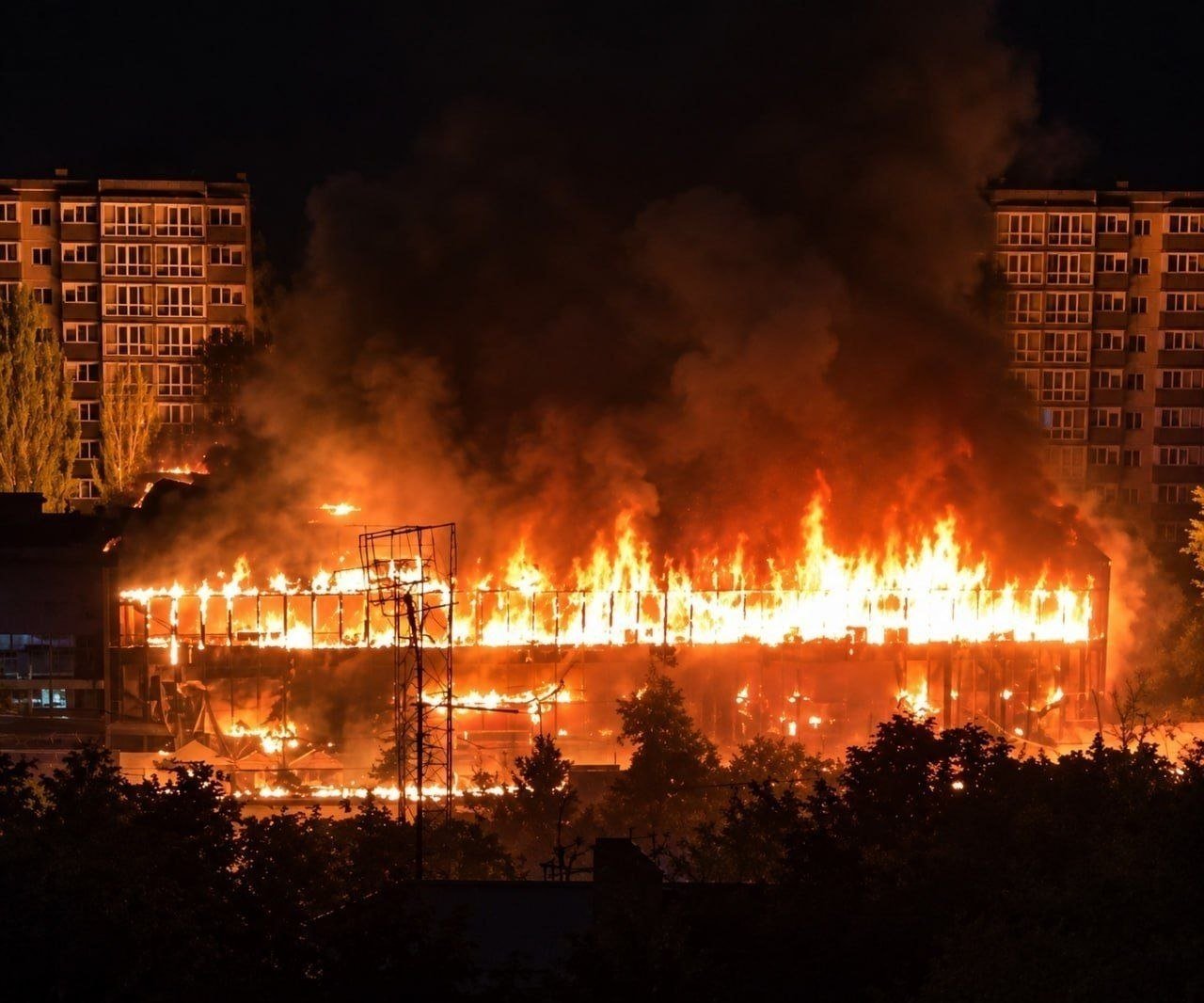
Every day, the Ukraine Battlefield update newsletter offers a clear look at how the war is unfolding on the ground. Subscribe for free here to get the full text delivered to your inbox. Over the course of a few days, Ukrainians released several videos showing Russian jet-powered drones being shot down by interceptor drones. They showed successful strikes by three different interceptor drones in total; the key will be to produce them at scale. They also struck a drone base from which Russia launches jet-powered Gerans. Documents show that Russia plans to expand a factory, potentially allowing it to produce 28,000 more Gerans. The most important battle is taking place near Dobropillia — what Russia is trying to achieve. Map of the day: What part of Nato countries’ territory Geran-4 and Geran-5 drones could theoretically reach. Videos of the day: the destruction of a historic building in Zaporizhzhia; a falling drone frightened kayakers; a failed Russian infiltration; how Russia protects its ships. The mass deployment of Russian jet-powered drones is one of the most negative developments for Ukraine in recent months. Russia produces around 3,000 of them each month, and they currently make up roughly half of the drones Russia deploys to bombard Ukrainian cities every day. And many of them do so successfully: Ukraine shoots down 60 percent of jet-powered Gerans, compared with more than 90 percent of conventional drones. When speaking of jet-powered Gerans, there are essentially two types: the Geran-4 and Geran-5. Their specifications are similar, but their shapes differ. While the Geran-4 still retains the delta-wing design of the Geran-2, the Geran-5 is essentially a six-metre cruise missile. Comparison of the Geran-4 and Geran-5: engine, maximum range, maximum speed and warhead weight. Source: United24Media Ukraine had already said in the summer that it was working on interceptor drones capable of shooting down this new Russian weapon as well. Speed is crucial: jet-powered drones fly at around 500 km/h. To shoot them down, they must first be caught up with. It appears that Ukraine is beginning to succeed. Over recent days, it has released five videos showing Russian jet-powered drones being shot down using new types of interceptor drones. The first video was released by Ukrainian president Volodymyr Zelensky, indicating why a response to the new type of Gerans is so important for Ukraine. It was the work of Ukraine’s SBU security service. The video shows interceptor drones of an unknown make taking off, with a delta-wing design. They appear to have jet engines. At the end, one such drone catches up with and strikes a Russian Geran-5. “A new interceptor drone has been developed and has already been successfully deployed,” Zelensky wrote. He did not disclose the drone’s name. Report from SSU Head Oleksandr Poklad. There is a good result from the Security Service’s military counterintelligence in defending against jet-powered “shaheds.” A new interceptor drone has been developed and has already been successfully deployed. Step by step, we are moving… pic.twitter.com/cIFp7mThwf— Volodymyr Zelenskyy / Володимир Зеленський (@ZelenskyyUa) September 19, 2026 Later that day, he released a second video of another strike. Today, we have already seen the second successful deployment of a new Ukrainian interceptor drone by the Security Service of Ukraine. SSU military counterintelligence personnel successfully struck a Russian Geran-5 jet-powered drone.I thank the SSU warriors for their precision.… pic.twitter.com/ljIofjAaw3— Volodymyr Zelenskyy / Володимир Зеленський (@ZelenskyyUa) September 19, 2026 That same day, the Ukrainian company Wild Hornets published two similar videos. It added another on Monday. STING S takes down a Geran-5 jet-powered drone-missile ❗️💥The crew from the 1020th Anti-Aircraft Missile Regiment took down a Russian Geran-5 using the new STING S. This drone is faster and carries a larger explosive payload than other Geran variants.Big thanks to the… pic.twitter.com/Eg0rQgd1tL— Wild Hornets (@wilendhornets) September 19, 2026 One less jet-powered Shahed: the work of the Sokil crew of the 1020th Anti-Aircraft Missile Regiment 💥The daily work of the Paskudy division using interceptor STING drones continues. pic.twitter.com/bZykUnFG1c— Wild Hornets (@wilendhornets) September 21, 2026 “Thanks to the crew’s skill — especially that of the pilot with the call sign ‘Babai’ from the 1,020th Air Defence Regiment — the target was neutralised. The warhead of this type weighs as much as 90 kg and has a range of 950 km,” the company said. The company told the Militarnyi website that it had already managed to shoot down more than a dozen Russian jet-powered drones. In this case, the type of drone used for the strike is also clear. It was hit by a STING S drone, developed from the basic STING model with improved aerodynamics and a better engine. The company does not want to disclose its precise specifications, as it is still being tested and has not entered serial production. On Monday, one account released another video. It shows a Geran-5 attempting to shoot down a SPYS interceptor drone. It is manufactured by the Ukrainian company WIY Drones, although some reports describe it as a Ukrainian-German consortium. Whilst Ukrainian manufacturers are urgently improving their means to counter the new, significantly upgraded Russian Geran-5s, there is now also good news from Germany. I received a video from a credible source showing the successful interception of a Geran-5 by the new SPYS… pic.twitter.com/IUj6xCcq5s— GAU (@deaidua) September 21, 2026 Some specifications are already known. According to its representatives, the drone can fly at 600 km/h, which is sufficient to match the current speeds of Russian jet-powered drones. Ukraine manufactures the engine itself, which is an advantage over Russia, which must import jet engines for its drones from China, even as it seeks to launch domestic production. “This is a major advantage for Ukraine — we have developed this industry to the point where we now manufacture both engines and electronics ourselves,” a company representative told Militarnyi in July. Over the course of a few days, Ukraine has thus released videos of three types of interceptor drone that have demonstrated the ability to shoot down Russian jet-powered drones in combat conditions. This is good news, but the key question will also be whether production can be scaled up to manufacture enough drones to counter this threat during the winter. The preceding months have shown that ballistic missiles and jet-powered drones are the main weapons Russia has prepared for winter. “If Ukraine has found a solution — or solutions — and can scale them up over the next month or two, it could genuinely help defend against the approaching Russian winter campaign,” Financial Times journalist Christopher Miller wrote. Until then, Ukraine must also focus on stopping these drones on the ground. On Monday, it struck the Russian drone base at Tsymbulovo in the Oryol region. It deployed its own jet-powered drones and Neptune missiles. According to Ukrainian analyst Bohdan Myroshnykov, it is Russia’s largest and most secure launch site for jet-powered drones. According to the Ukrainian KiberBorosno account, the attack struck bunkers and damaged hangars and launch sites. The Russian Military Informant channel also wrote that Ukraine has recently been attacking Russian drone bases in an effort to stop the launch of drones it cannot intercept in the air. “The infrastructure of these facilities is sufficiently fortified to withstand such attacks, however, while their above-ground parts, such as launch ramps, are relatively easy and cheap to restore,” it wrote. Myroshnykov nevertheless believes this makes sense. “It is impossible to destroy everything on the first or even the tenth attempt. Systematic strikes will, however, bring results. If there are no launches from there for at least three to four days, it will mean they have serious problems,” he wrote. Politico reported worse news, not only from Ukraine’s perspective but also for European security. It obtained Russian documents outlining plans to build and expand a factory in the Alabuga special economic zone in Tatarstan, where Russia currently manufactures, among other things, Geran drones based on Iran’s Shahed drones. According to the documents, whose authenticity, Politico reported, was confirmed by US and Ukrainian officials, Russia plans to expand a factory in Alabuga that will produce carbon fibre. This is important for drone construction, making them sufficiently light and giving them a longer range. Satellite images from May and June, showing preparatory work on the ground, also confirm the plans to build the factory. According to the documents, the aim of the factory — which could open as early as next year — would be to produce 500 tonnes of carbon fibre annually. According to experts consulted by the website, this would be enough for 28,000 new Geran-2 drones. Russia has so far imported much of its carbon fibre, and the new factory section could therefore reduce its dependence on imports. Naturally, carbon fibre is only one component of a drone, and other parts — such as jet engines — may constrain the increase in drone production. These plans concern the future and may not relate only to Ukraine. “The expansion of the Yelabuga company and its affiliated businesses should not be viewed merely as a problem for the Ukrainian front, but as a long-term threat to the security of all Europe,” Serhii Kuzan, an analyst and director of the Ukrainian Security and Cooperation Centre, told Politico. In this context, Marko Mihkelson, chair of the foreign affairs committee in the Estonian parliament, wrote that Russia’s war machine was expanding at an “alarming rate”. He compared 2024 with 2026. According to him, the number of ballistic missiles produced during that period rose from 50 to 1,180, the number of Gerans from 10,000 to 127,000, and the number of FPV drones from four million to 10 million. Russia’s war machine is scaling up at an alarming speed.Production: 2024 → 2026 (estimated) Ballistic missiles: 50 → 1,180Shahed/Geran-type attack drones: 10,000 → 127,000FPV drones: 4 million → 10 million— Marko Mihkelson 🇪🇪🇺🇦🇪🇺 (@markomihkelson) September 20, 2026 It is unclear where he obtained this information, although it was probably from Estonian intelligence services. According to the Shahed Tracker account, Russia is launching Gerans and similar drones at Ukrainian cities this year at a rate of 70,000 annually. This would mean either that the Estonians are exaggerating, or that Russia will produce 57,000 such drones for stockpiling this year. The battle for Dobropillia. The most important battle on the front is currently taking place near Dobropillia. After Ukraine cleared the salient in the north near Lyman, Russia has been trying to encircle the fortified cities of Sloviansk and Kramatorsk from the south. The intensity of fighting in Kostiantynivka has declined compared with the first half of last year. Russia has redeployed some of its units towards Dobropillia. Denys Prokopenko, commander of Ukraine’s Azov group of forces and the First Corps of the National Guard, which is responsible for defending the area, recently said that Russia had deployed one-third of the crews of its Rubikon drone centre there and held a six-to-one advantage. According to analyst Kostyantyn Mashovets, Russia’s aim is not to capture the city, but to bring a large number of troops into the villages south of it, which are currently being fought over. From there, they would carry out infiltrations into the city. This is shown by the dashed square on the map. The infiltration routes used by Russian soldiers are also visible. Source: Vitalii French analyst Clément Molin looked at this from a broader perspective. In his view, cities such as Sloviansk and Kramatorsk, as well as Dobropillia itself, are well fortified. Russia will therefore try to exploit the area between Dobropillia and Druzhkivka to the north-east, he said. Defences there are not as strong, and Russia will seek gaps through which it can advance. Map of Donbas by Black Bird Group Reaching this area would be advantageous for Russia. According to topographical maps, the area between Dobropillia and Druzhkivka is at a higher elevation than Kramatorsk, Sloviansk and Druzhkivka. “If Russia manages to cross the line before winter, regardless of the scale of its losses, it could gain fire control over one of the three supply routes into Donbas and attack key cities from the rear,” Clément Molin wrote. Map of the day Russian propaganda channels have in recent days published maps showing how far jet-powered Gerans could fly into European countries. For example, the Rybar channel used a map to illustrate that Gerans launched from Algeria could threaten half of France. Algeria has good relations with Russia, but that does not mean it would allow Russia, in the event of a hypothetical war, to bombard European Nato countries from its territory. It is more likely an attempt to intimidate Ukraine’s Western allies. However, French analyst Clément Molin examined the real risk that the current range of jet-powered Gerans — the Geran-4 and Geran-5 — poses to European allies. According to him, Russia launches these drones from 15 sites in Russia and occupied Ukraine, including Crimea. The map shows how far they could reach. The whole of the Baltic states, almost all of Romania and Bulgaria, much of Poland, and small parts of Greece and Finland could be at risk. The map shows that jet-powered Geran-5s could also reach eastern Slovakia. Geran-4s cannot reach that far. Ce genre de propagande russe est assez ridicule, loin de la réalité et de l'état de la menace. Voici donc, l'état réel de la menace 🇷🇺 des drones Geran :🔸Il y a à l'heure actuelle 15 sites de lancements fixes pour les drones Geran (dont la moitié lancent les Geran-4/5 à… https://t.co/AC4SDyTBX2 pic.twitter.com/8FCjmEPwfU— Clément Molin (@clement_molin) September 19, 2026 Videos of the day Russia responded to Sunday’s attack on Moscow with strikes on various locations across the country. On Monday, it also struck a historic early 20th-century building of Zaporizhzhia National University. According to videos, part of it was completely gutted by fire. Russia continued attacks on Kryvyi Rih, Dnipro, Pavlohrad and Kremenchuk on Tuesday. 🚨 BREAKING: At least 5 people were injured as Russian strikes targeted Zaporizhzhia, severely damaging a historic campus at Zaporizhzhia National University. Built in the early 1900s, the landmark originally served as a women's gymnasium. pic.twitter.com/nLy04qdRfl— UNITED24 Media (@United24media) September 21, 2026 This is what the kill zone looks like. Ukraine’s 225th Assault Regiment released a video showing Russian soldiers attempting to push forward. They arrived in two BTR-80 armoured amphibious vehicles. The video shows Ukrainians striking one of them. The soldiers then continued on foot. Ukrainian drones attacked them, killing at least one soldier. Finally, drones also destroyed the abandoned armoured vehicle, intended for one-way use. A couple went kayaking on a river near Kyiv when a Russian drone suddenly fell a short distance in front of them. This, too, is what life in Ukraine looks like in 2026. Russia is building anti-drone cages around its warships. According to the description, this is a vessel in the Caspian Sea. What are the losses By Tuesday (22 September), Russia had verifiably lost 24,138 pieces of heavy equipment, compared with 24,098 on Monday (14 September). Of these, Ukraine destroyed 19,105 (19,065), 1,000 (1,000) were damaged, 1,194 (1,194) were abandoned by their crews, and the Ukrainian army captured 2,839 (2,839). This includes 4,448 (4,447) tanks, of which 3,353 (3,352) were destroyed in combat. Ukraine lost 12,175 (12,143) pieces of equipment, of which 9,579 (9,551) were destroyed, 702 (698) damaged, 695 (695) abandoned and 1,199 (1,199) captured. This includes 1,464 (1,462) tanks, of which 1,125 (1,120) were destroyed in combat. Note: Neither side regularly reports its own fatalities or destroyed equipment. Ukraine publishes daily figures for Russian casualties and destroyed equipment, which cannot be independently verified. This overview uses data from the Oryx project, which has compiled a list of equipment losses documented exclusively by photographs since the start of the war.
Ukraine shows how it shoots down jet-powered Russian drones, as Moscow seeks to expand production (Ukraine Battlefield update, day 1,671)
Full Article
Original Source
Read the full article at Euobserver →KhanList aggregates and links to publicly available news content. We do not host full articles from third-party sources. Always verify important information with original sources.