
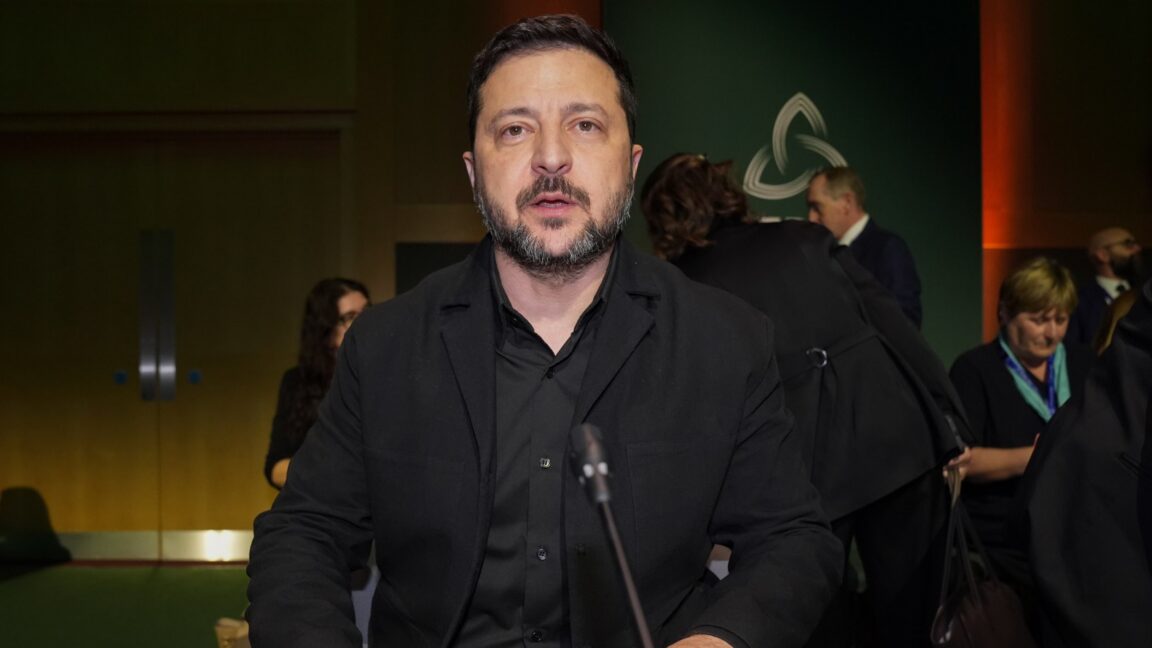
Skip to content Report: Ukraine suspects speeds limits are intended to help Russia in peace talks. Ukraine President Volodymyr Zelenskyy at the 9th European Political Community Summit in Dublin, Ireland on November 12, 2026. Credit: Getty Images | Brian Lawless/PA Images Ukraine President Volodymyr Zelenskyy said today that Starshield has again been disabled on fast-moving drones in Ukrainian territory occupied by Russian forces, and that the US has provided “very little” information about the return of the restriction. “We have detected speed restrictions on Starshield on our Ukrainian territory again, in the temporarily occupied parts of Ukraine,” Zelenskyy said in a speech at the 9th European Political Community Summit in Ireland. “The speed limit is back at 161 kilometers per hour—that’s 100 miles per hour.” Zelenskyy’s allegation is that Starshield—the military variant of SpaceX’s Starlink satellite service—stops working on Ukrainian military drones when they travel above 161 kilometers per hour. SpaceX today denied Zelenskyy’s allegation. “This is false. There has been no change,” SpaceX’s media relations department told Ars today when asked if SpaceX has any response to Zelenskyy’s statement that Starshield is being restricted again. “This means more Russian strikes get through” SpaceX has received multiple Pentagon contracts to give Ukraine access to the military-focused Starshield. SpaceX CEO Elon Musk said last month that any decisions on Starshield restrictions are made by the US government. The Pentagon inspector general’s office has since declined a request from US senators to investigate who ordered the restrictions. Ukraine officials reportedly said today that they believe the limit was reinstated to put pressure on Ukraine in the latest round of peace talks with Russia. Zelenskyy said in today’s speech that without satellite connectivity on its drones, Ukraine cannot intercept Russian drones that fly in from the occupied parts of Ukraine. It has often been unclear whether US and Ukrainian government officials discussing the restrictions were referring to Starlink, the civilian service that isn’t supposed to be used for offensive military purposes, or Starshield, which relies on the same technology but is intended for military use. But today, Zelenskyy clearly stated that the current restrictions affect Starshield. “This directly affects our ability to intercept Russian jet-powered Shahed drones,” Zelenskyy said. “These drones come from those [occupied] areas, and because of the speed restrictions, we simply cannot catch up with them in time. Near the front line, we cannot use our aircraft. Only drone interceptors can operate there. And without the speed we need, shooting down these Shaheds becomes much harder. This means more Russian strikes get through, and more of our people are killed, our civilians are killed, by Russia.” Ukraine suspicions about US motivation Ukraine officials reported the first round of restrictions about a month ago, but the limits were removed by October 24. Zelenskyy said today that Ukraine doesn’t know why the limit is in place again. “We are trying to get the details from the American side, but so far we know very little,” Zelenskyy said. “But some things are very clear. If someone in America is making decisions that basically treat Ukrainian territory as if it is not Ukrainian, then this tells us where things are going. We need to be clear and never recognize Russia’s occupation of Ukrainian territory in any way.” A Financial Times article today described Ukrainian officials’ allegations that the Starshield limit was put back in place to influence peace talks: Senior Ukrainian officials told the FT they believed the speed restrictions were imposed in an effort to pressure Kyiv during the latest peace talks with Russia, which just concluded in Abu Dhabi. US special envoy Steve Witkoff and Donald Trump’s son-in-law, Jared Kushner, were in Moscow on Thursday to meet Russian President Vladimir Putin, after which they were set to travel to Ireland to meet Zelenskyy. One senior Ukrainian official said it appeared that Washington wanted to strengthen Russia’s position in the talks. “These are not random errors, but systematic speed restrictions,” Zelenskyy said. “For us, this primarily means a significant complication in intercepting Russian jet-powered drones.” EU: Starshield limits “unacceptable” Musk last month accused Ukraine of using the Starlink commercial service for offensive drone strikes, which he said violates the terms of service. A Ukraine official denied Musk’s accusation and said previous limits imposed by SpaceX already prevented Ukraine’s military from using the commercial Starlink service in the way Musk described. As for the Starshield military variant, Musk has said that “Starshield systems are owned and controlled by the US government. Any limits on speed or usage are decided by the US military and ultimately POTUS.” Trump denied making the decision to limit Ukraine’s satellite connectivity, and Secretary of State Marco Rubio said the administration had “no foreknowledge” of the slowdown. We contacted the White House today and will update this article if we get a response. European Commission spokesperson Thomas Regnier said that restrictions on Ukraine’s use of Starshield are unacceptable. “It is not the first time that Ukraine is facing Starshield disruptions. These reports are deeply concerning and, if confirmed, unacceptable,” Regnier said at a press conference. “SpaceX must have a consistent approach in sharing its services with Ukraine. Starshield services must be restored urgently for Ukraine to keep its soldiers connected, to protect its citizens, and to defend its territory.” Jon is a Senior IT Reporter for Ars Technica. He covers the telecom industry, Federal Communications Commission rulemakings, broadband consumer affairs, court cases, and government regulation of the tech industry. 12 Comments
Ukraine says SpaceX Starshield is restricted again; SpaceX claims it isn’t
Full Article
Original Source
Read the full article at Arstechnica →KhanList aggregates and links to publicly available news content. We do not host full articles from third-party sources. Always verify important information with original sources.