
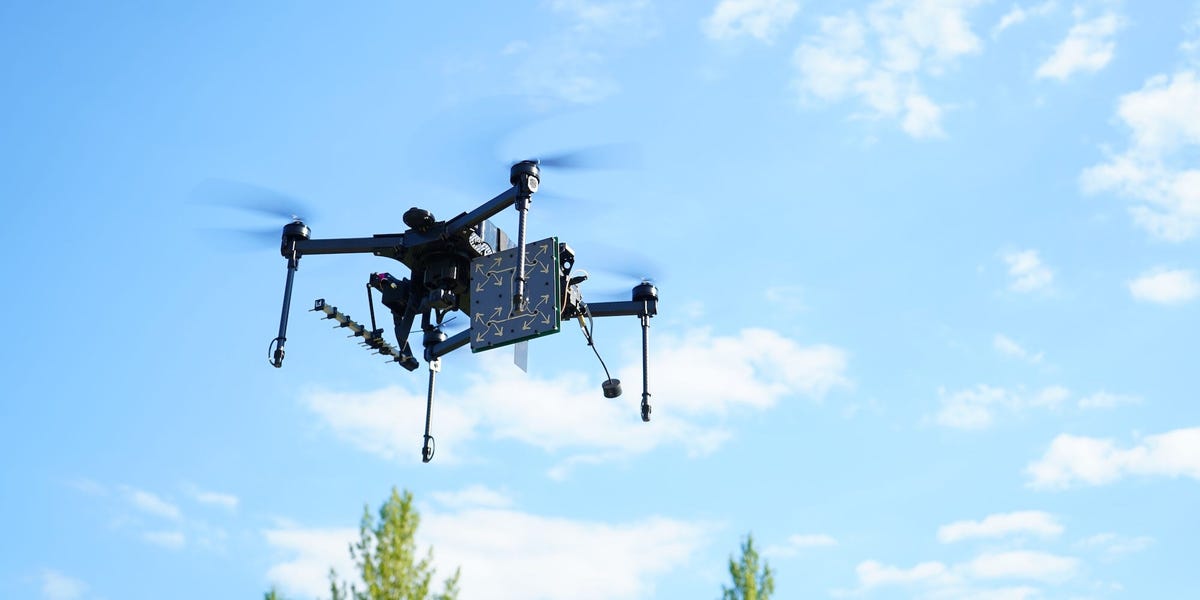
Ukraine is using drones like hovering WiFi repeaters to help attack drones reach farther Twist Robotics' drones can be used as signal repeaters to help the connection between a drone operator and their mission drone. Twist Robotics Ukraine has created drones that act as flying relay towers, allowing its drones conducting missions to fly farther while making them harder for Russia to jam.In a war where drones gather intel and account for more than 95% of Russia's front-line losses, Ukraine wants its operators to keep control of their drones over longer distances with stronger signals that are harder for Russia to break.One solution is the signal repeater drone, a flying signal booster that operates between a pilot and a mission drone, relaying commands to the aircraft and sending back video and intelligence to the operator. Able to fly much higher than a ground antenna, airborne repeaters can extend a drone's range and help preserve the connection under pressure.It increases the mission drone's operational range by extending how far it can fly while staying connected to its pilot. It's a similar principle to how wifi repeaters work.Ukrainian arms maker Twist Robotics makes a signal-repeating drone, born from its Saker Scout drone.Rostyslav Olenchyn, the company's co-founder and chief information officer, told Business Insider that the drone was widely used for reconnaissance and strike operations, but this war changes rapidly, with arms and warfighting technology quickly becoming obsolete. And without updates, this drone was at risk of falling victim to that pattern in the cat-and-mouse technology race.Drones needed to be effective at longer ranges, and the Saker Scout's range was "not enough" for many missions. So, the drone was redesigned "for another objective. It became the signal relay station," Olenchyn said. Ukraine's drone operators want to be able to fly their drones as far and with as strong a connection as possible. Ukrinform/NurPhoto via Getty Images The Saker Scout, able to also be used in other combat roles, can extend the operational range of drones by more than 50 kilometers, according to the company.The concept of using aircraft as signal middlemen isn't new. Militaries have used helicopters and planes to relay communications between assets and forces disconnected by the terrain, though usually troops rather than drones. These crewed aircraft, however, struggle to operate over Ukraine, but while such air assets are few and far between, drones are prolific. Large crewed aircraft cannot "necessarily survive in the heavy saturated air of the battlefield," where drones and air defenses are a threatening presence, Olenchyn said. "So the small, versatile platform was a solution." He said that serial production of the Saker Scout with this function started in 2023.The company's strike drone, the Signal Hunter, can also be used as a relay.Other Ukrainian companies are also working in the space, with some updating existing drone types and some designing new ones. Roboneers, for example, developed a version of its Wardog drone that can carry relay equipment weighing up to three kilograms, and Skyriper makes the Skyriper-R Airborne Repeater, a dedicated drone with the single function of acting as an airborne repeater.Volodymyr Zinovskyi, the CEO of the Ukrainian defense firm TAF Industries, told Business Insider that his company started making relay drones last year at the request of units, describing the technology as going from optional to essential.Brave1, Ukraine's state-backed innovation platform, wrote last year that "the use of UAVs over long distances or in difficult terrain requires the use of repeaters - special devices that help increase the range of a stable signal several times."Some Ukrainian drones are built for this relay mission, while others can be fitted with add-on repeater equipment. Twist Robotics' Saker Scout repeats the signal from a drone operator to their mission drone, and the reverse. Twist Robotics Beyond overcoming geographical challenges, airborne repeaters also help counter Russian electronic warfare by strengthening the communications link between operators and mission drones, making it harder to disrupt, though Russia can still target the relay itself.An analysis published by the Center for Strategic and International Studies, a US think tank, last year described the creation of relay systems as a response to growing electronic warfare tactics, including the ability that both sides have to trace drone control signals back to their source for strikes on operators, priority targets in this war.Dmytro "Liber" Zhluktenko, a former drone operator who now serves as a lessons-learned analyst with Ukraine's 413th Unmanned Systems Regiment "RAID," told Business Insider that Ukrainian forces are "keeping somewhat a stable radio link by mass utilizing signal repeaters."He said that some uncrewed repeater aircraft are fixed-wing drones, while some are repurposed bomber-type drones. Instead of bombs, it just carries the signal repeater," he said."We optimize those signal repeater carriers to just stay in the air for an extremely long time, like one hour plus," he said. "That's their only job: to be in the air." Working with strike drones, they give operators a "great radio link over the target."Oleksiy, the commander of the 2nd UAV engineer platoon of the International Defense Legion of Ukraine, told ArmyInform, the official information agency of the Ministry of Defense of Ukraine, last year that his unit uses repeaters on drones to expand the radio horizon of the drones they want to use and fly further to target Russia.Russia is using the technology too, including to help attack drones fly deeper into Ukrainian territory.And these lessons aren't limited to the Ukraine war. The US military is also experimenting with ways to extend drone operations and keep operators connected from farther away. The Marine Corps, for instance, has experimented with using helicopters as FPV motherships, as well as handing off control after launch.Though different from Ukraine's airborne repeater work, both address a similar battlefield problem, which is that drones are only useful if operators can launch them, control them, and keep receiving information at tactically relevant distances.Olenchyn said that updates, like the signal repeating ability, are critical in combat. He said that every two weeks, the company has "a new update, new kinds of techniques, new kinds of drones or functionality which are released." Read next Business Insider tells the innovative stories you want to know Business Insider tells the innovative stories you want to know Business Insider tells the innovative stories you want to know Business Insider tells the innovative stories you want to know Sinéad Baker is a Military and Defense Correspondent based in Business Insider's London bureau, writing about Russia's invasion of Ukraine and NATO actions.Sinéad most often covers soldiers' experiences, military strategy, battlefield developments, weapons systems, the defense industry's response, and the impact on NATO and European security, and geopolitical decisions that surround the Ukraine war. She has reported from NATO’s frontlines and around Europe, has interviewed multiple prime ministers and defense ministers, has appeared on BBC News and The Guardian's politics podcast, and has been cited by Congressional hearings.Sinéad has also extensively covered US politics and previously led Business Insider's breaking news coverage from London.Sinéad previously completed a master's degree in investigative journalism at City, University of London, and has written for The Guardian, The Observer, and TheJournal.ie. Sinéad is the former editor of the multi-award-winning The University Times in Dublin.ExpertiseExperiences of soldiers in Ukraine, including battlefield developments and tacticsWestern military responses to the war, and lessons they should learnNew weaponry built for and in response to the war Email Sinéad at sbaker@businessinsider.com or find her on X. Jake Epstein is a defense correspondent in London for Business Insider, covering the US military, NATO, and European security, as well as emerging tech in warfare.Jake has filed stories from conflict zones in Ukraine and the Middle East, where he embedded with a US aircraft carrier on a combat mission in the Red Sea. Jake has reported extensively on NATO operations and activities across Europe, including from aboard one of its AWACS surveillance aircraft along the Russian border, a British Voyager tanker refueling fighter jets over the Baltic Sea, and a Dutch helicopter flying to a warship in the Arctic. Ukraine Russia Drones More Drone
Ukraine is using drones like hovering WiFi repeaters to help attack drones reach farther
Full Article
Original Source
Read the full article at Businessinsider →KhanList aggregates and links to publicly available news content. We do not host full articles from third-party sources. Always verify important information with original sources.