
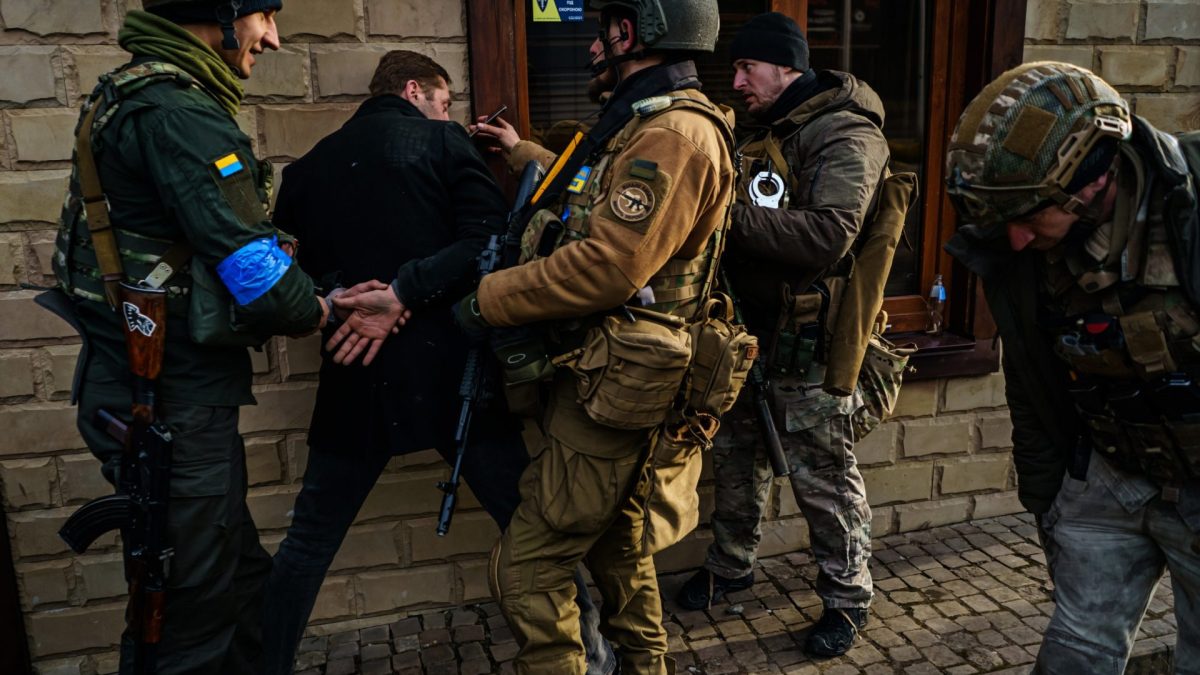
The behind-the-lines war between Kyiv and Moscow is being fought not just by drones and missiles, but also by criminals. A firefight between Ukrainian security officers last week was a reminder that this can be a risky strategy, with potentially dangerous consequences. Both Ukraine and Russia encourage hackers to break into enemy systems. Moscow also uses smugglers to bypass Western sanctions, while Kyiv is using telephone scammers to try to disrupt life in Russia and coerce ordinary Russians into becoming saboteurs. Partly as a result, Ukraine has emerged as a major player in this massive criminal industry. There may now be as many as 1,500 telephone scam centres in the country, generating the equivalent of up to £750m every month. Shorts These criminals try to con their targets into giving up their online passwords, taking up too-good-to-be-true fake investment opportunities or moving their money into accounts controlled by the scammers. They are driven by profit, not politics, and their targets range from Europe to Israel, the US to Central Asia. Russia is obviously a favoured target, though: they can generally speak the language and Ukrainian police do not share information with their counterparts there. There have been crackdowns, especially since Ruslan Kravchenko took over as Ukraine’s prosecutor general last year, but such a lucrative criminal industry can afford to buy itself protection. And this is a growing concern. Polled in April, 54 per cent of respondents expressed the view that corruption was a greater problem than the ongoing war. Kravchenko was forced to stand down this week when it emerged that some of his investigators were also taking bribes to protect the scammers. There is a widespread view both among Western law-enforcement agencies and Ukraine’s own independent anti-corruption agencies that the Security Service of Ukraine (SBU) is especially vulnerable to corruption. Massive extortion, embezzlement and protection rackets directly involving top SBU leadership have been exposed. Ruslan Kravchenko was forced to stand down this week as Ukraine’s prosecutor general after it emerged that some investigators were taking bribes (Photo: Marianna Kotyk/Ukrinform) This is where things get murky. The SBU is also at the forefront of Ukraine’s campaign of sabotage within Russia. These have ranged from major set pieces like last year’s Operation Spiderweb, when 117 drones hidden inside cargo containers simultaneously struck five Russian airbases, to a constant stream of smaller-scale attacks, from shootings to the firebombing of military draft offices and relay boxes that carry signals data along railway lines. While some of those who carry out these attacks are ideological opponents of the Kremlin, or are simply offered money, many have been blackmailed or conned into it, usually by Ukrainian telephone scammers. They might have their savings stolen and are then offered their money back if they do as they are told. Alternatively, they might be warned that their money was sent to Ukraine, meaning they risk being charged for treason. In a few cases, they are even persuaded that they have been contacted by the Russian authorities and are simply testing local security. In return, the scammers buy themselves a degree of impunity, which exposes the security service to moral hazards. Just as the Russians have found when working with hackers, smugglers and gangsters, it is often difficult to be sure quite who is using whom, and many within the SBU have become rich off the back of the telephone scams. However, they are likely not the only ones. Last Wednesday, the SBU arrested Stepan Kaplunov, a Russian fighting on Kyiv’s side. His unit, the Russian Volunteer Corps, is essentially run by GUR, Ukraine’s military intelligence. The SBU accused Kaplunov of being a Russian plant, but when they were taking him back to his flat in Kyiv to search it, they were met by GUR officers. A standoff led to jostling and shots were fired. Three GUR officers were wounded. This ignited a political firestorm. Ukrainian President Volodymyr Zelensky was reportedly furious and a senior SBU official was sacked. Since then, though, it has become increasingly clear that this was not just about Kaplunov, but was part of a wider rivalry between the SBU and GUR. There is something of a political rivalry between acting SBU director Olexander Poklad and Kyrilo Budanov, the former GUR chief who is now Zelensky’s chief of staff. However, the SBU is also pushing back against the GUR’s efforts to muscle in on the telephone scam sector. Police from various countries took down an organised crime network that operated scam call centres in Dnipro, Kyiv and Ivano-Frankivsk last year (Photo: Latvian State Police) The official line is that they want to use scammers to recruit assets inside Russia, where military intelligence also carries out covert operations. But the suspicion is that at least some within GUR are eyeing up opportunities for bribe-taking. Ukraine is fighting for its own survival, and will use whatever tools it has at its disposal. After all, during the Second World War, US forces co-operated with the Mafia in their conquest of Sicily, while Germany forced Jewish counterfeiters to make fake British banknotes. However, while criminals make useful assets in times of war, they are also dangerous and can stick around long after the fighting is done. For Ukraine, where many worry about endemic corruption, there is a fear that the criminals could take over. A Western intelligence officer who has worked with both agencies told The i Paper: “SBU and GUR do amazing work, often by cutting corners and breaking the rules. That can be corrosive, creating the kind of culture where it’s hard to keep people on the straight and narrow, especially when they’re working with crooks.” As the war drags on, this might only become worse.
Ukraine is using criminals to destabilise Russia. But it could be consumed by them
Full Article
Original Source
Read the full article at Inews →KhanList aggregates and links to publicly available news content. We do not host full articles from third-party sources. Always verify important information with original sources.