
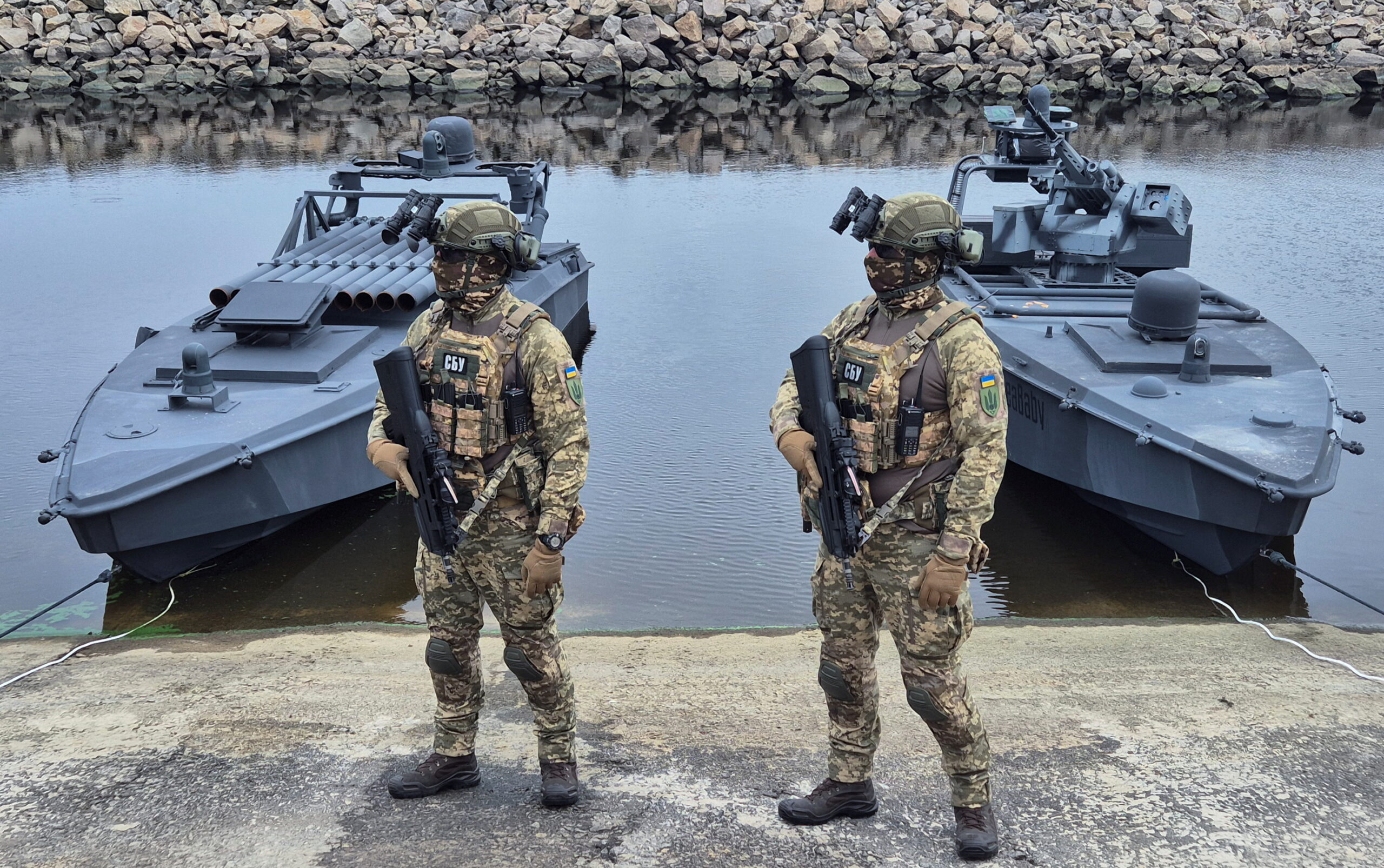
Early on Sunday morning, a small squadron of Ukrainian naval drones struck and sank one of Russia’s most modern warships at the port of Benghazi in Libya. This spectacular surprise attack was hailed by Ukrainian President Volodymyr Zelenskyy as an “exemplary Ukrainian operation.” The following day, Zelenskyy confirmed that Ukraine was also responsible for a recent drone attack on a Russian cargo ship in the Gulf of Finland, more than three thousand kilometers to the north. These twin strikes in the Mediterranean Sea and the Baltic Sea have highlighted the growing geographical reach of Kyiv’s offensive capabilities. They have also served to underline Ukraine’s status as a world leader in drone warfare. Ukraine’s emergence as a drone warfare innovator reflects the realities of waging a twenty-first century war against a far larger and more conventionally powerful enemy. In the early months of Russia’s full-scale invasion, Ukraine identified drone technologies as a relatively cheap and technologically accessible solution to counter the Kremlin’s often overwhelming advantages in terms of both firepower and manpower. This led to the rapid development of Ukraine’s domestic drone industry. By the second year of the invasion, hundreds of Ukrainian defense tech startups were designing and manufacturing drones. Many had direct relationships with specific military units, making it possible to test and modify drones with remarkable speed. Output soon skyrocketed, with Ukraine’s annual production climbing from a handful of units to millions of drones. This remarkable expansion owed much to Ukraine’s grassroots entrepreneurial spirit and the agility of the country’s vibrant tech sector. It also reflected the old adage that necessity is the mother of invention. With Russia clearly committed to wiping the country off the map, drones offered Ukrainians a chance to fight for their national survival. The results have been so remarkable that some have called it a revolution in military thinking. It is not difficult to see why. After all, Ukraine’s pioneering use of drones has reshaped the battlefield and transformed international understanding of how modern wars are fought. Almost five years after Russia’s invasion began, Ukraine is now widely recognized as a drone superpower at sea, on land, and in the air. Stay updated As the world watches the Russian invasion of Ukraine unfold, UkraineAlert delivers the best Atlantic Council expert insight and analysis on Ukraine twice a week directly to your inbox. The effectiveness of Ukraine’s naval drones was first demonstrated in the Black Sea, with unmanned marine units playing a key role in efforts to restrict Russia’s Black Sea Fleet. Following a highly effective campaign of drone attacks that sank or damaged dozens of Russian warships, Putin eventually ordered the bulk of his remaining fleet to retreat from occupied Crimea to the relative safety of Russian ports. Having turned the tide in the Battle of the Black Sea, Ukrainian naval drones are now demonstrating their potential further afield. Sunday’s sinking of a Russian warship in Libya sends a clear signal that Ukraine intends to target Russian naval power globally and has the tools to do so. On land, Ukraine claims to have repeatedly made military history since 2022 with the innovative use of ground drones along the front lines of the war. This includes drones serving in a logistical capacity to resupply troops and transport wounded soldiers, and also robot drones deployed in combat roles. Ukraine’s successful recent Operation Vivaldi counteroffensive in the Donbas region showcased this prowess, with Ukrainian units reportedly using large bomber drones to transport unmanned ground vehicles (UGVs) deep behind enemy lines. This made it possible for Ukraine to liberate significant territory at a time when much of the front is locked in a bloody stalemate. Ukraine’s drone revolution has been most immediately obvious in the air. Swarms of Ukrainian strike drones have turned the front lines into an exposed kill zone that stretches for dozens of kilometers into the rear, making large-scale breakthroughs extremely difficult. Meanwhile, mid-range drones are steadily eroding the logistical foundations of Russia’s invasion. Much of this has been coordinated by Ukraine’s Unmanned Systems Forces (USF). Established in summer 2024, the USF is believed to be the world’s first military branch dedicated specifically to drone warfare. Ukraine now even has a designated professional holiday for drone operators, with Unmanned Systems Forces Day marked for the first time in June 2026. In terms of impact, Ukraine’s long-range drones may be the country’s most effective weapon. Since 2022, Ukraine has developed a fleet of domestically produced long-range drones capable of hitting targets thousands of kilometers inside Russia. This has made it possible to conduct a strategic bombing campaign against the energy industry that funds the Kremlin and fuels Putin’s war machine. In the past month alone, long-range Ukrainian strikes on oil refineries have reduced Russia’s refining capacity by 45 percent, Reuters reports. Eurasia Center events All this is very bad news for the Kremlin. When Vladimir Putin launched the full-scale invasion in February 2022, he identified the “demilitarization” of Ukraine as one of his key war aims. It is now hard to avoid the conclusion that Russia’s invasion has had the exact opposite impact. Far from being demilitarized, today’s Ukraine has never been more militarily powerful. As Zelenskyy pointed out this week, his military is now able to strike back at Russian targets “all the way from Siberia to the coast of Libya.” This has not gone unnoticed internationally. When countries across the Middle East were confronted with the threat of Iranian drones in spring 2026, many quickly signed defense partnerships with Kyiv as they sought to benefit from Ukraine’s unrivaled drone expertise. Likewise, numerous European armies are now incorporating lessons from Ukraine’s drone warfare experience into their training and are enlisting the help of Ukrainian instructors. As Russia’s invasion approaches a sixth year, Ukraine’s position at the forefront of drone warfare should shape future support for the country. While no single weapon system will win the war, Ukraine’s domestic drone industry has proved time and again that it can help even out the odds and hit Russia where it hurts. Crucially, many Ukrainian drone producers are currently operating well below capacity. With additional foreign funding and enhanced technological support, they could do much more. For now, Putin appears determined to fight on as he seeks to extinguish Ukrainian independence and return the country to Kremlin control. At the same time, however, Russia is evidently struggling to defend itself against Ukraine’s ever-evolving drone capabilities. Exploiting this vulnerability may be the most realistic way to end the war. If Kyiv’s partners want to push Putin toward peace in 2027, they should prioritize increased support for Ukraine’s world-class domestic drone industry. Peter Dickinson is editor of the Atlantic Council’s UkraineAlert service. Further reading The views expressed in UkraineAlert are solely those of the authors and do not necessarily reflect the views of the Atlantic Council, its staff, or its supporters. The Eurasia Center’s mission is to enhance transatlantic cooperation in promoting stability, democratic values, and prosperity in Eurasia, from Eastern Europe and Turkey in the West to the Caucasus, Russia, and Central Asia in the East. Follow us on social media and support our work Image: Servicemen of Ukraine's Security Service (SBU) stand guard near the latest versions of its "sea baby" naval drone, amid Russia's attack on Ukraine, in an undisclosed location in Ukraine. October 17, 2025. (REUTERS/Vlad Smilianets)
Ukraine is now a drone superpower at sea, on land, and in the air
Full Article
Original Source
Read the full article at Atlanticcouncil →KhanList aggregates and links to publicly available news content. We do not host full articles from third-party sources. Always verify important information with original sources.