
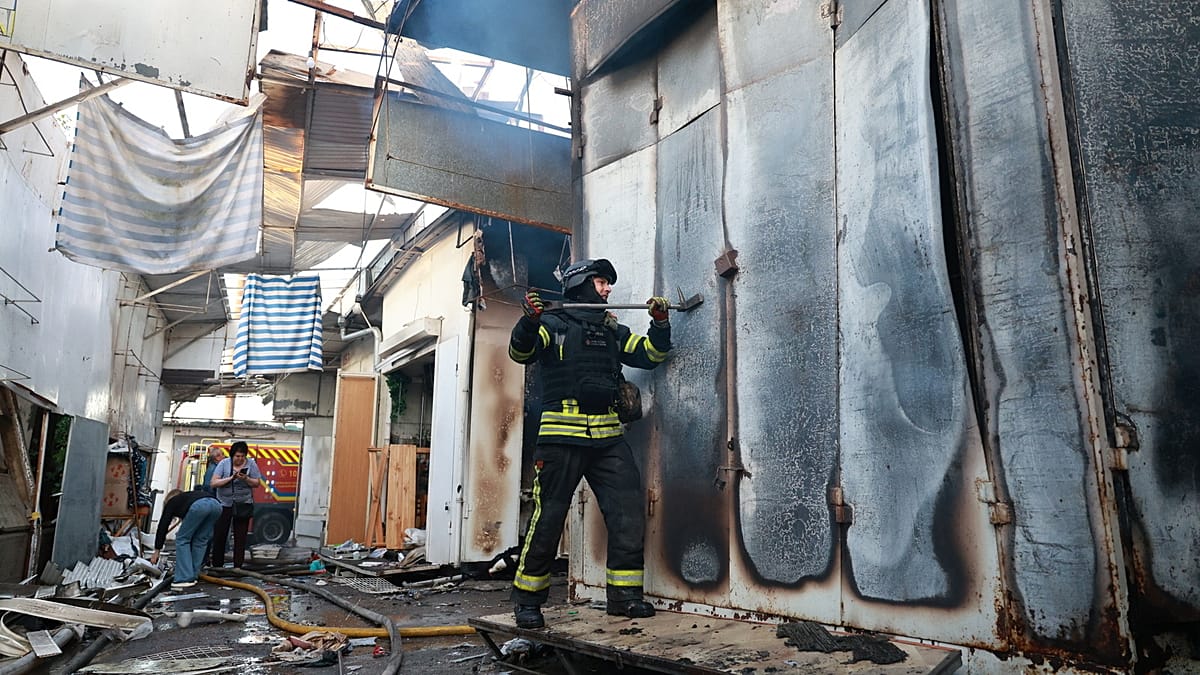
Hold the fort: European defence ministers are meeting in Brussels this morning to discuss more support for Ukraine as well as fortifying the bloc’s own skies and seas, my colleague Angela Skujins reports from down the road at the European Council. It comes as Russia continues to pound Ukraine, with the impact also bleeding out across Europe’s borders. ADVERTISEMENT ADVERTISEMENT The effects of Moscow’s aggression continues to be felt around the continent, through rogue aircraft and drones. Ministers will be tasked on Monday to start putting flesh on the bone to European Commission President Ursula von der Leyen’s bold pitch for the bloc’s own emergency protocol for hybrid threats, as unveiled at her agenda-setting State of the European Union speech in Strasbourg. An EU official close to the security file told reporters, including our own Angela Skujins, that there is space for dialogue between the bloc and the North Atlantic Treaty Organisation (NATO) particularly when it comes to these unwanted incursions – and how to step up defences. But avoiding duplication is the big question. Speaking to Euronews, Lithuania’s former foreign minister, Gabrielius Landsbergis, acknowledged the d-word is the biggest concern, but he admitted allies need to be more forceful with tools to counter these threats, particularly when it comes to Europe’s eastern flank. The Kyiv funding gap: Landsbergis also said, however, that the biggest challenge facing Europe over the next 12 months will be how it steps up financial support for Ukraine, which is naturally experiencing the brunt of Russia’s aggression. Ukrainian President Volodymyr Zelenskyy has made it quite clear he needs €23.5 billion to prop up his military to continue this defence, with Prime Minister Serhii Koretskyi saying on Sunday that some €6 billion will be covered through strict cost-cutting measures, while international partners are expected to step in to cover the rest of the gap. The delicate conversation that needs to occur now is whether Europe should continue to apply pressure on Kyiv to implement necessary reforms to unlock more cash, or give unfettered access to its coffers. “We can argue that they need to do reforms and they will do that maybe slowly, slower than we would like to, but then the question is: Do we allow Ukraine to just stop defending themselves if they lack the money?” Landsbergis told Europe Today. “And I believe that that will be the most important question of the next year.” Under pressure to provide relief, EU countries on Friday agreed to release a €6.6 billion programme of military aid for Ukraine that had stalled since spring 2023, when Hungary imposed a controversial veto that paralysed the initiative. Jorge Liboreiro has the details. Diplomatic delegations' fight for survival: My colleague Luca Bertuzzi reports this morning that the EU is unlikely to slash its delegations across the world, despite the network being eyed as part of sweeping budget cuts. European governments are locked in tense negotiations over the bloc's next long-term budget, with the administrative costs of EU institutions abroad and the global programme the most likely casualties. But one official told Luca that the idea that the next long-term budget might cut the delegations is politically unlikely, and stems from an ongoing power play by the Commission to take fuller control of the EU's diplomatic service. Luca has the full read. Pope makes a mark: Meanwhile, Pope Leo XIV concludes his four-day visit to France today in Metz, after travelling from Paris to the major Catholic pilgrimage site of Lourdes over the weekend. In Lourdes, Pope Leo entered France’s divisive debate over assisted dying, warning against “the temptation to cause death under the guise of false compassion” and invoking the “inalienable dignity of the human person”. France’s aid-in-dying law, which grants a right to assisted dying under strict conditions, came into force in August following years of fierce political and public debate. “What is legal is not necessarily moral,” Pope Leo told crowds. Popemobile frenzy: Earlier this weekend in the French capital, the pontiff drew crowds totalling around 800,000, where hundreds of babies and young children were lifted towards the Popemobile to receive his blessing. EU tells countries to curb energy demand as gas prices face winter squeeze European Energy Commissioner Dan Jørgensen has urged EU governments to continue curbing energy demand to reduce gas and electricity consumption amid "exceptionally low" storage levels, according to a letter seen by Euronews. "I invite you to consider taking or continuing to take measures that can sustain injections or reduce gas and electricity demand for as long as necessary," reads the letter, noting that the situation "has not improved" since Jørgensen's first warning in March. The warning comes as EU gas storage is around 70% full, roughly 12 percentage points below the same point last year, according to the latest figures from the trade association Gas Infrastructure Europe. Continued disruption in the Middle East and fierce competition from Asia for liquefied natural gas (LNG) cargoes are pushing prices up, threatening a supply crisis. Marta Pacheco has the full story. More from our newsrooms Collateral damage: How Cognac is paying the price for Europe’s trade wars. French Cognac producers are battling falling sales as trade disputes with China and the US squeeze the export-dependent industry and leave growers seeking EU support. Peggy Corlin hasthe details. Seoul seeks apology after Ukraine 'breached' confidentiality agreement over transfer of North Korean POWs. South Korea's President Lee Jae Myung’s office demanded an apology from Ukraine for denying an agreement to keep the transfer of two North Korean prisoners of war from its territory to Seoul confidential. Zelenskyy disclosed last week that his country had sent two North Korean soldiers to the South, adding that they were "not easy to capture alive". Malek Fouda has more. How Russia recruits Belarusians to fight in Ukraine. Russia's recruitment drive targeting Belarusians has become a key tool to boost manpower on the battlefield and exploits economic hardship and isolation, as Anka Kirexplains. We're also keeping an eye on EU defence ministers gather in Brussels EU agriculture ministers also meet, and are joined by their Ukrainian counterpart Taras Vysotskyi European Central Bank (ECB) President Christine Lagarde speaks to the European Parliament’s Economy Committee at 15.30 CET That’s it for today. Angela Skujins contributed to this newsletter.
Ukraine funding gap looms over Brussels defence talks
Full Article
Original Source
Read the full article at Euronews →KhanList aggregates and links to publicly available news content. We do not host full articles from third-party sources. Always verify important information with original sources.