
Another round of US-brokered Russia-Ukraine talks this week again failed to make significant breakthrough towards a long-awaited peace deal, as differences over territory hinder progress.The days since have seen the countries continue launching major attacks on each other’s energy and oil infrastructure and on cargo vessels in the Black Sea, after the talks in Abu Dhabi failed to bear fruit. Eight regions of Ukraine overnight going into Sunday, Mr Zelensky said on Sunday, in attacks he said were made partly possible due to restrictions on Ukraine's use of SpaceX's Starshield service.But it comes after a potential positive emerged for Kyiv from the talks. Volodymyr Zelensky said on Friday 14 November that the US delegation had proposed Ukrainian membership of Nato in exchange for ceding the entirety of the Donbas region. It marks an implicit rejection of Russia’s long-term demand that Ukraine must commit to not joining the western military alliance. While ceding land that it currently controls had been a red line for Kyiv, Mr Zelensky said he would hold a referendum to allow Ukrainians to vote on a peace agreement should the US and Nato support the proposals. It could mark a welcome shift in the US approach as Kyiv continues to be battered by Russian attacks on energy and railway infrastructure. Russian forces struck a cargo vessel in the Ukrainian port of Chornomorsk, the defence ministry said on Saturday.Attacks by Ukraine, meanwhile, killed one and injured several others in Russia's southern Rostov region overnight, the region’s governor said on Sunday.Ukrainian forces also struck the Nizhnekamskneftekhim petrochemical plant, a major producer of rubbers and plastics, and an oil refining facility in Russia's Tatarstan region overnight, Kyiv's General Staff said on Sunday.Following the talks earlier this week, Russia’s chief negotiator Vladimir Medinsky said that mutual understanding had been achieved on some issues and that more talks would be held, adding that the two sides had agreed on a large-scale prisoner swap.Ukrainian negotiator David Arakhamia said that there was “good momentum” towards reaching a solution by the end of this year, but that Europe should also be represented in future discussions.The talks marked a restart for diplomacy some nine months after delegations last met in Geneva to discuss peace terms.Ukrainian president Volodymyr Zelensky voiced concerns in February that Kyiv was being asked “too often” to make concessions as Moscow stuck to its maximalist demands for land in Ukraine’s mineral-rich east.The last year has seen Ukraine test Russia’s resilience with expanded strikes on major businesses and energy infrastructure across the border, piling pressure onto the Kremlin to end what has become a costly and gruelling attritional conflict.But Moscow has largely benefited from concessions from an increasingly favourable United States, which temporarily waived sanctions in October and cut a deal to facilitate the export of Russian diesel.US president Donald Trump had tried to orchestrate an ‘energy ceasefire’ between the two sides to rein in attacks on oil refineries and keep down global prices lifted by his own war with Iran.But when Russia apparently ignored the truce last month, Ukraine restarted its attacks on Russian infrastructure and drew Trump’s ire.Several months ago, Kyiv subsequently reported difficulty with its Starlink communications service and officials said they were no longer receiving reliable US warnings of incoming Russian attacks.The White House said there had been no changes to intelligence sharing with Ukraine, however Mr Zelensky says restrictions on operating speeds are still affecting defence capabilities."The Russians are targeting substations with 'shaheds'," Mr Zelensky said on X on Sunday."And many of these strikes are getting through because restrictions on the operating speed of Starshield terminals along the front line and in the temporarily occupied territories are still there."A heavily damaged building at a site of a drone strike in the city of Chornomorsk, Odesa region, on November 15 (AFP/Getty)In comments to NBC’s Meet the Press, Zelensky acknowledged that Ukraine would not be able to “prevail” if the United States “officially” takes Russia’s side in the conflict.President Trump has positioned himself as a key mediator in the conflict since returning to office last year. But he has fairly consistently argued that Ukraine will have to give up land to end the nearly five-year war.In an interview with 60 Minutes only on November 9, Trump said he expected a peace deal, but that Ukraine was “going to end up with a little bit [of a] different shape”.“I believe that that war is going to end and it's going to end soon. And the only reason it's going to end is because of me,” he said, assessing that the biggest obstacle to peace was “the hatred between Zelensky and [Russian president, Vladimir] Putin”.But when negotiators met in Geneva, it was territory that emerged as the major sticking point. Russia held firm on its demand that Ukraine cede the remaining 20 per cent of the eastern region of Donetsk.Jared Kushner, US President Donald Trump's son-in-law, US Special Envoy Steve Witkoff and Sergiy Kyslytsya in the UAE on Wednesday (Reuters)The frontlines have moved since those talks in February. Russia then had claimed 43,585 sq miles of land, according to analysis by the Institute for the Study of War. Today, that figure has shrunk marginally to 43,527 sq miles.Assessed Russian advances - land where Russian forces have operated in or launched attacks but do not control - sat at 1,465 sq miles in February, and are now down to 1,448 sq miles.And assessed Ukrainian counteroffensives - “territory where Ukrainian forces are reportedly or assessed to be conducting counteroffensives or counterattacks” - has swollen from 23,089 sq miles in February to 27,113 sq miles in November, according to the same source.Changes on the battlefield are reflected in changes in technology and tactics behind the scenes. Russia went into the war with the range advantage, hosting stockpiles of ballistic missiles and access to long-range Shahed drones as early as summer 2022.Those Iranian-made drones can travel up to 2,000km with a 50kg warhead.Head of Ukraine's Foreign Intelligence Service Rustem Umerov attends a meeting with European, Ukrainian and the US delegations on the sidelines of UAE-hosted trilateral talks on Tuesday (Reuters)That advantage gave Moscow the ability to thrash morale in Ukraine’s major cities, destroy warehouses full of munitions, and devastate energy infrastructure deep behind enemy lines.But Ukraine today says its weapons are destroying targets some 1,750km away - up from 630km in 2022.Kyiv says its strategy of targeting Russian energy facilities is aimed at sapping a key source of Russia’s war funds and showing Russians the conflict started by Moscow is closer to home than ever. In these objectives, it has been effective.As of November 10, analysts estimate that around 30 per cent of Russia’s total oil-processing capacity has been knocked offline or disrupted. That figure is a jump from a fifth - 20 per cent - reported only in June.“This level of disruption is unprecedented in the history of the Russia-Ukraine conflict,” the IEA said over the summer.
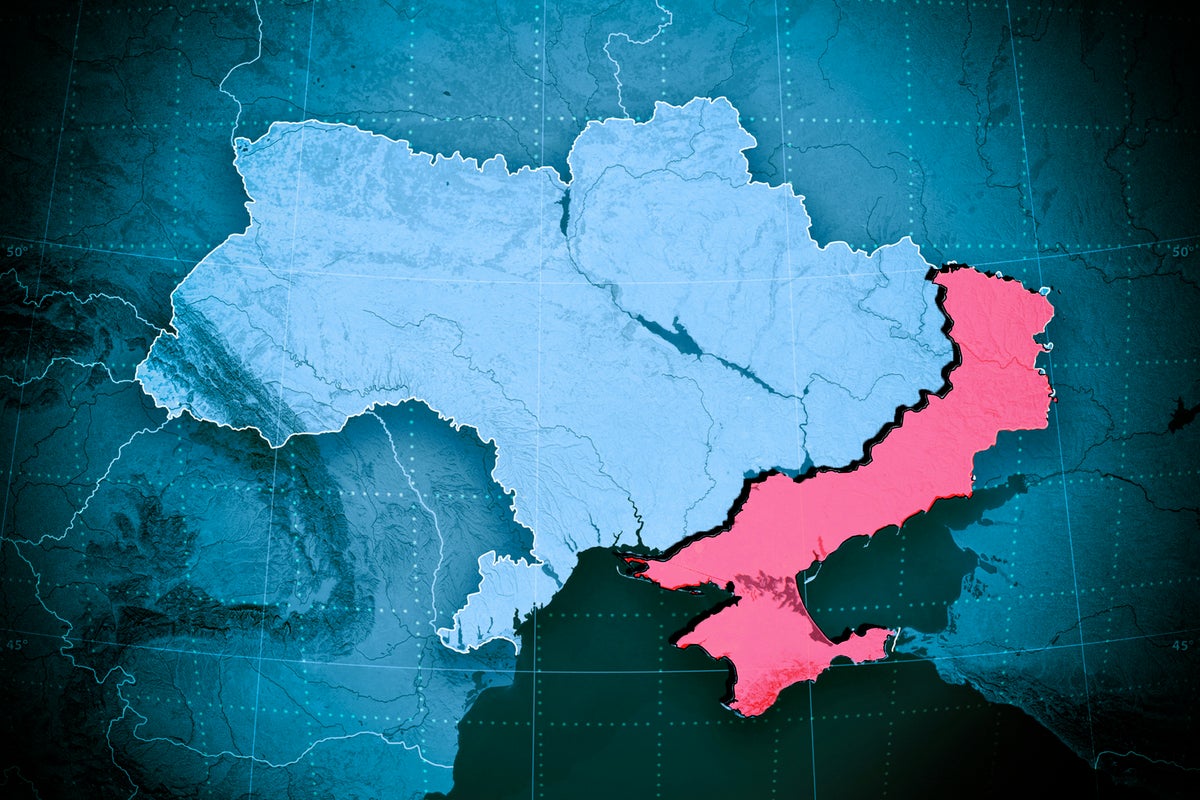
Ukraine frontline mapped: The land in dispute as US proposes Zelensky cede terrority for Nato membership
Full Article
Original Source
Read the full article at Independent →KhanList aggregates and links to publicly available news content. We do not host full articles from third-party sources. Always verify important information with original sources.