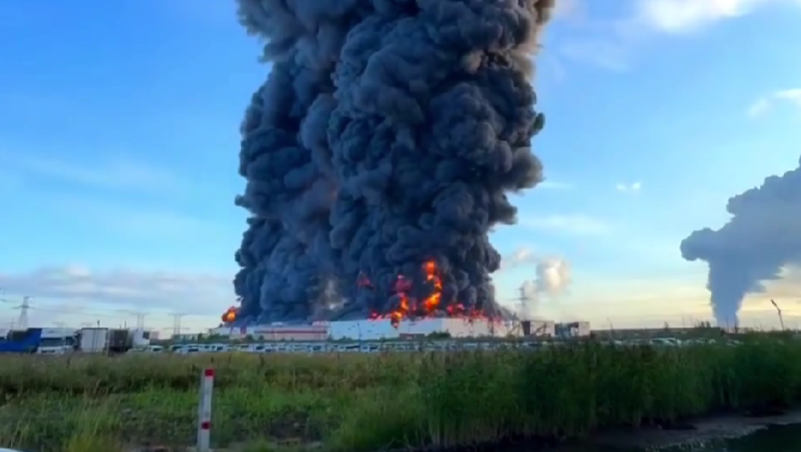
Every day, the Ukraine Battlefield update newsletter offers a clear look at how the war is unfolding on the ground. Subscribe for free here to get the full text delivered to your inbox. Ukrainians are continuing their campaign against Wildberries. How could it affect the Russian economy? The head of Ukrainian company Fire Point said it could threaten the Russian banking system. A Russian Kh-101 missile appears to have fallen on Polish territory, leaving a large crater in a field. Ukrainians lost another F-16 fighter jet, but the pilot survived. The number of Geran drones attacking Ukraine fell sharply in July. Chart of the day: Russians are pressing in Donbas, but this is not reflected in the speed of their advance. Videos of the day: A Russian throws a drone; a Ukrainian drone stopped at the last moment; Rubikon attacks on Ukrainian drones. Ukrainians are continuing attacks on the warehouses of Russian online retailer Wildberries. On Thursday morning, they struck two such facilities — in the city of Penza, around 600 km from the front line, and in the city of Sarapul, around 1,300 km from the front line. Two more Wildberries facilities can be moved to the list of damaged hubs, and they burn so much that there is a chance that we can move them to the total loss list.Penza is around 700 km (430 miles) from the Ukrainian border (under Ukrainian control) and Sarapul in Udmurtia is… pic.twitter.com/d3QIaqbTHv— (((Tendar))) (@Tendar) July 30, 2026 The footage shows fire and smoke rising from the struck warehouses. First good view on the burning Wildberries logistics hub in Penza, Russia. I’m pretty sure that no package will be dispatched from here any more. The area size of that facility is / was 90,000 square meters, around 1 million square feet. And there were plans to double the size. pic.twitter.com/0J73ldBqhJ— (((Tendar))) (@Tendar) July 30, 2026 Only two weeks ago, Ukrainians attacked the first two Wildberries warehouses in Russia. It is now clear that this was not an isolated incident, but the start of a campaign that could affect not only the Russian military but also the country’s economy. Officially, the main reason for the attacks — apart from the fact that Russians also attack Nova Poshta terminals in Ukraine — was that Wildberries sells military equipment, including vests, drones, fibre-optic cables and other drone components. The online retailer had a website category entitled “Everything for the SVO” (Special Military Operation), which, according to Foreign Policy, contained more than 200,000 items. Some volunteers bought equipment for soldiers through Wildberries, although independent Russian analysts said equipment was also sourced in other ways and that the military itself did not buy directly through Wildberries. The Kremlin claimed it was a civilian target. In any case, the company removed the “Everything for the SVO” section from its offering this week. However, disrupting the supply of drones and other equipment for soldiers may not be the only — or even the main — reason why Ukrainians are committing resources to this campaign. Attacks on Wildberries could also affect the Russian economy. So far, Ukrainians have attacked at least 12 warehouses, reducing the company’s storage capacity by approximately 10 percent overall. They have mainly struck its largest warehouses. The company has around 200 logistics facilities in total. Russians buy virtually everything through Wildberries. Around 50 percent of Russia’s online commerce currently passes through the platform. The company operates similarly to Amazon — as an intermediary connecting Russian sellers with customers. Around 200,000 Russian companies sell through it in total. It appears that Wildberries chief executive Tatiana Kim, who founded the company while on maternity leave in 2004 and is now Russia’s richest woman, knew about the planned attacks. At the beginning of July, the company changed its terms for sellers, classifying fires and explosions as force majeure events. The company therefore does not cover sellers’ losses caused by such incidents. The losses were thus passed on to the sellers themselves — small and large Russian businesses or sole traders. Financial analyst Andriy Shevchyshyn estimated to RBC Ukraine that sellers had lost goods worth between $1bn and $1.3bn [€1.1bn] during the attacks, while total damage amounted to around $2bn. No one is likely to compensate sellers for these losses in full. This could affect them severely, as the median annual income of Russian sellers on Wildberries is around $7,500, which is not much. “Experts nevertheless believe that a wave of bankruptcies among small and medium-sized businesses is still some way off,” RBC Ukraine wrote. In any case, if the attacks continue, they could also affect the Russian banking system. This spring, VTB Bank, the second-largest state-owned bank, bought a five-percent stake in WB Bank, a Wildberries subsidiary. They formed a strategic partnership, meaning that the company is now closer to the state than it was in the past. Now, according to Reuters, the Russian state is considering providing the company with financial assistance through VTB Bank. Sales through Wildberries and Ozon fell by around 11 percent over the past week. Denys Shtilerman, head of Ukrainian company FirePoint, whose drones attack Wildberries warehouses, also spoke about the bank. He said the attacks would affect the Russian banking system because Russian banks had financed Wildberries as well as Ozon, Russia’s second-largest online retailer. Although Ukrainian drones have not yet struck Ozon warehouses, the company’s publicly traded shares fell by around 10 percent (Wildberries is not publicly traded). “We must now finish off Wildberries and Ozon — this is absolutely essential. It would lead to the collapse of the banking system,” Shtilerman said this week. “VTB has bet everything on Wildberries. It expected to automatically acquire Wildberries’ entire customer base of around 50 million — 60 million, in my view — as its own clients. VTB was already in a precarious position, and now loans worth trillions of roubles will be irretrievably lost. That could cause the collapse of Russia’s second-largest bank,” Shtilerman said. It is questionable whether the situation is really this serious from the perspective of the Russian bank. However, experts agree that it represents further pressure on the Russian economy. The Russian state and Wildberries have already begun responding. Reports have emerged, for example, that the company is now looking for warehouse space in Kazakhstan, where it need not fear Ukrainian attacks. Russian independent website The Bell wrote that the only area in which attacks on Wildberries could effectively affect the wider Russian economy and society was through their psychological and political impact. “Oil refineries are remote and almost invisible to the ordinary consumer. Online marketplaces are part of the daily lives of tens of millions of Russians. An attack on Wildberries warehouses affects Russians’ sense of normality far more than reports of damage to another plant in a remote Volga region — even if its real economic impact is much, much smaller,” the website wrote. A Russian Kh-101 missile reportedly hit Poland. Russia launched another major attack on Ukraine overnight into Thursday. Its most notable feature is that, apparently for the first time, a Kh-101 cruise missile struck the territory of neighbouring Poland. In the past, only drones had entered the airspace of Poland or Romania. It happened near the village of Tarnawa-Kolonia, around 80 km from the border with Ukraine. A large crater was found in a field. Polish prime minister Donald Tusk said later that Polish airspace had been violated during the Russian attack on Ukraine and that a missile had fallen near the village of Tarnawa-Kolonia. There were no casualties or damage to property. “All the indications are that it was a Russian Kh-101 ballistic missile,” the Polish prime minister said. Tusk added that Ukrainian air forces were prepared to shoot down the missile if it had continued its flight. If confirmed, it would be the first case of a Russian cruise missile landing on the territory of a Nato Member State. Russia launched 61 Kh-101/Kalibr missiles at Ukraine overnight, of which 54 were shot down. Last night, Russia launched a massive combined strike against Ukraine. During the attack, Polish airspace was also violated, underlining once again that Russia’s aggression is a threat to the security of Europe as a whole.My thoughts are with the victims of these attacks. The…— António Costa (@eucopresident) July 30, 2026 Ukraine lost another F-16 fighter jet, the Ukrainian Air Force reported. It happened during a combat operation on Wednesday (29 July). “On one section of the front, the pilot was carrying out a combat mission to intercept enemy aerial targets. According to preliminary information, an emergency occurred aboard the aircraft and the pilot was forced to eject,” the air force wrote in a statement. It is unclear from the information released whether the fighter jet was shot down by Russia, or whether it crashed because of a technical malfunction or another cause. Ukrainians use F-16s to shoot down Russian drones and cruise missiles, but also to strike ground targets. The good news is that the pilot survived and was evacuated. According to some analysts, the loss of pilots could be even more painful for Ukraine than the loss of the fighter jets themselves. So far, Ukrainians have lost five F-16 aircraft. They have received around 50 in total, while Belgium has promised to deliver another 50 around 2030. On Tuesday (28 July), the United States confirmed that a Ukrainian F-16 had recently shot down a Russian aircraft. It was the first successful air-to-air engagement between two aircraft in this war. General Dan Caine, chairman of the Joint Chiefs of Staff, the nation's highest-ranking military officer, told the Senate on Tuesday (28 July) that a Russian aircraft had been shot down — an incident reported in the Ukraine Battlefield update two weeks ago. “We recently witnessed the first aerial kill, when a Ukrainian F-16 shot down a Russian fighter jet, so I believe their ability to expand their layered defence has advanced considerably over the past two years,” Caine said. He did not specify the type of Russian aircraft that was shot down, but Ukrainians had previously said it was an Su-35 and that the incident occurred on the eastern front. Russia launched another major air attack on Ukraine, deploying 284 drones, among other weapons. Earlier, French analyst Clément Molin published a chart showing the number of Russian Geran and similar drones launched at Ukraine in recent months. It appears that their number fell sharply in July. The overall total will be almost half that of the record month of May. It has been 22 days since an attack in which Russia deployed more than 300 drones. There were 10 attacks involving this number of drones or more in April and May, compared with only four in June and July. Why is this happening? There are various theories. One is that Russia is experiencing problems with drone production. Another claims that Russia is conserving and accumulating them for an autumn and winter campaign against Ukraine’s energy infrastructure. Another possibility is that it is focusing on a new Geran model — the jet-powered Geran-4 — which is more expensive and can therefore be produced in smaller numbers. In any case, recent months have shown that Ukrainians have learned to shoot down Gerans fairly effectively (more than 90 percent). They face greater difficulties with ballistic missiles, against which they do not have enough Patriot interceptors or other suitable air-defence systems. Number of Geran drones and their decoys shot down (blue) and not shot down (red): Ce mois, le nombre de frappes russes 🇷🇺 avec des drones Shahed/Geran a drastiquement diminuéLes causes sont multiples, je reviendrai bientôt dessus, mais c'est le signe d'un changement de stratégie :🔹Production plus faible du Geran-2, qui ne faisait que 60% des drones… pic.twitter.com/0SmnPKz5yv— Clément Molin (@clement_molin) July 28, 2026 Chart of the day In recent weeks and days, Ukrainians have reported mounting Russian pressure in Donbas. Russians are increasingly penetrating Kostiantynivka, which is entirely in the grey zone, and are now even attacking beyond the city. They are trying to break through towards Dobropillia. They are also making some progress east of Sloviansk and Kramatorsk. They are currently around 10 to 13 km from these cities. Nevertheless, in terms of the number of square kilometres captured, they are advancing slowly. This is shown, at least, by data from the DeepState UA account, which is conservative and updates its map only slowly. According to its data, Russians advanced by only 10 square kilometres last week as well, and the overall slow pace of their advance has not changed significantly since April. Of course, it is not only the extent of their advance that matters, but also where they advance. Here, the situation already looks worse, as they are approaching the last important cities in Donbas. Russian progress by week Amount of territory occupied by Russians per week. Data is in square kilometers. Source: Oko Hora/Datawrapper. Videos of the day This is what drone warfare can look like. A Russian soldier was defending himself against an attacking Ukrainian FPV drone. At the last moment, apparently no longer knowing what to do, he threw the Maciv drone he was holding in his hand at it. He hit it and, very likely, saved his life. Russians stopped an attacking drone targeting a Wildberries warehouse in St Petersburg at the last moment. 🇺🇦🔥🇷🇺Materiał filmowy przedstawiający zestrzelenie ukraińskiego drona, który zaatakował magazyn rosyjskiego koncernu Wildberries w Sankt Petersburgu. pic.twitter.com/I1EcagxpnC— WarNewsPL (@WarNewsPL1) July 28, 2026 A collection of videos showing Russia’s Rubikon drone centre attacking Ukrainian medium- and long-range drones. As Ukrainian drone operator Dimko Zhluktenko wrote, the fact that Rubikon has to shoot down drones heading towards Russia is good news. Its operators are then absent from the front line in Ukraine. Many people miss what this admits. russia's elite drone unit Rubicon now spends more of its time intercepting Ukrainian FP-2 drones far from the front.That's the point of deep strikes: force the enemy's best operators to defend the rear from our strategic strikes. pic.twitter.com/eS7PsQjbEJ— Dimko Zhluktenko 🇺🇦⚔️ (@dim0kq) July 29, 2026 What are the losses No update on Thursday morning. By Monday morning, Russia had verifiably lost 23,916 pieces of heavy equipment (23,888 on Friday). Of these, 18,902 (18,866) were destroyed by Ukrainians, 991 (993) were damaged, 1,193 (1,199) were abandoned by their crews, and 2,830 (2,830) were captured by the Ukrainian army. This includes 4,430 (4,430) tanks, of which 3,336 (3,332) were destroyed in combat. Ukraine lost 11,826 (11,781) pieces of equipment, of which 9,251 (9,205) were destroyed, 695 (694) were damaged, 687 (689) were abandoned, and 1,193 (1,193) were captured. This includes 1,447 (1,450) tanks, of which 1,108 (1,111) were destroyed in combat. Note: Neither side regularly reports its own deaths or equipment losses. Ukraine publishes daily figures for Russian casualties and destroyed equipment, but these cannot be independently verified. This overview uses data from the Oryx project, which has compiled a list of equipment losses documented exclusively by photographs since the beginning of the war.
Ukraine escalates Wildberries attacks to hit Russia’s second-biggest bank as missile crashes in Poland (Ukraine Battlefield update, Day 1,618)
Full Article
Original Source
Read the full article at Euobserver →KhanList aggregates and links to publicly available news content. We do not host full articles from third-party sources. Always verify important information with original sources.