
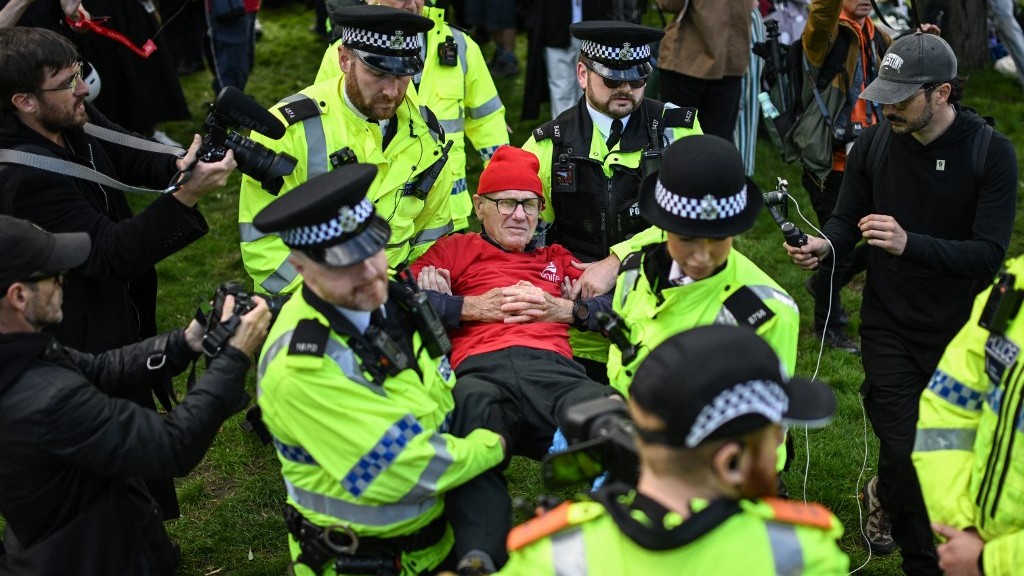
Co-founder of Palestine Action will appeal ban on the direct-action group after court ruled in favour of Home Office Police officers arrest a protester during a demonstration in support of the proscribed group Palestine Action outside the conference venue on the first day of the annual Labour Party conference in Liverpool, north-west England, 27 September 2026 (AFP) Published date: 3 November 2026 15:08 GMT | Last update: 5 sec ago The British government will defend its decision to ban Palestine Action at the UK Supreme Court, in a landmark case that continues to test the boundaries of British counterterror legislation, freedom of speech and the right to protest. The appeal, which begins on Wednesday and is expected to last two days, comes amid mounting civil unrest and police crackdowns across Britain in relation to the ban on Palestine Action. A portion of the proceedings will be heard in secret because of the national security nature of the evidence. Over the weekend, police arrested hundreds of demonstrators outside the US Embassy in London and Edinburgh for holding placards that read “I oppose genocide, I support Palestine Action.” Since the government banned Palestine Action in 2025, the six-word statement has become a rallying cry and led to 4,000 people facing arrest under Britain’s Terrorism Act, including human rights lawyers, elderly activists and holocaust survivors. New MEE newsletter: Jerusalem Dispatch Sign up to get the latest insights and analysis on Israel-Palestine, alongside Turkey Unpacked and other MEE newsletters The ban has also raised questions about whether it breaches the right to free speech, following Irish novelist Sally Rooney's books being withdrawn from sale in the UK after she expressed support for the direct-action group. After the ban, Palestine Action co-founder Huda Ammori launched a legal appeal that has moved through England’s highest courts and led to legal ping-pong: July 2025: The British government banned Palestine Action under UK terrorism laws, criminalising membership and public support for the group. February 2026: The UK High Court delivered a landmark victory to campaigners, ruling that the government’s proscription was unlawful and represented a disproportionate interference with human rights. June 2026: The Court of Appeal overturns the High Court decision, restoring the terrorism designation. August 2026: The Supreme Court justices grant Palestine Action co-founder Huda Ammori permission to launch a final appeal. Lawyers representing Ammori will argue over the next two days that using counterterrorism laws to designate a direct action group targeting arms suppliers sets a dangerous precedent which criminalises political dissent. In written submissions to the Supreme Court, Ammori’s legal team noted that the Home Office assessed that less than one percent of Palestine Action’s “direct action protest activities over five years fell within a definition of terrorism”. Raza Husain KC, for Ammori, said that only three out of 385 actions carried out by Palestine Action over a five-year period were assessed as meeting the definition of terrorism under part of the Terrorism Act. 'Total destruction' Husain added the ban has led to “the total destruction of a protest group which enjoyed widespread support from across civil society”. Human rights groups and international observers, including UN Special Rapporteurs, also submitted written statements, which warned the ban sets off a chilling effect across civil society. Hundreds to risk arrest at 'mass actions' targeting US embassies over Palestine Action ban Read More » The British government, meanwhile, will continue to defend its position, and remind the Supreme Court that the Court of Appeal rejected Ammori’s attempt to portray Palestine Action as a “non-violent direct action protest group”. In written statements to the Supreme Court, James Eadie KC, the government's standing counsel, notes: “The principles applied by the Court of Appeal in allowing the Secretary of State’s appeal were long-standing, settled, and orthodox. “The Court of Appeal made no error of law. Their conclusions of fact were plainly justified on the evidence before them.” Jewish groups, including the Community Security Trust and Jewish Leadership Council, also submitted evidence to the court, in support of the ban, claiming the proscription protects Britain’s Jewish community. Earlier this year, UK Foreign Secretary Ed Miliband, said the proscription of Palestine Action had inadvertently led to "grannies and vicars" being arrested for terror offences. "I don't think anyone's intent was to have those people criminalised," Miliband told LBC News. “But obviously the Supreme Court has got to look at this issue and obviously it’s something we keep looking at as government.” Middle East Eye delivers independent and unrivalled coverage and analysis of the Middle East, North Africa and beyond. To learn more about republishing this content and the associated fees, please fill out this form. More about MEE can be found here.
UK Supreme Court to hear landmark appeal over Palestine Action ban
Full Article
Original Source
Read the full article at Middleeasteye →KhanList aggregates and links to publicly available news content. We do not host full articles from third-party sources. Always verify important information with original sources.