
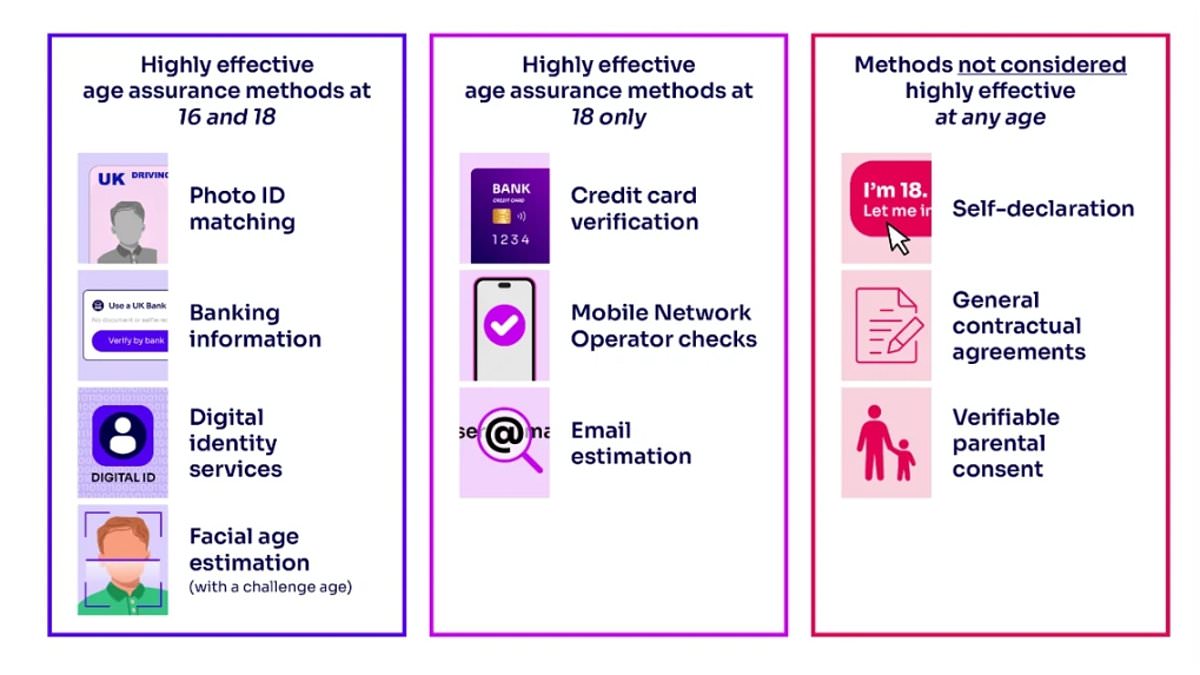
Ofcom has revealed the four ways teenagers will be able to prove they're over-16 when the social media ban comes into force next year.The regulator said photo ID, digital IDs, banking checks and facial age estimation are the only methods currently considered 'highly effective' at verifying a user's age.The guidance comes after ministers unveiled plans in June to ban under-16s from social media, with robust age checks seen as crucial to enforcing the restrictions.While Ofcom acknowledged that some determined youngsters will attempt to circumvent the rules, it said platforms should be able to significantly reduce under-age access by using a combination of age verification measures.Dame Melanie Dawes, Ofcom's chief executive, said: 'This ban will shape the future of children's lives online, so it's important to get it right.'We should expect that motivated children will seek to bypass the restrictions – just like alcohol laws can't completely eradicate underage drinking – but there'll be ways for platforms to mitigate this risk.'This will be a huge cultural shift for our society, so it'll take time to adjust, and everyone will have a part to play.' The regulator said photo ID, digital IDs, banking checks and facial age estimation are the only methods currently considered 'highly effective' at verifying a user's ageOfcom explained that photo ID matching would involve users uploading a passport, driving licence or another approved identity document.The details and photograph on the document would then be compared with a live image captured during the age-checking process.Banking-based checks would allow users to verify their age using information already held by their bank or financial institution, with their consent.People are typically required to provide proof of age when opening a bank account, meaning these records could subsequently be used for age verification purposes.Another option is the use of digital ID services, which allow people to prove information about themselves electronically, including their age.Similar systems are already used by millions of Britons to prove their right to work, rent a home and access services online without needing to show physical documents. The fourth method is facial age estimation technology, which uses artificial intelligence to estimate a person's age from a photograph or live video image.While the technology has improved significantly, Ofcom warned that some systems can still be inaccurate by several years – meaning that in cases where there is uncertainty, users may be asked to complete a second verification check. The guidance comes after ministers unveiled plans in June to ban under-16s from social media, with robust age checks seen as crucial to enforcing the restrictions (stock image)Ofcom also stressed that age checks can be carried out in a way that complies with data protection laws, despite concerns from privacy campaigners about the collection of personal information.The government is expected to publish detailed regulations setting out how the ban will operate before the end of this year.After this, Ofcom will consult on guidance for technology companies and begin monitoring compliance when the restrictions take effect in 2027.The age-check proposals form part of a wider Government crackdown on children's use of social media.Earlier this year, ministers revealed that while under-16s will be barred from platforms entirely, 16 and 17-year-olds will face overnight restrictions.From midnight to 6am every night, their access to popular social media will be switched off.Features that are designed to keep teens scrolling for longer will also be switched off by default for older teenagers.This includes videos that automatically play one after another and feeds that continually serve up personalised content.'Our consultation provided a clear message from parents and teenagers alike – even as young people gain greater independence at 16, they should still be protected from the most addictive online features that can have a harmful impact on their wellbeing,' said Technology Secretary Liz Kendall.'These measures will be crucial in helping young people get the sleep they need, focus on school and college, and spend more quality time with family and friends, all of which are fundamental to building a happy, healthy and fulfilling adult life.'We want young people to enjoy the benefits of technology while having the tools to make the online world a place where they can thrive.'
UK social media ban plans revealed: Ofcom outlines the four ways teens will be able to prove they're over-16 when new rules come into force next year
Full Article
Original Source
Read the full article at Dailymail →KhanList aggregates and links to publicly available news content. We do not host full articles from third-party sources. Always verify important information with original sources.