
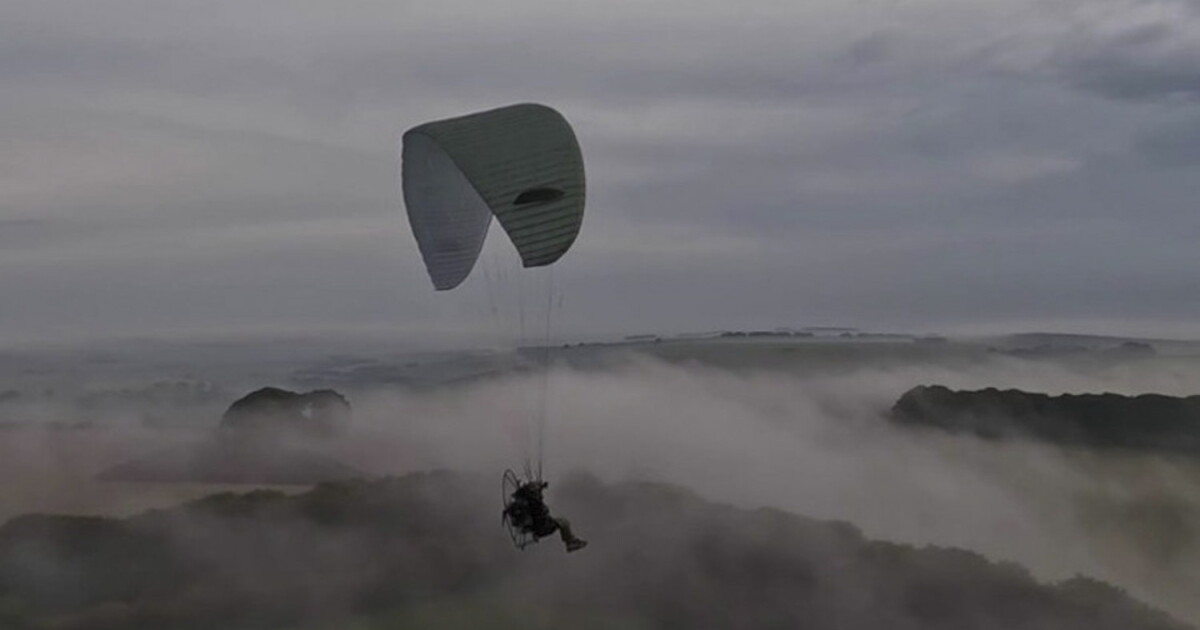
The British Ministry of Defence is looking into a novel way to drop troops behind enemy lines, with a £6-million (US$8.1-million) study to evaluate the use of foot-launched powered paragliders as transports for reconnaissance and troop insertion.Getting soldiers from Point A to Point B has been a perennial problem ever since Odysseus had to figure out how to get a squad of Greeks from one side of the walls of Troy to the other. Since the Second World War (wooden horses having fallen out of fashion), one discreet way of getting troops behind enemy lines has been by parachute. In the old days, that meant men jumping out of Dakotas and hoping they wouldn't scatter too far when they reached the ground. Today, military forces use ram-air paragliders, which consist of canopies made of flexible, ram-air wings with an upper and lower shell connected by internal fabric ribs to form hollow cells. Air enters through openings in the leading edge of the canopy as the pilot moves forward, inflating the wing and generating lift as air flows over its aerofoil shape.The upshot of all this aerodynamic engineering is that paratroopers can steer themselves with great accuracy and remain in the air for a surprisingly long time. This allows for acrobatic displays by air teams who look like they've gone completely daft and for special forces to land quietly in a secluded location. A paraglider showing off at the Farnborough Airshow complete with Union JackDavid Szondy/New Atlas The main drawback of all this is that paratroopers must still be dropped from an aircraft, which is often visible enough to spoil the whole stealth thing. And that's assuming there's a convenient airfield available for said aircraft to operate from.If the geography is right, a paraglider pilot can take off from the ground, though that means having a convenient mountain with a windy top near a flood plain for landing. It works and it's a pretty impressive sight, as I speak from experience: a load of enthusiasts use a mountain near where I live as a launch pad, with a field out in the plain below that sees so much traffic they've installed a windsock to help with landing. It's also a good place to park with a pair of binoculars and watch the show. And get glared at by suspicious paragliders.It also shows that you can get rid of the drop plane if you have a convenient peak, or the technological equivalent. Eight minutes to build, powered flight up to 200 miles, no runway required. This partnership between British start-up Blakcro, UK Defence Innovation, and the MOD is an example of how backing agile, homegrown innovators can deliver cutting-edge capability and sustainable growth. pic.twitter.com/vYgZpREWX2— Ministry of Defence 🇬🇧 (@DefenceHQ) August 28, 2026 What the MoD is looking at is an upgrade on the paraglider by Blakcro, a Wiltshire-based start-up, that adds a powered fan in a titanium frame to the back of the pilot. The canopy and the fan assembly can be folded up and stored in a large rucksack for transportation, which can be unpacked and reassembled in eight minutes.Once donned, the pilot can inflate the lightweight wing by turning into the wind with the fan running on idle or standing by, depending on whether it's electric or internal combustion-powered, and then launch on foot with a short run. Once airborne, the fan is throttled up to provide forward thrust, generating airspeed over the wing to gain altitude. The pilot can then adjust speed and make turns by pulling steering brake lines to deform the trailing edge or shifting weight in the harness.It's not a new idea. In fact, James Bond did battle with a squad of baddies using the snow ski version in the thriller The World Is Not Enough, and the US military has been experimenting with the concept. And it's been reported to have been used by irregular forces in the Middle East.According to the MoD, the paragliders have a range of 200 miles (322 km) and have very low acoustic, visual, and radar signatures. Tests will include trials with the Royal Marines and the Parachute Regiment later this year.Source: Ministry of Defence
UK military tests powered paragliders for covert troop insertion
Full Article
Original Source
Read the full article at Newatlas →KhanList aggregates and links to publicly available news content. We do not host full articles from third-party sources. Always verify important information with original sources.