
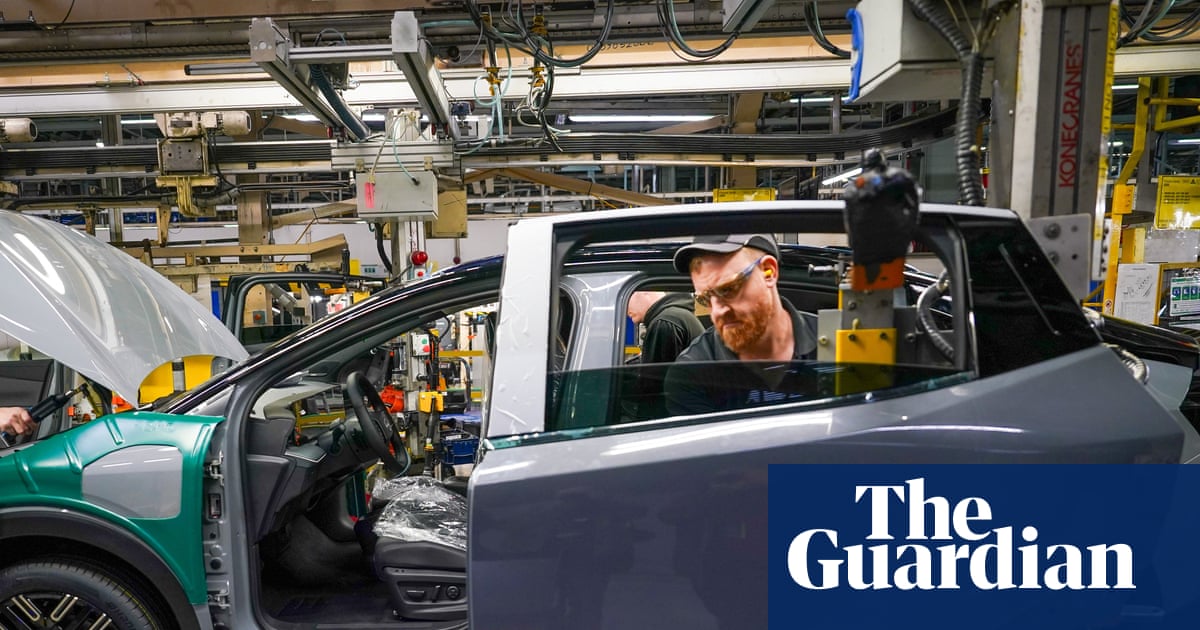
The UK car industry is preparing to push for a two-year delay to Brexit tariffs on electric cars traded with the EU, after an initial European proposal suggested a shorter delay.Tariffs are due to kick in on 1 January for the majority of electric cars traded between the EU and UK unless the two sides can come to an agreement to delay for a second time the implementation of “rules of origin” on batteries.The Brexit deal, rushed through on Christmas Eve in 2020, included a clause that British and European electric cars would have to use batteries made in either the UK or the EU with local materials, or face 10% tariffs. The rules would not have existed had the UK remained in the EU.The rules were initially due to come into force on 1 January 2024, encouraging the industry to invest in local lithium-ion battery manufacturing rather than relying on the dominant Chinese battery industry. In 2020 the prospects seemed rosy, but three years later several prominent projects on both sides of the Channel had collapsed. The EU and UK agreed to extend the deadline in December 2023.Other battery projects have since taken their place, but many are yet to produce at the scale required to meet European demand. Instead, carmakers are mainly reliant on imports from China, Japan and South Korea.Workers at an AESC battery manufacturing plant in Sunderland. Photograph: Richard Saker/The GuardianCarmakers in the UK and Europe are united in their calls for the introduction of the rules of origin to be delayed again. However, an agreement has yet to be reached, with the EU and UK also wrangling over whether Britain can be included in “Made in Europe” subsidies, and whether the UK should match EU tariffs on Chinese car imports. The topics are likely to form part of an EU-UK summit planned for next week.The European Commission has shared proposals with the automotive industry to delay the start of the tariffs, although they have not yet been shared formally with the UK government. The proposals are understood to be highly technical, but essentially equate to delaying the start of the rules of origin by a year.Some of the proposals are understood to include adjusting customs procedures and origin calculation methodologies, which could offer some temporary tariff flexibility.skip past newsletter promotionafter newsletter promotionHowever, some parts of the UK car industry believe more time is needed for the sector to adapt and for battery gigafactories to churn out enough units.One executive in the UK said: “The industry will be really clear – two years minimum or we have the same discussion next year. Giga-industrialisation is happening in the EU and UK but it is not producing at the required volume yet.”Another person said the negotiations would also focus on the technical details of the proposals, rather than simply aiming for a set time delay.The European Automobile Manufacturers Association, an influential lobby group in Brussels, has argued that the tariffs are a serious concern for Europe’s automotive industry. It estimated that 82% of EU electric car and van exports to the UK would face the 10% customs duty in 2027 under the rules, adding costs of €1.47bn (£1.23bn) next year alone.
UK car industry to press EU for two-year delay to Brexit EV tariffs
Full Article
Original Source
Read the full article at Theguardian →KhanList aggregates and links to publicly available news content. We do not host full articles from third-party sources. Always verify important information with original sources.