
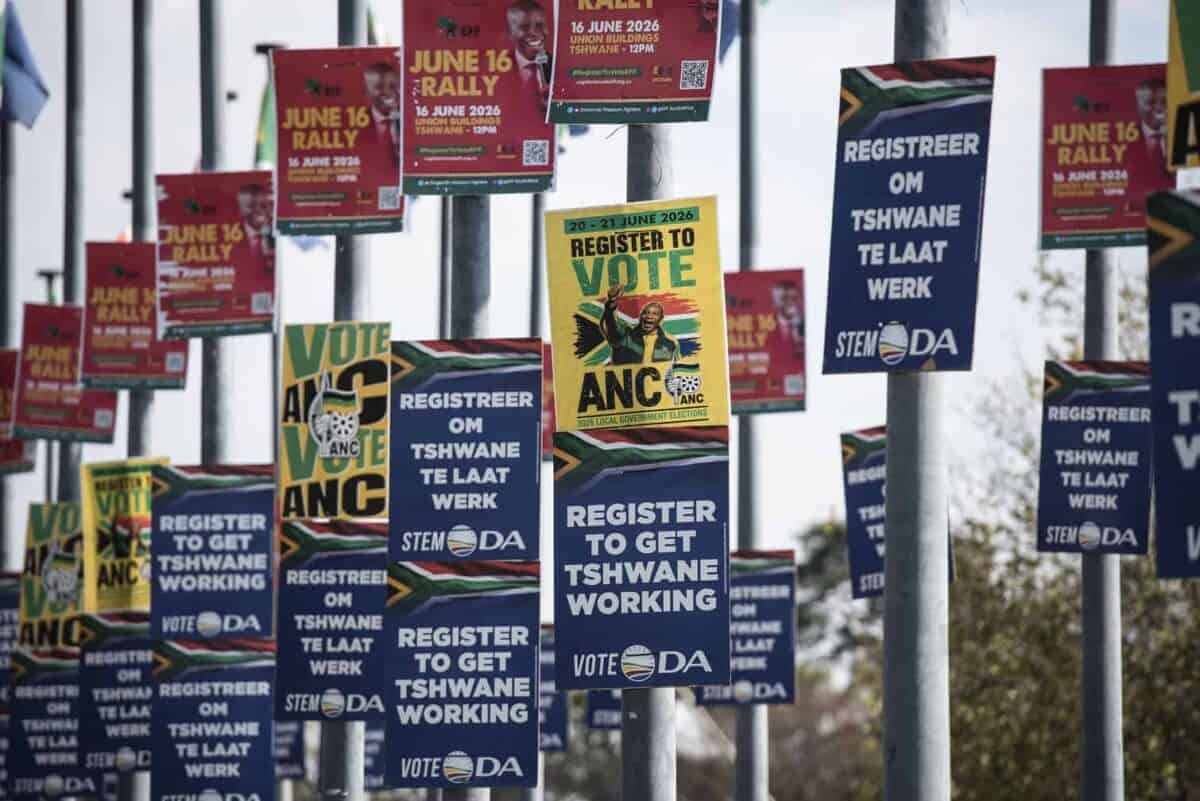
The revived civic movement says political parties should not have sole control over decisions that determine municipal governing arrangements. Post-election coalition negotiations undermine voters’ constitutional right to choose their governments directly, says the revived United Democratic Front (UDF). It has called for amendments to the Electoral Act and a national referendum on coalition governments. UDF challenges behind-the-scenes coalition negotiations The civic movement, which insists it is not affiliated to the ANC or any political party, says coalition agreements reached behind closed doors allow political parties to determine governing arrangements that were not explicitly endorsed by voters at the ballot box. It wants an overhaul of the whole coalition process in the Act. The call comes as political parties continue negotiations in hung municipalities across the country, including seven of the eight metropolitan municipalities, where no single party has secured an outright majority. The election outcomes have necessitated the formation of coalition governments through agreements among multiple parties. UDF interim national convener Jo Mboweni said the organisation believes coalition arrangements infringe on voters’ rights by transferring crucial decisions about governance from the electorate to party negotiators. “The UDF is of the opinion that voters’ rights under Sections 1 and 19 of the constitution, read together with the Bill of Rights, are infringed whenever political party leaders meet in corridors to decide which coalition will govern,” Mboweni said. “Corridor coalitions undermine the will of the people and bypass voter accountability.” Constitutional concerns over coalition deals According to Mboweni, the coalition negotiation process and its outcomes are inconsistent with the spirit of Sections 1, 2 and 19 of the Constitution when read together with Chapter 2 of the Bill of Rights. Section 1 describes South Africa as a sovereign democratic state based on human dignity, equality, human rights, non-racialism, non-sexism, constitutional supremacy and multiparty democracy. Section 2 deals with the constitutional supremacy while Section 19 guarantees political rights to all SA citizens. On election day, 4 November, the UDF wrote to President Cyril Ramaphosa, while also submitting copies of its concerns to the Electoral Commission of South Africa (IEC), the departments of cooperative governance and traditional affairs and justice and constitutional development, the speaker of the National Assembly, parliamentary party whips and various Chapter 9 and Chapter 10 institutions. UDF considers million-signature petition The UDF is seeking a referendum to test public opinion on whether coalition governments dilute voters’ democratic choices. The movement’s national spokesperson, Juliet Dingiswayo-Diratsagae, said the organisation would launch a petition campaign targeting one million signatures by March next year if its demands are not addressed by the end of January. Originally established on 20 August 1983 in Mitchells Plain, Cape Town, the UDF became one of the most influential anti-apartheid formations, mobilising communities against the tricameral parliament and broader apartheid policies. It was revived in August 1991 but again during its 40th anniversary commemorations in August 2023 by ANC/UDF veterans and longtime UDF activists who seek to re-establish it as a progressive civic movement focused on community issues. The UDF says it is not a political party but an independent civic body willing to engage with civil society organisations, trade unions, business, various associations and political parties on matters affecting communities and development. Joburg coalition arrangements fuel debate The UDF’s criticisms reflect concerns raised by some political analysts about coalition politics in municipalities where election outcomes have produced fragmented councils. Critics argue that coalition agreements can produce governing arrangements that differ from voters’ expectations. Joburg has emerged as a prominent example. While the DA finished as the largest party, followed by ActionSA and then the ANC, ActionSA entered into agreements with the ANC to form a government in Joburg, Tshwane and Ekurhuleni, effectively sidelining the DA despite its leading vote. Analysts have argued that such arrangements carry political risks, particularly for ActionSA, whose supporters may have opposed cooperation with the ANC. They also point to long-standing tensions between ActionSA leader Herman Mashaba and DA Joburg mayoral candidate Helen Zille as complicating coalition prospects.
UDF calls for overhaul of Electoral Act over coalition politics
Full Article
Original Source
Read the full article at Citizen →KhanList aggregates and links to publicly available news content. We do not host full articles from third-party sources. Always verify important information with original sources.