
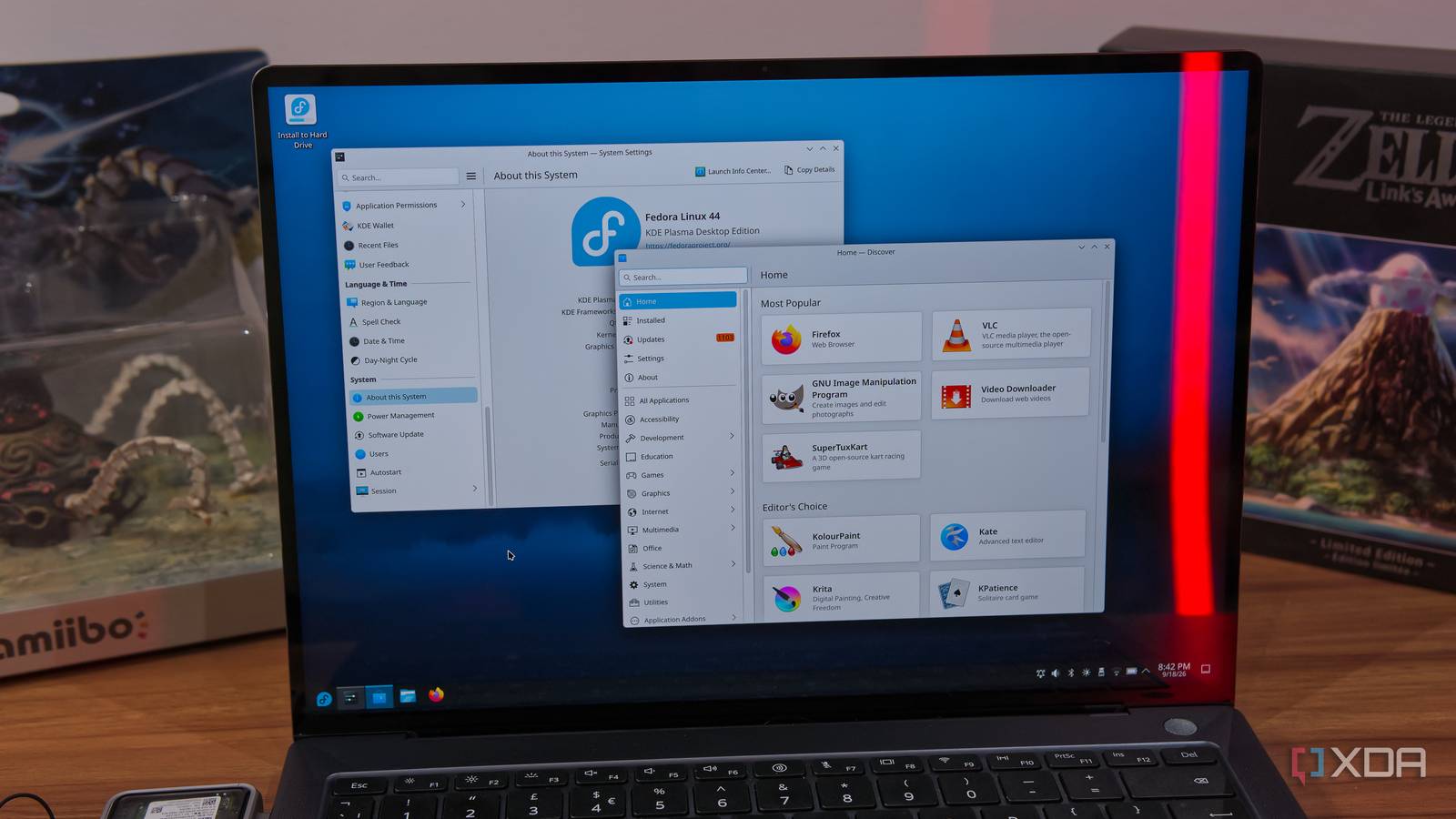
Published Sep 19, 2026, 1:30 PM EDT João has been covering the tech world for over 7 years, with a heavy focus on laptops and the Windows ecosystem. I also love all things tech and videogames, especially Nintendo, which he's always happy to talk about. Prior to joining XDA in 2021, he worked at Neowin: https://www.neowin.net/news/poster/jo%C3%A3o-carrasqueira/ Whenever you think of Linux, you probably think of Ubuntu. It's the most popular Linux distribution out there, and there are good reasons for that, seeing as it's been around for a long time, it has the backing of a major organization, and it features a relatively easy-to-use setup. But Ubuntu has also been making some frustrating decisions. The choice to continue favoring snap packages, the GNOME desktop, and even the general push towards embracing AI have pushed me towards the competition, and I've found that Fedora is a perfect replacement. My grumbles with Ubuntu I got tired of GNOME and Snaps Ubuntu's GNOME desktop may be part of its appeal, but to me, it also gets old quickly. Sure, it may be simplistic enough for most people to understand, but too much of it just doesn't operate how I would expect or want. I don't like that the default app launcher takes up the full screen, and that even just using the system search does the same. And while GNOME can be heavily customized with extensions, those extensions are also prone to causing issues whenever GNOME is updated, so I'm not particularly fond of them. I also don't like that Canonical, Ubuntu's developer, insists on pushing its own Snap packaging format onto users rather than adopting the more widely-supported Flatpak. It's a bit of a tired discussion at this point, but if Linux is going to ever become a mainstream platform, there needs to be a more predictable set of expectations, and Flatpak has clearly established itself as the preferred cross-platform packaging system in most distros. All the while, Ubuntu keeps leaving it out in favor of Snap, which is not only bad for Ubuntu, but Linux as a whole, considering Ubuntu represents a large portion of the ecosystem. Ubuntu has also been raising its system requirements more and more as time goes on, and the latest release requires 6GB of RAM, which is even more than Windows 11's official minimum requirements. On the topic of AI, while I'm aware that the Linux kernel itself is also relying on AI for its development, I'm always skeptical of products veering in this direction, and Ubuntu didn't need to do it. I would rather support projects that either use it less or not at all. No single one of these things is a huge problem, but they stack up to the point where I want an alternative. Fedora was my port of call KDE is so much better With Ubuntu out of the equation, the first name that came to mind would be Fedora, and it quickly became apparent that it was much more suited to me. Fedora actually comes with the same GNOME desktop in its more "standard" distribution, but there's an official spin of Fedora that ships with KDE Plasma as the desktop, and that's a huge upgrade right off the bat. KDE Plasma looks a lot more similar to Windows, which I used for a long time before switching to Linux, but it's also far more powerful and customizable. There are a few simple themes available out of the box, but the official theming marketplace is packed with more interesting designs I can easily apply to my desktop, changing icons, colors, transparency, and more. And there's a huge degree of fine-tuning I can do to get the look just right, taking icons from one theme and colors from another, for example. But that's not all, because KDE Plasma is also full of advanced and helpful features that I wouldn't even have thought of. One thing I love is that it offers much better tiled window management, very reminiscent of PowerToys FancyZones for Windows PCs. It gives me way more control over how I organize my windows. Then there's little things like being able to hide specific windows from a screenshot or screen recording without having to minimize them. Or creating an entire virtual display where I can put certain windows specifically for the purpose of streaming or recording that virtual display. More features keep being added, including a quick accent menu (somewhat akin to macOS), or improved multi-display handling that no other desktop is offering. Flatpak is here, too Plus faster software updates Another benefit of Fedora is that, naturally, it ships with Flatpak instead of Snap for its cross-distro app platform. Using the Discover store, it's easy to find a wider variety of Flatpak software, including things like OBS Studio for streaming, which doesn't have an official Snap package. On top of that, Fedora is well-known for its fast update cadence compared to Ubuntu. It's not a rolling release distro like Arch, but the Fedora team tends to test and publish updated packages much faster than Ubuntu, so I get the latest features more quickly. The downside to Fedora's package management is that it doesn't ship with proprietary third-party repositories enabled by default, so if you want to install apps that aren't open-source, you need to configure those repositories for both Flatpak and the more native DNF package manager. It's a hurdle I wish I didn't have to go through, but you only need to do it once, so it's not as big of a deal. I'm not putting all my chips in Fedora I still have some concerns While Fedora is a big step up from Ubuntu in my experience, it's not like I'm completely safe from all the things I called out in Ubuntu. For one thing, the Linux kernel is still developed using AI, but perhaps more importantly, Fedora hasn't exactly been opposed to AI, either. In fact, the team was thinking about an AI Desktop initiative, which was only brought to a halt by intense community backlash. And while I'm happy that Fedora team responded by putting its AI plans on ice, it's still open to future proposals around AI, and I'll have to see what those look like to know whether it's the right approach or not. Fedora is the best mainstream distro Despite those reservations, for the time being, Fedora is probably one of the easier distros to recommend. It's fast, it has strong support from its developers, gets frequent updates, and it has what's arguably the best Linux desktop for most people. For most newcomers to Linux, this would be my first recommendation. Fedora KDE Plasma Desktop
Ubuntu's snap obsession and GNOME pushed me to Fedora, and I'm not going back
Full Article
Original Source
Read the full article at Xda-developers →KhanList aggregates and links to publicly available news content. We do not host full articles from third-party sources. Always verify important information with original sources.