
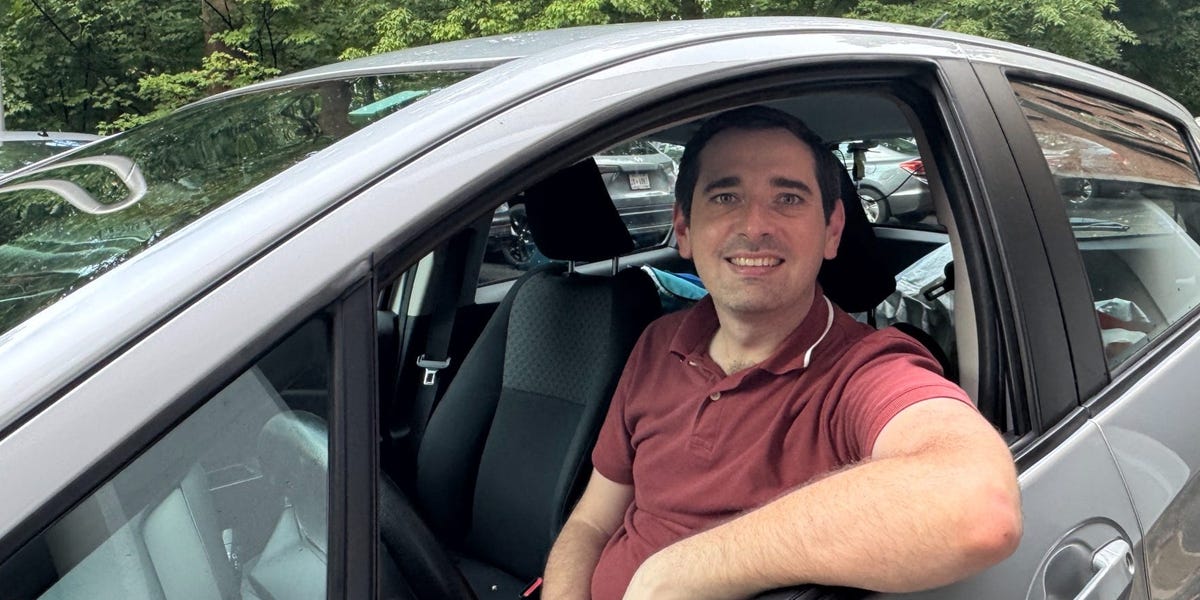
I bought a used car. It was much more expensive than using Uber or Lyft. Alex Bitter/BI No one had ever been this excited about a used Toyota Yaris.That was my thought as my wife and I picked up the keys to the car we found on Facebook Marketplace one morning in August 2025. For the first time in seven years of living in the Washington, DC area, we were car owners.It was also a rebuke of sorts for one of the companies I write about most often. For years, Uber executives have said that the company's gig-worker drivers — and, increasingly, the self-driving cars on its app — compete with car ownership.Uber President Andrew MacDonald told a podcast last month that the rising cost of a new car makes owning one a worse deal than several years ago. And CEO Dara Khosrowshahi said last year that the rise of robotaxis will reduce car ownership over the next two decades, making driving a car yourself look "something like horseback riding."So, did I make a horrible mistake spending just over $6,000 on a used sub-compact car that's effectively the next draft horse?Last month, one year after buying my Yaris, I decided to add up all my expenses and compare them with the previous year, when I was car-free and relied on Uber, Lyft, and public transportation.Your milage my vary. Your own calculation will depend on where you live, the cost of your car, how fast it depreciates, and the current price of gas (or charging, if you drive an EV).My results showed that Uber might have a point.The costs of a Toyota Yaris add upMy wife and I decided we wanted a car last summer when we realized that parking at our apartment complex was free. Owning a car never made sense to us in Washington. DC is one of about a dozen US cities with a rapid transit system, and a parking spot can cost up to $300 a month. Plus, wait times for rides on Uber and Lyft are rarely more than a few minutes.Parking is just one of the costs of owning a car these days. The average sticker price of a new car is above $50,000, according to Kelly Blue Book, a Cox Automotive brand that tracks car prices. Used cars, while more affordable, have become more expensive, too. There's also maintenance, insurance, and, for many of us, the elevated price of gas.When my wife and I found our used Toyota Yaris L — that's "L" meaning the lowest-trim model — we thought that we were being as thrifty as possible. We could buy the car without a loan. And my research suggested that, even when it needed repairs, they wouldn't be that expensive on a small, simple vehicle. If any car had a chance of rivaling the cost of Uber, this was it.But it didn't.After buying the car for $6,000, one year of car ownership cost us another $5,000.That's more than three times as much as the $1,600 we spent on ride-hailing trips and rental cars in the year before we bought the car.Some of the expenses were optional, like $250 to have my transmission fluid drained and replaced as a preventative maintenance measure. But most of those costs were the basics: Oil changes, gas, registration fees, insurance, and tolls.I also didn't quit using Uber or Lyft. I took rides to plenty of weekend bar hangs with friends, either because parking was a hassle or because I wanted to drink.Suddenly, free parking started to lose its shine. Our little sub-compact was more expensive than I had expected.Maybe, though, there's more to it.'Ready to be driven at a moment's notice'I'm merely the latest person to compare whether owning a car makes sense in the era of ride-hailing apps. Even Sam Altman made the comparison in a blog post back in 2014.His conclusion: Using Uber was cheaper than driving his Tesla Roadster — at least, back when the millennial life subsidy made fares on the app cheaper than they are today.Doing a strict cost comparison isn't how most of us think about car ownership, though, according to David Keith, associate professor of strategy at the Melbourne Business School in Australia.Keith is one of the authors of a 2021 study that asked drivers from major US cities how much they would need to be paid annually to give up their car.The exact number — $11,197 on average — wasn't as interesting as why people said that they valued owning a car. More than half of that amount, Keith and colleagues found, was "non-use value," which includes having the option to take a car whenever you want, and a perceived status boost from owning a car.In other words, drivers are okay if their car sits unused most of the time. "I can walk outside, and there's this box of metal sitting there on the street, ready to be driven at a moment's notice," he said.I knew exactly what he meant.For weeks after buying my car, I had to change how I thought about transportation. Questions like "How much are Uber rides?" and "Is my destination accessible by Metro?" were replaced by a single statement: "Just drive there now, stupid!"There were also places I would never have visited without a car: For example, Fredericksburg, Virginia, for a day of antiquing, or rural Maryland to search the site of a Civil War camp with my metal detector. Being able to hop in a car whenever you want feels great. Those are trips that would have been difficult or impossible with Uber, and they're the main reason that my wife and I plan to keep our car, extra costs and all.Recreating that freedom with modes of transportation that you don't own is an important aspect of reducing car ownership in the US, Keith told me.Some places have tried it. A company called MaaS Global — that's "Mobility as a service" — operated an app called Whim, which offered taxi rides, bike shares, and public transit as a bundle for a monthly subscription. Whim operated in several European cities, including Helsinki and Vienna, before MaaS Global filed for bankruptcy in 2024 and ceased operations.Meanwhile, in the US, car ownership has stayed steady over the last couple of decades, even as alternatives from Uber and Lyft to local bike-sharing programs grow."All of these things are fantastic, but none of them have really led to there being fewer cars in cities," Keith said.Do you have a story idea about Uber? Contact this reporter at abitter@businessinsider.com or via encrypted messaging app Signal at 808-854-4501. Use a personal email address, a nonwork WiFi network, and a nonwork device; here's our guide to sharing information securely. Read next Alex Bitter is a senior retail reporter covering the gig economy, food, and retail. His work focuses major gig delivery and ride-hailing apps, including Uber, Lyft, DoorDash, Instacart, and Walmart's Spark. He is interested in everything from what it's like to work on the apps to the companies' business strategies.Some of his recent stories feature gig workers who have been deactivated on the apps, DoorDash hiring traditional employees to make deliveries, gig workers' use of bots, and gig work expanding into new professions, such as nursing.Alex has also written about Aldi's US expansion, Starbucks' turnaround efforts, and the fallout from Kraft-Heinz's budget cutting. Convenience store chain Sheetz ended its "smile policy" after his reporting.Before joining Insider in September 2020, he wrote about consumer and retail companies for S&P Global Market Intelligence. He's a graduate of the University of Hawai'i at Mānoa and grew up on the Big Island.Alex lives in the Washington, DC, area, where you can find him studying ancient coins or searching for Civil War artifacts with his metal detector in his free time.Got a tip? Reach out at abitter@businessinsider.com or via encrypted messaging app Signal at +1 (808) 854-4501. Uber Lyft
Uber says it can replace car ownership. My used Toyota Yaris proved its point.
Full Article
Original Source
Read the full article at Businessinsider →KhanList aggregates and links to publicly available news content. We do not host full articles from third-party sources. Always verify important information with original sources.