
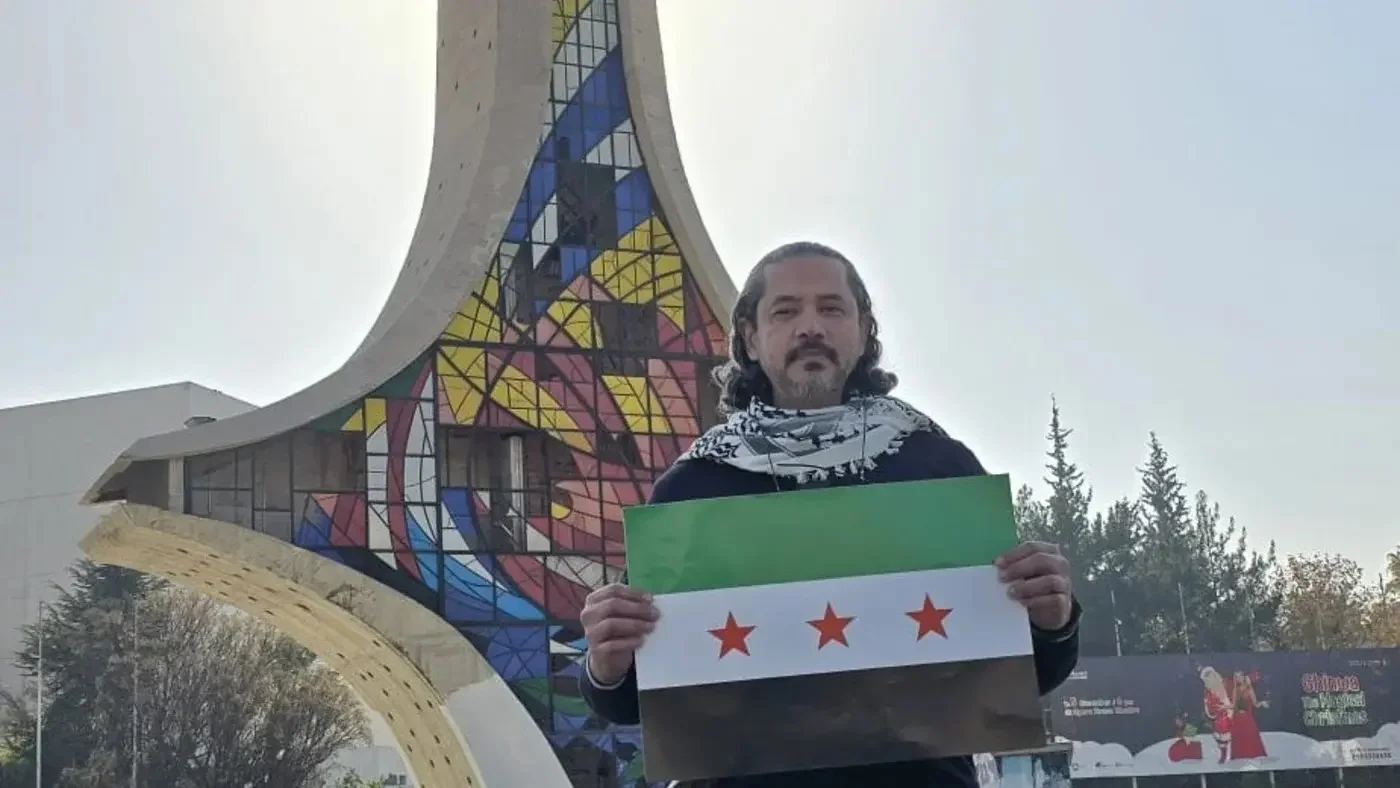
The Egyptian-Turkish national was 'forcibly disappeared' following his extradition to the United Arab Emirates and facing a 10-year prison sentence Abdul Rahman Yusuf al-Qaradawi, an Egyptian poet and activist, celebrates the fall of Syrian President Bashar al-Assad (X) Published date: 4 September 2026 12:03 BST | Last update: 6 sec ago The president of the United Arab Emirates has pardoned Egyptian poet and high-profile activist Abdul Rahman Yusuf al-Qaradawi, who was facing a ten-year prison sentence in the country, Emirati media reported. According to the reports, Sheikh Mohamed bin Zayed Al Nahyan issued the pardon on Friday after Qaradawi was convicted by the Cybercrime Circuit of the Abu Dhabi Federal Court of Appeal on 27 August, which handed him a 10-year custodial sentence and a fine of AED200,000 ($54,452). The dual Egyptian-Turkish national was first detained in Lebanon in January, and extradited to the UAE on charges of "fake news" and "disturbing public security" relating to a video he posted to social media while visiting Syria, in which he expressed critical views of the Egyptian, Emirati and Saudi authorities. Both Egypt and the UAE issued extradition requests for Qaradawi, with Lebanese authorities acting on the Emirati warrant on 8 January. MEE reported that, for over 200 days following his extradition, Qaradawi remained "forcibly disappeared" with no charges or indictment, sparking widespread criticism and calls for his release by rights groups and UN experts. New MEE newsletter: Jerusalem Dispatch Sign up to get the latest insights and analysis on Israel-Palestine, alongside Turkey Unpacked and other MEE newsletters Amnesty International warned that his extradition constituted a "flagrant violation of due process guarantees and other international human rights obligations, notably the principle of non-refoulement". In March, a group of United Nations human rights experts raised the alarm over Qaradawi’s continued forced disappearance, and called on the UAE to disclose his whereabouts. They further expressed concern regarding the legal process of Qaradawi’s extradition, which was triggered by an arrest warrant issued by the little-known security body, the Arab Interior Ministers’ Council (AIMC), saying that the move was politically motivated and not based on legal criteria. The extradition process orchestrated by the AIMC, they said, “is being abused by some states to silence criticism, shut down dissent, and pursue activists beyond their borders”. Pro-revolution figure According to Amnesty International, Abdul Rahman “was interrogated by Lebanese security forces in relation to a 2017 verdict issued in absentia by an Egyptian court, convicting him on charges of spreading ‘false news’, among others, and sentencing him to five years in prison in a politically-motivated case, as well as the UAE extradition request”. UAE takes custody of poet and dissident Abdul Rahman Yusuf al-Qaradawi Read More » Samar Elhussieny, executive director of the Egyptian Human Rights Forum, welcomed the news but urged the Emirati authorities to expedite his release. "I hope the procedures will be finalised as soon as possible for him to be reunited with his family," Elhussieny told Middle East Eye. "Then he can live his life with his daughters in peace and safety, and heal from this traumatic experience." Qaradawi was a major proponent of the 2011 Egyptian revolution that ended the decades-long rule of former Egyptian President Hosni Mubarak. He also worked on the campaign of Mohammed el-Baradei, the former head of the International Atomic Energy Agency, who ran for the Egyptian presidency after Mubarak's rule ended after the Egyptian revolution. After 2011, Abdul Rahman was banned from broadcast appearances and publications in Egypt and went into exile - like many prominent figures who opposed the Egyptian authorities - in Turkey. His sister, Ola, has spent four years arbitrarily detained in Egypt on what are widely believed to be unsubstantiated terrorism-related charges. His father, Yusuf, who died in Qatar in 2022, was arguably one of the most prolific and published Islamic scholars and a household name in the Arab world. Middle East Eye delivers independent and unrivalled coverage and analysis of the Middle East, North Africa and beyond. To learn more about republishing this content and the associated fees, please fill out this form. More about MEE can be found here.
UAE president pardons Egyptian poet Abdul Rahman Yusuf al-Qaradawi
Full Article
Original Source
Read the full article at Middleeasteye →KhanList aggregates and links to publicly available news content. We do not host full articles from third-party sources. Always verify important information with original sources.