
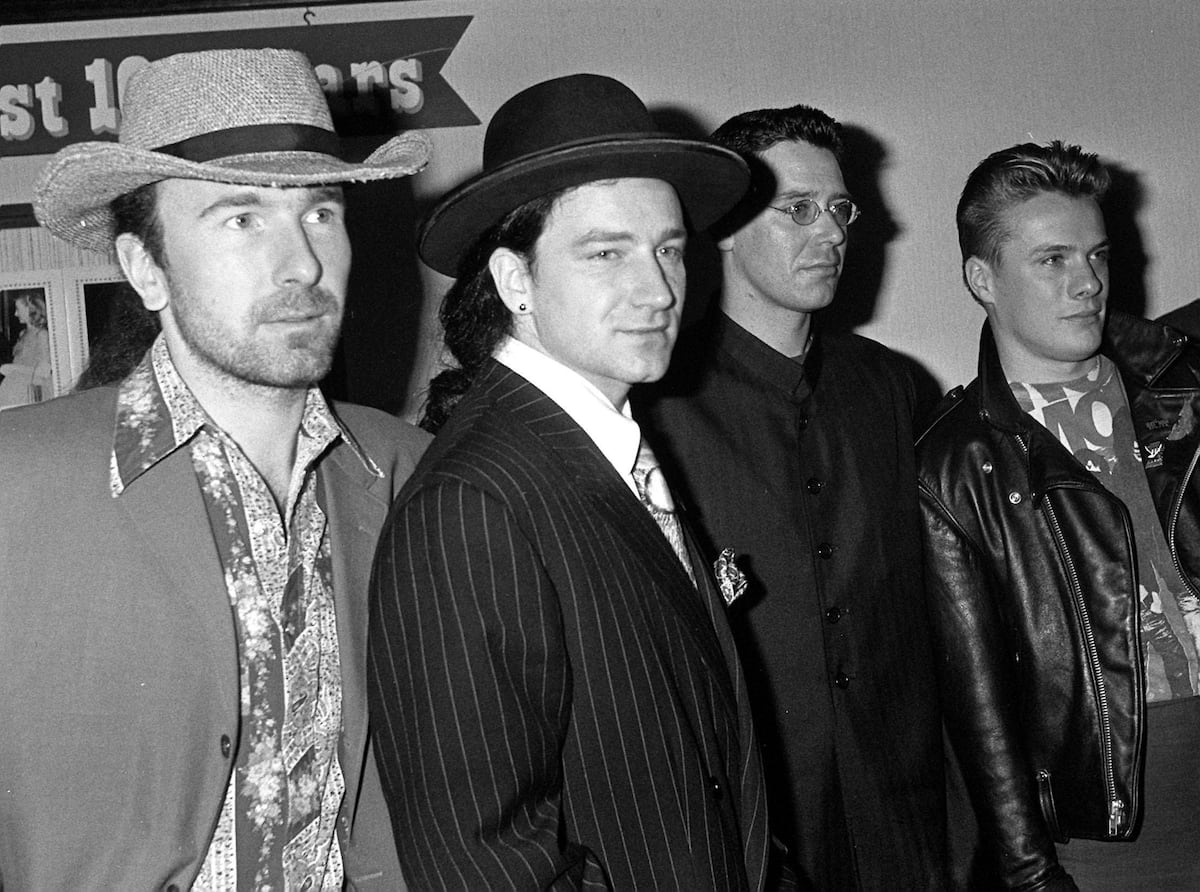
There are no direct references to Dublin in U2’s songs. In the Irish capital’s street map there isn’t an avenue, park or even an alley named after the band or its members. Yet Ireland’s most universal rock band, the quartet made up of Bono, The Edge, Adam Clayton and Larry Mullen Jr., would not be what it is without the launchpad Dublin provided: the city of rainy days, sea air and mouldy walls that does populate much of their songbook. Devoted fans know the band and Dublin are inseparable, and have logged dozens of locations linked to the writers of songs such as One. Those who haven’t yet followed their trail through the city have a good excuse this year: four teenagers formed a school band that would end up calling itself U2 in 1976. That was 50 years ago; the anniversary is being marked with the release on Friday, November 13, of the album Carnaval de Luz.But it’s best to begin this tour with the second chapter. Around The Temple Bar, Dublin’s epicenter for tourism and live music in its many pubs, the novice quartet used to travel by bus from their neighborhood, Malahide, down to the city’s first McDonald’s on Grafton Street. On the way they crossed North Earl Street, where James Joyce’s statue now poses for photographs. A few yards away is Bonavox, the hearing-aid shop with a Latin name that gave the young, brash Bono his nickname: the one with the “good voice.”After honing their craft in school and family performances, their first major live show took place very near there, at the long‑gone The Baggot Inn in 1979, whose scar can still be seen on Baggot Street. Across St. Stephen’s Green, on South King Street, The Gaiety Theatre remains very much alive — an operatic temple that each Christmas Eve hosts a charity performance by a major musical figure. The most recent, in 2025, brought together Imelda May and Bono for a rendition of the song Baby Please Come Home. The imprint of the creators of the two surprise EPs released this year, Days of Ash and Easter Lily, is also found in the Stephen’s Green shopping centre. There, the Dandelion Market, a converted car park with no toilets or bar, became in the late 1970s a hotbed of punks. After calling themselves Feedback and The Hype, the band performed there as U2 in 1979: “It was where we definitely caught the vibe,” Mullen confirmed.To remember that past that is disappearing from the map, a few steps away is The Irish Rock ‘n’ Roll Museum. Curved Street leads to a tour of the history of Irish rock, from Thin Lizzy to the genuine national hero Rory Gallagher, and on to Enya, The Cranberries and Sinéad O’Connor. It includes a rehearsal room dedicated to U2 that can be rented for €20 an hour. They display photos, clothing, gold and platinum records and concert tickets. On leaving, along Cecilia Street, the traditional-music shop Claddagh Records — open since the 1980s — can be found. On its first floor they used to have a recording studio, STS, frequented by Bono and his bandmates in their early days.Still within Dublin’s nerve center, on a corner of Merrion Square park stands the statue of Oscar Wilde, beside a column showing several of the author of The Picture of Dorian Gray’s quotations written by hand by famous people. Bono contributed the line “Man is least himself when he talks in his own person. Give him a mask, and he will tell you the truth.” Within stone’s throw, The Little Museum of Dublin is an unclassifiable venue that reconstructs the city’s history with everyday objects, actors who serve as guides and an uncontainable passion for filling every inch of its walls. There is a room there reserved for U2, assembled with contributions from the band and their fans.It’s also worth crossing the River Liffey by its most famous bridge, the Ha’penny Bridge, where the quartet posed for a photo shoot in 1980 when they released their first album, Boy. On the river’s south bank you soon find the path to Trinity College. The Dublin university displays, among other things, buildings lent to the series Wednesday, its lavish library — which will close for renovations at the end of 2027 — and two places marked in red in the band’s history: The Moyne Institute, whose steps the quartet played on in 1979, and especially the Examination Hall, where another band, The Clash, performed two years earlier. That event changed the four young rockers; it altered their minds, they later admitted.In under half an hour on foot you reach Windmill Lane in the Docklands. The rooms of the fourth incarnation of these recording studios — the previous three no longer exist — reveal their particular stamp and the legend of the Grammys and multi‑platinum records produced there by performers such as The Rolling Stones, The Commitments, David Bowie, Miley Cyrus and almost anyone topping the charts over the past five decades. U2 debuted there with Boy and traced the first steps of their discography. In the current building they finished Zooropa (1993), Pop (1997) and All That You Can’t Leave Behind (2000). Back on the street, almost against the maritime skyline, the Poolbeg chimneys cut a recognizable silhouette, present in the video for Pride (In the Name of Love).It was precisely that song, written by Bono together with Bob Dylan, that was born after a Nobel laureate concert at Slane Castle in 1984. The imposing Conyngham estate sits on the banks of the River Boyne at one end of the village of Slane, an hour’s drive north of Dublin via the N2 road. The castle — with a farm, whiskey distillery, guided tours and luxury accommodation for about 15 guests — is famed for the rock concerts conceived by its previous owner, Lord Henry. Since 1981 artists such as Bruce Springsteen, the Stones, Madonna and Queen have played on its natural amphitheater. And, of course, U2, who presented their second album, October, there in 1981, recorded The Unforgettable Fire over five months in 1984 in one of its rooms, and recorded a live LP there in 2001.On the other side of Dublin, 10 miles (17 km) to the southeast, a 14th‑century castle and a tourist network full of pubs welcome visitors to Dalkey. Up the steep streets of Killiney Hill you can find Elsinore, the mansion U2 used as a recording residence for the album Achtung Baby (1991). You also pass the castle where the singer Enya lives. And finally, the holy grail for the band’s fans after the global impact of The Joshua Tree (1987): Bono’s mansion, which locals say is not hard to spot at the pubs and social events of this Irish corner.To complete the route, the first chapter of this story. In 1976 drummer Larry Mullen Jr. posted a notice at his school, Mount Temple Comprehensive School. Dave, a guitarist, Adam, a bassist, and a singer‑guitarist, Paul — who gave a dreadful audition but whose unstoppable charisma everyone detected — responded. The school, the perfect final stop on this route and where the band returned this September to recreate one of their early recitals, is just a short turn off the M50, the airport road. Sign up for our weekly newsletter to get more English-language news coverage from EL PAÍS USA Edition
U2’s trail in Dublin, 50 years after the band’s formation
Full Article
Original Source
Read the full article at English →KhanList aggregates and links to publicly available news content. We do not host full articles from third-party sources. Always verify important information with original sources.