
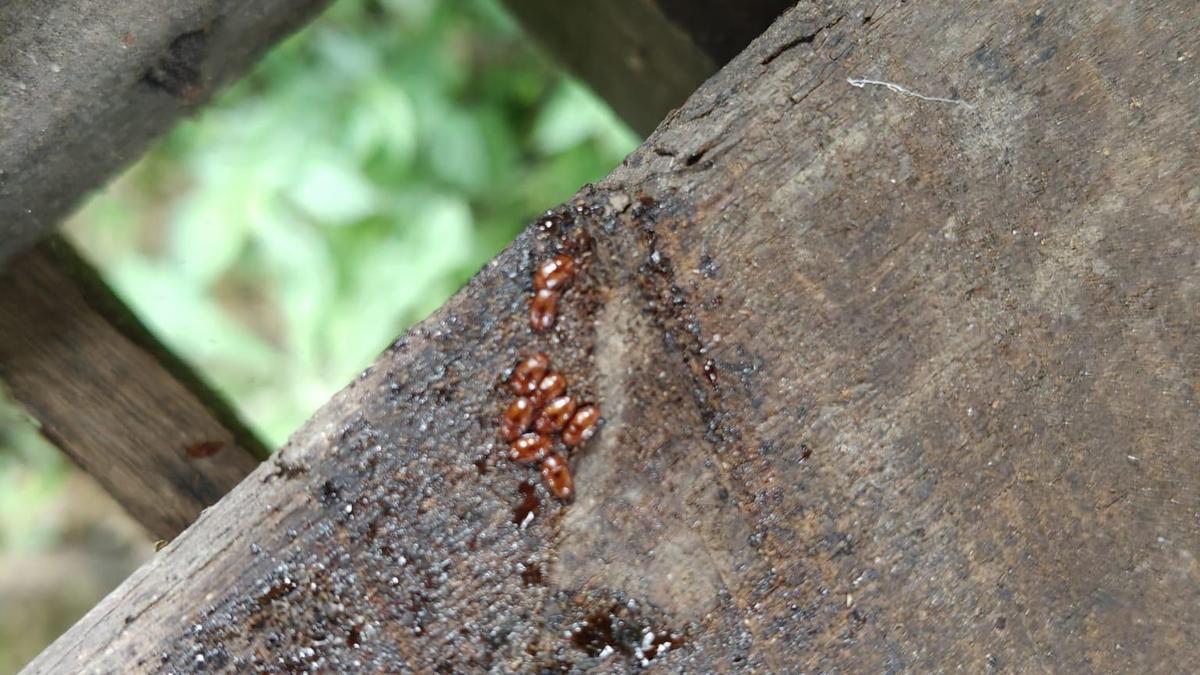
Around 800 colonies of honey bees were destroyed in a span of 25 days due to the attack of the small hive beetle, recently. | Photo Credit: The Hindu Two years after the small hive beetle’s attack on the apiculture industry in Karnataka, the problem continues to persist with the solution yet to be found. Around 800 colonies of honey bees were destroyed in a span of 25 days due to the attack of the small hive beetle, recently.Researchers and professors at the University of Agricultural Sciences Bangalore (UAS-B), GKVK, have identified the small hive beetle as a destructive, invasive scavenger that attacks honey bee colonies, bees, honey and pollen.Speaking to The Hindu, K.T. Vijayakumar, principal investigator (PI) and head of the Department of Apiculture at UAS-B, GKVK, explained, “The attack on bees and their colonies by this invasive scavenger insect has doubled over a period of two to three years in apiculture farms located in plains. The insect was originally found in America. In Asia, it was first found in China, followed by Bangladesh. From Bangladesh, it travelled to West Bengal, Assam, Odisha, Andhra Pradesh, Telangana and finally to Karnataka and the surrounding States.”“It looks like a bedbug and cannot be identified easily. For now, the beetle is destroying honey bee colonies in the plains, including Bengaluru Urban, Bengaluru Rural, Mysuru, Mandya and Chamarajanagar. It hasn’t travelled to the hills yet,” he said, adding that the beetle is affecting both bees that are bred and those naturally found in the forests.He fears that if these insects travel to the hills, pollination in coffee plantations will also be affected, and he has alerted the Department of Horticulture regarding the same.Beekeepers are cluelessMeanwhile, Sunny Burton from Sakleshpur has been beekeeping for five years. He said that when he moved the bee boxes to the plains from the hills during the rains, as is the practice, in June-July this year, 200 colonies were destroyed in a span of 25 days. “Four other farmers along with me had moved to the plains, and in a span of 25 days, around 800 colonies were destroyed,” he said.“The beetle lays eggs at a faster rate and multiplies in a single day, destroying colonies and honey. As a result, it has impacted pollination and agriculture in the area. The Horticulture Department and the National Bee Board must come up with a solution before the entire ecological system collapses,” he said.Apoorva B.V., a beekeeper based in Bengaluru, said that, for now, he was using a trap or poison bait to prevent the attack of the beetle. “But this cannot go on for long, as bees are sensitive to poison bait and other pest-like solutions,” he said.A senior official from the Department of Horticulture said that they were creating awareness among beekeepers about the beetle and how to trap it in coordination with the UAS-B. “But it is not possible to control it, as it has adapted to the environment. Hopefully, researchers at UAS-B will come up with a solution,” the official said. Published - October 28, 2026 06:00 am IST
Two years on, Karnataka beekeepers continue to face threat from small hive beetle
Full Article
Original Source
Read the full article at Thehindu →KhanList aggregates and links to publicly available news content. We do not host full articles from third-party sources. Always verify important information with original sources.