
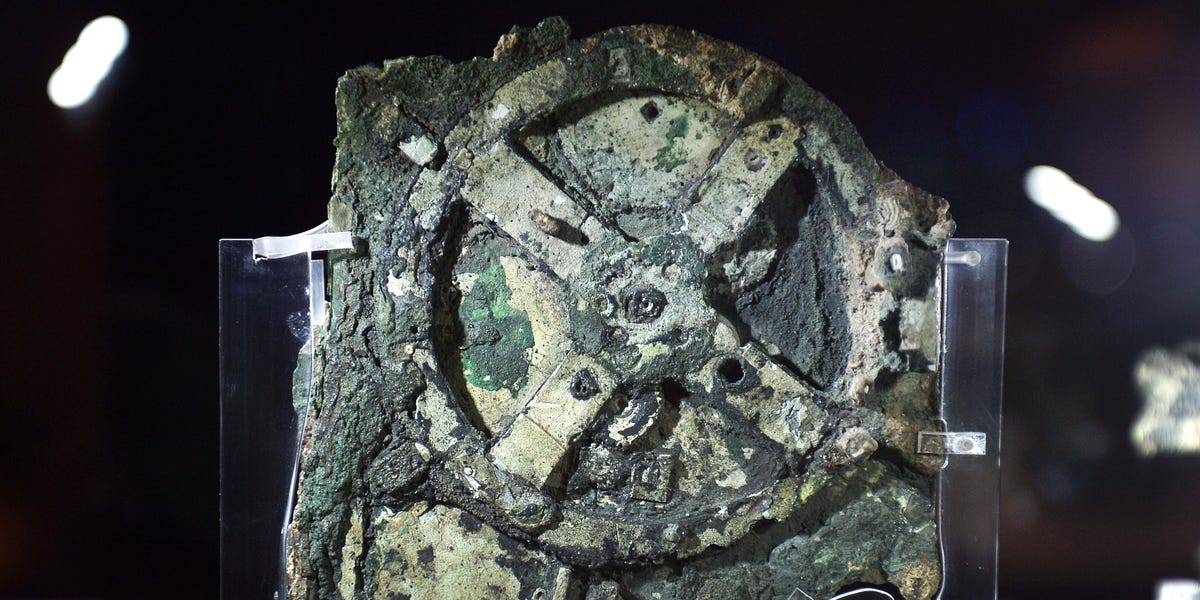
5 min readHere’s what you’ll learn when you read this story:More than 125 years ago, sponge divers discovered the wreck of a Greek ship laden with jewels, coins, bronze and marble statues, and a strange mechanism now thought to be the world’s first computer.Named for the nearby island where the sponge divers first discovered the object, the Antikythera mechanism largely remains a mystery to the mathematicians, clockmakers, metallurgists, astrophysicists, and underwater archaeologists who have studied it.Despite great interest from researchers, just one-third of the shoebox-sized device has been recovered from the sea.It was in the spring of 1900 that a group of waylaid sponge divers first stumbled upon a lost Greek ship after taking refuge on the island of Antikythera during a storm. When the storm subsided, the divers, who shared one brass diving helmet strapped to the ship with ropes, began plying the waters along the island’s eastern edge. One diver, Elias Stadiatis, pulled sharply on his rope. When he reached the surface, Stadiatis frantically described a scene of carnage—rotting corpses of women and horses strewn across the seafloor. The ship’s captain, Dimitrios Kontos, dove down to see for himself.One of the divers—most reports say Kontos—later resurfaced with a bronze arm, part of a lost masterwork of antiquity. By complete chance, these divers had discovered the world’s richest shipwreck and inadvertently became history’s first underwater archaeologists.When the divers, now employed by the Greek government, returned months later, excavating the site proved difficult. This part of the Aegean was frequently besieged by tumultuous waves. Furious storms were common, and the shipwreck had settled at a 45-degree angle, perilously close to the same rocky cliffs that likely ended its voyage two millennia prior. Some 300 years after the wreck, a rockslide had further entombed the vessel.But even in these challenging conditions, the divers exhumed dozens of containers called amphorae—what Foley describes as the 55-gallon drums of the ancient world—along with perfume jars, glass bowls, jewels, coins, and many of those “corpses,” which turned out to be not-so-spooky bronze and marble statues. The divers could only stay submerged for about 10 minutes, Foley explains, and likely spent only a few minutes on the seafloor. The divers worked with rudimentary kit by today’s standards yet still somehow rigged up sculptures so they could be pulled from the water depths. “What they did was almost superhuman,” he says.At some point in the middle of the first century B.C.E., the Antikythera mechanism, thought to be the world’s first computer, came to rest in the salty sediments of the Aegean.Foley’s own memories of diving at the island of Antikythera—he visited the site and its surrounding waters once or twice every year between 2011 and 2017 and estimates that he’s spent around 87 hours beneath the waves—contain two juxtaposing truths about the Aegean: It’s one of the most beautiful marine environments in the world and it’s very challenging to study.During an expedition in September 2014, Foley and his colleagues—experts from the Hellenic Ministry of Culture and Sports’s Ephorate of Underwater Antiquities (EUA) and the Australian Centre for Field Robotics—planned to spend a week mapping the wreck with autonomous underwater vehicles (AUVs). They also had a crew of divers, armed with rebreathers and metal detectors, ready to scan the seafloor for ancient artifacts. Then they would debut a piece of heavy-duty diving equipment called the exosuit—picture a cross between Tony Stark’s Iron Man suit and the Michelin Man—into which divers could climb and explore depths too deep for scuba.Foley and his team managed to get only four days of diving in and used the bulbous exosuit twice before the sky grew dark and strong winds rolled in.Though rough weather scuttled their plans, they were still able to generate a three-millimeter-resolution map of the shipwreck and managed to recover an impressive collection of artifacts. On subsequent dive trips, he and his team uncovered more sculptures, a mysterious 100-kilogram lead weapon known as “the dolphin,” a nearly complete human skeleton, and a peculiar mechanism thought to be an ancient astronomical calendar and one of the earliest progenitors of the modern computer. Today, we call it the Antikythera mechanism.Foley recalls peering over the cliff face on a particularly stormy day during that 2014 expedition, watching with awe as waves pummeled the shore near the site of the wreck: “It gave me a really good indication of what the conditions may have been like the night or day when this ship sank.”Over the decades, experts have tried to piece together what exactly happened to this ship all those centuries ago. While some details shift among varying narratives of the ship’s fateful journey, the end result remains the same: At some point in the middle of the first century B.C.E., the Antikythera mechanism, thought to be the world’s first computer, came to rest in the salty sediments of the Aegean. Since then, mathematicians, clockmakers, metallurgists, astrophysicists, and underwater archaeologists have tried to make sense of this fragmented, corroded, and maddening amalgamation of gears, pins, and dials.For two millennia, the mechanism lay untouched in its watery tomb more than 100 feet below the waves as time slowly trickled by, giving way to the birth of empires, the collapse into the Dark Ages, the rise of theocratic kingdoms, the foundation of nation-states, and the arrival of modern science.It’s a wonder the mechanism survived at all, given the conditions it faced in the ocean. “If you go into many of the archaeological museums in Europe, all of the fabulous bronze sculptures primarily come from shipwrecks or from sites underwater,” Foley explains. At the time of antiquity, bronze was valuable. And because it was malleable, it could be easily repurposed. “You might make a statue of a Greek god, but once that religion goes out of fashion…you can melt [the statue] down and make church bells or artillery gun barrels,” he says.But 2,000 years underwater didn’t do the Antikythera mechanism many favors. Seawater rich with salts and other chemical compounds reacted with the high amount of copper in the bronze mechanism, slowly corroding it and replacing it with a green-hued rock known as atacamite. Over time, silt and sand accumulated between the gear wheels, which eventually solidified into hunks of lumpy rock. Bits of wood found among the fragments suggest the mechanism was housed in an ornate wooden frame.The device is almost as famous for its incompleteness as it is for its complexity. Now housed at the National Archaeological Museum in Athens, Greece, only one-third of the roughly shoebox-sized mechanism, spread across 82 fragments of varying sizes, has been found. The rest has been lost to the sea.More than a century later, the discoveries—and controversies—surrounding one of the most incredible archaeological finds in human history are only growing.Darren lives in Portland, has a cat, and writes/edits about sci-fi and how our world works. You can find his previous stuff at Gizmodo and Paste if you look hard enough.
Two-Thirds of the World’s First Computer Is Still Missing Beneath the Sea
Full Article
Original Source
Read the full article at Popularmechanics →KhanList aggregates and links to publicly available news content. We do not host full articles from third-party sources. Always verify important information with original sources.