
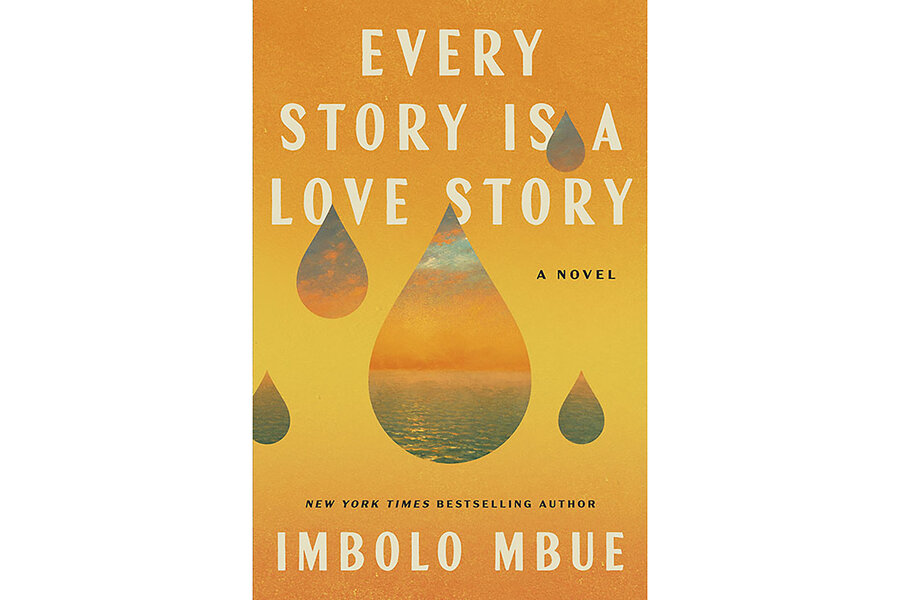
Imbolo Mbue’s buoyant novel, “Every Story Is a Love Story,” begins with a letter. Wolo Lifafa, a Cameroonian immigrant living in the U.S., receives a request – almost a plea – from Victoria Snow, the woman who accidentally killed his wife, Yoma. Pregnant with twin children, she had been struck and killed by the car Victoria was driving at a suburban New Jersey intersection three years prior. In an instant, Wolo’s whole world, and his place in it, were destroyed. Yoma’s death was ruled accidental by the authorities. But was it? Does Victoria hold some sort of political or cultural influence that enabled her to get away with murder? As one passage puts it, “His anger comes in brief waves now, his sadness in long ones.”Wolo needs to know the truth. Victoria is the only remaining witness to the tragedy. He wonders whether forgiveness is even possible. Can he ever hope to find peace again in this life?Wolo is part of a vast, close-knit family, rooted in Cameroon but with a diaspora spread throughout the world. Very few of them are supportive of any contact with Victoria. His mother, Keka, is against it. So is his “second mother,” Jokeh. The pastor of his church tells him it is best to leave well enough alone. Only Yoma’s father, the wise Tata Munyenge, encourages him to move forward in his quest for the truth. And in the end, it is that deep need for certitude that wins out. He agrees to meet Victoria on a Saturday in New York City’s Central Park. Their initial encounter does not go well. Wolo’s and Victoria’s story will not be an easy, feel-good, kumbaya one. But what that initial encounter does accomplish is to open both of them, and the reader, to a deeper understanding of what truth and forgiveness actually are, and how they can be found in the most unexpected of circumstances.For one thing, if anyone could be considered privileged, a case can be made that it is Wolo. He belongs to a sprawling, highly educated family of professionals, many of whom have emigrated from Cameroon. They have become prosperous and well regarded in the United States. They are viewed almost as royalty whenever they return to Cameroon. Which they do often. On the other hand, Wolo discovers that Victoria, a pilot, is middle class. She does not have extraordinary influence or power that Wolo, in his despair, has attributed to her. He is forced to reckon with that misapprehension.The novelist does an excellent job of drawing the reader into close-knir. We come to know about their food and their customs. But we also learn of the sometimes implacable rules that their culture sets for them. They’re codes that Wolo had always taken for granted. The Lifafas are African, but they also share universality with the many emigrant groups that have integrated into and enriched their new homes around the globe. Mbue, who is Cameroonian American, shows how it is possible for one person to love both their newly adopted home country and the old one left behind. The characters have much to teach us. Neither Wolo nor Victoria give up on their quest to come to some sense of resolution, and of forgiveness, and to learn from this tragedy. In the process, both have their sense of truth disrupted, only to be eventually reconstructed. The process is not always easy but it is hopeful and Mbue maintains a sense of uplift even as her characters grapple with uncomfortable insights.Because Victoria is a pilot, she is able to offer Wolo access to a wider world. She is able to take him, both physically and then mentally, to places he had dreamed of seeing with Yoma. He learns more about his wife than he had ever thought possible when she died. He is even able to fulfill Yoma’s dream of having her writing published. In Cameroon, however, Wolo must face certain aspects of his family’s life and see their privilege for the entitlement it actually is.The genius of Mbue’s novel is that Wolo no longer shies away from truth and understanding. He accepts it, acts on it, and grows through it.At one point, Mbue has a very wise character say to him, “At my age, I do not stop myself from feeling. I am not afraid of feeling anything, good or bad.” Deepen your worldviewwith Monitor Highlights.Politics with respectGet political stories with respectful analysis.There‘s a world of new ideas in everyBooks newsletter.There‘s more to life, enrich yours withCulture & Learning weekly.Follow humanity‘s discoveries withScience & Nature stories in your inbox.Gain a spiritual perspectivefrom the stories in your inbox.Want to understand the deeper impact of critical events? Learn the Monitor‘s insight.Already a subscriber? Log in to hide ads. By the end of his quest, Wolo has grown through his experiences to embody these words. Although the end of the novel avoids easy answers, he finds that the search for truth and forgiveness has brought him to a longed-for place of peace – and hope.Deborah Johnson is the author of “Washington and Leigh,” which will be published in February. ALREADY A SUBSCRIBER? LoginReal news can be honest, hopeful, credible, constructive.The Christian Science Monitor was founded in 1908 to lift the standard of journalism and uplift humanity. We aim to “speak the truth in love.” Our goal is not to tell you what to think, but to give you the essential knowledge and understanding to come to your own intelligent conclusions. Join us in this mission by subscribing.
Two strangers, on opposite sides of a tragedy, seek resolution
Full Article
Original Source
Read the full article at Csmonitor →KhanList aggregates and links to publicly available news content. We do not host full articles from third-party sources. Always verify important information with original sources.