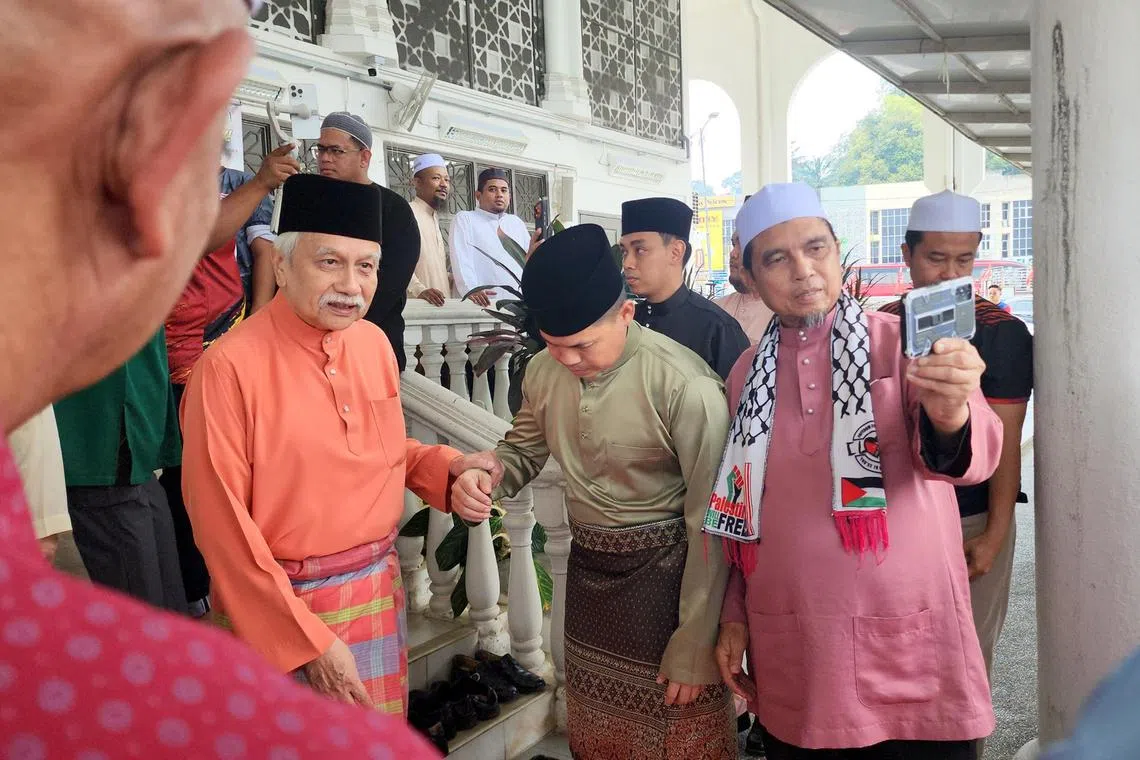
KUALA PILAH – In Kuala Pilah, regarded as the royal heartland of Negeri Sembilan, a crowd hailed Yang di-Pertuan Besar Muhriz Munawir with a centuries-old royal salute at the mosque where he performed his Friday prayers on July 24.“Daulat Tuanku! (Long live the king!),” a dozen people shouted in unison as they stood outside the mosque.Just hours earlier in Tampin, 40km away, supporters also erupted into cries of “Daulat Tuanku” when his cousin Nadzaruddin Ja’afar stepped out of his vehicle at the residence of a traditional chieftain.The two scenes unfolded in the midst of a succession fight between both men, heirs to one of South-east Asia’s oldest surviving elective monarchies.On Aug 1, Negeri Sembilan voters will choose a new state government, but the question is still unsettled: Who will have the constitutional authority to swear in the next menteri besar?Identity shaped by customary lawThe answer depends on a royal succession dispute that has left supporters on both sides equally convinced their claimant is the legitimate state ruler.The royal stand-off has moved beyond palace walls and into the courts, with competing sides battling over the legality of key decisions, the appointment of customary chiefs and the constitutional process governing the throne.At its heart is Adat Perpatih, or customary law – a traditional system of rules that has shaped Negeri Sembilan’s identity for generations – which some feel has been infringed on by the federal government.Negeri Sembilan is the only state in Malaysia that follows an elective monarchy rooted in Adat Perpatih, brought by Minangkabau migrants from Indonesia centuries ago.Meaning “Nine States”, Negeri Sembilan was originally a federation of nine original chiefdoms. Today, four traditional chieftains, known as the Undang, assume the constitutional role of electing the state ruler.British colonial administrators codified many customary institutions into constitutional arrangements, allowing the system to endure alongside modern state institutions.A brewing royal stormNow, this arrangement sits at the heart of a constitutional crisis unlike any Malaysia has seen.The dispute erupted in April, when the four chieftains attempted to depose Muhriz, and later installed Nadzaruddin as the new ruler on June 5.But the feud between the chieftains and the head of state extends beyond prestige or succession. It is also a struggle over power and influence that reaches into politics and business. There have been allegations that an Undang issued mining licences despite lacking the authority to do so.Nadzaruddin Ja'afar arrives at the residence of the Tunku Besar of Tampin in Negeri Sembilan on July 24. ST PHOTO: HAZLIN HASSANThe federal government, however, continues to recognise Muhriz as the legitimate Yang di-Pertuan Besar upon the Attorney-General’s advice. The state government, led by Pakatan Harapan (PH), also publicly backed Muhriz.Meanwhile, Muhriz has moved to fill vacancies among the Undang after two of the four positions became vacant or disputed, further deepening divisions within the state’s customary hierarchy.The constitutional uncertainty triggered a snap election, to be held on Aug 1.This came about because Barisan Nasional’s (BN) UMNO, a partner in Negeri Sembilan’s ruling coalition, withdrew support for Menteri Besar Aminuddin Harun over the palace dispute. The state assembly had to be dissolved, bringing forward an election that was not due until 2028.And with some 20 to 25 of Negeri Sembilan’s 36 state assembly seats falling within the territories governed by the four Undang, it could prove dicey for Prime Minister Anwar Ibrahim’s PH coalition.Tricia Yeoh, a political scientist at the University of Nottingham Malaysia, believes the Undang issue will be the centrepiece of the Negeri Sembilan state election.“While PH will stress its financial management of the state, improved investments and savings, it is the Undang issue and the adherence to Adat Perpatih that will drive the majority of voters’ sentiment, especially within Malay-majority and Undang-related constituencies,” she said.Complicating matters is that supporters of both Muhriz and Nadzaruddin claim adherence to Adat Perpatih.Retiree Che Rus Husin, 70, who regularly attends prayers at the mosque in Kuala Pilah, described the attempt to topple the ruler as a betrayal of Negeri Sembilan’s monarchy. He said people should support Muhriz because “he is the legitimate ruler under the law accepted by everyone”.“You are in Negeri Sembilan. Like it or not, Adat Perpatih is important,” he said.Implications for the state electionMeanwhile, BN and the opposition coalition Perikatan Nasional (PN), which have formed a pact for the election, have used the royal crisis to criticise the PH-led state government, arguing that it failed to manage the situation effectively, Yeoh noted.“They have accused the PH Menteri Besar Aminuddin of interfering in the affairs of the Undang, where in their opinion, the executive arm of government ought not to be meddling in matters that must be resolved primarily from within the Undang and luaks (territories) themselves,” she said.By taking a stand and explicitly supporting Muhriz as the rightful ruler, both Aminuddin and Anwar are seen as passing judgment over a matter they believe is exclusively within the domain of the Undang to determine, she said.“(Voters in) Malay-majority seats will consider this an infringement, which may mean voting for BN and PN, which they believe adhere more closely to the Adat Perpatih,” she added.But while constituencies that fall within the influence of the four Undang may lean towards BN-PN, urban and mixed constituencies are less likely to be swayed, she said, adding that Muhriz supporters are more likely to support PH. “(Muhriz) does have a support base, given that he has ruled the state with grace and exceptionally good governance. However, those who are strong adherents of Adat Perpatih may consider the procedures and process of Adat to have been infringed upon,” she said.“BN-PN have positioned themselves as the only coalition able to settle the matter of who the rightful Tuanku is. While this may not be necessarily true, the narrative is being used against PH in this election – and as we know, politics is all about the best narrative put forward,” noted Yeoh.The palace crisis has also been folded into the issue of Malay identity.On July 24, the Undang of Johol, Muhammed Abdullah, told a gathering of traditional leaders in Tampin to demonstrate what he called the strength of the Malay community through the ballot box.“Don’t bring machetes or sickles. Show it at the ballot box,” he said, while stressing that he was not endorsing any political party. “I’m not talking about any political party. I’m talking about establishing a Malay-led government.”Political analyst Syaza Shukri from the International Islamic University Malaysia told ST that the Undang Johol’s call for a Malay-led government was widely understood as a coded reference to a BN-PN administration.It is a message that resonates with business owner Muhammad Azri, 38, who said the Undang cannot be seen endorsing any political party, and it is up to voters like him to choose correctly.Once a staunch PH supporter, Azri said his confidence in the coalition has unravelled because of the royal succession dispute. The turning point, he said, was the Prime Minister’s public acknowledgement of Muhriz as the state’s ruler.“The Menteri Besar Aminuddin Harun was biased. He did not respect the Adat,” he said. “The ruler of Negeri Sembilan is not Muhriz alone. The Undang are part of the institution.”Azri said he now saw BN as his only choice.Divided views and a generation gapAnother Muhriz supporter, Muhamad Kamel Yassin, 68, argued that a ruler could not simply be removed without satisfying constitutional requirements, adding that it should be permitted only under conditions like death, illness and mental incapacity.“Some people are using this issue for their own benefit,” said Kamel, a descendant of famed palace official and war chief Siamang Gagap.While older Negeri Sembilan folk may have strong feelings about the issue, it is less important to younger people, said Mohd Faizal Kasmani, director of the Strategic Communication Centre at Universiti Sains Islam Malaysia.Street food vendor Azahan Harris, 26, for instance, admitted he had no idea who his Undang was.Muhamad Kamel Yassin, a descendant of famed palace warrior Siamang Gagap, says he is carrying forward his great-grandfather's legacy by defending Yang di-Pertuan Besar Muhriz Munawir. PHOTO: COURTESY OF MUHAMAD KAMEL YASSINAnd while retiree Haniff Aziz, 63, supports Muhriz, his 22-year-old son has little interest in the constitutional crisis.Others, like Anuar Abdul Razak, 47, a healthcare worker in Jelebu, an Undang territory, are indifferent because the dispute does not affect their daily lives.“For me, this issue is trivial,” he said.Nonetheless, there are those for whom the issue, having lain dormant for years, has now awakened a deeper sense of who they are.Businessman Muhammad Azri Abdul Razak, 38, who moved back to Rembau, another Undang territory, in 2017 after years working elsewhere, is one of them.Growing up in a customary clan, he was too young to understand conversations about lineage and Adat Perpatih though they were part of everyday life.“It was something I struggled to understand as a teenager. But you only truly understand it when you come home,” he said.Mohd Shahir Sulaiman, a 40-year-old car workshop owner from Nilai, also said he only now understood the significance of being part of a clan.“Life is not just about putting food on the table,” he said. “It’s also about having a government that protects our culture, our heritage and what has been enshrined in the law.”Additional reporting by Lu Wei HoongSign up for our weekly Asian Insider Malaysia Edition newsletter to make sense of the big stories in Malaysia.
Two rulers, one ballot: how will Negeri Sembilan’s royal crisis sway voters?
Full Article
Original Source
Read the full article at Straitstimes →KhanList aggregates and links to publicly available news content. We do not host full articles from third-party sources. Always verify important information with original sources.