
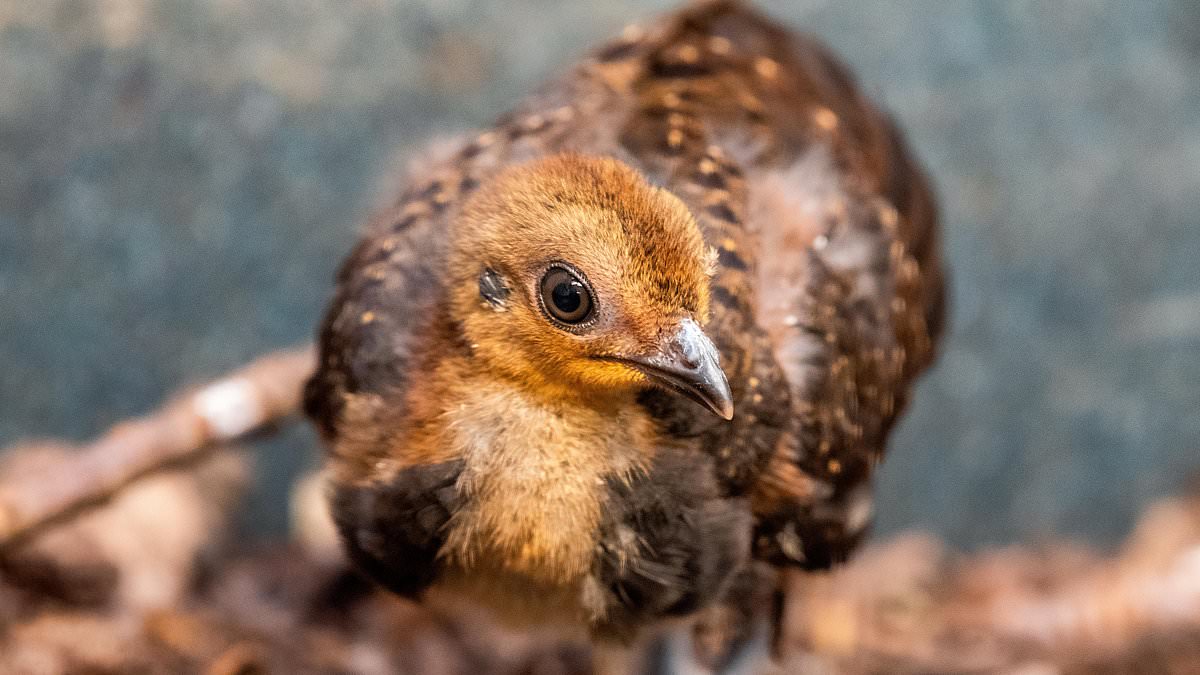
Published: 19:27 EST, 12 November 2026 | Updated: 20:08 EST, 12 November 2026 Two of Europe's rarest chicks are thriving at Chester Zoo after keepers used an improvised hot-water bottle made from a rubber glove to help them survive.The two Malay peacock-pheasant chicks are the only known members of the endangered species to have hatched in a European zoo this year.According to the European Association of Zoos and Aquaria (EAZA), just 15 Malay peacock-pheasants are recorded in European zoos. As few as 2,500 are thought to remain in the wild, where extensive habitat loss has pushed the species towards extinction.Bird keepers at the Cheshire zoo stepped in when the chicks' mother failed to sit on her first egg. Recognising the importance of every hatchling, they transferred the egg to a bronze-tailed peacock-pheasant, a closely related species, to be incubated. But the second chick needed urgent help shortly after hatching.Keepers discovered that the mother had left the nest too early, leaving her newborn chick dangerously cold.Leanne Lowton, lead keeper on Chester Zoo's Birds team, improvised a miniature hot-water bottle using a rubber glove to keep the hatchling warm. Two Malay peacock-pheasant chicks haev been born at Chester Zoo The male birds have striking features The pair only known members of the endangered species to have hatched in a European zoo this year Recognising the importance of every hatchling, bird keepers transferred the egg to a bronze-tailed peacock-pheasant, a closely related species, to be incubatedShe also gave it glucose syrup every hour for 24 hours before returning it to its mother.She added: 'The chick was chilled, so we needed to provide warmth and energy. It was quite an intense 24 hours.'We popped the hatchling back with mum the next morning and she immediately accepted her chick. I've never been so relieved in my life. She's reared the baby really well ever since.'The first chick has developed into a healthy young male and is due to move into his own habitat at the zoo this week.The foster arrangement also gave the Malay peacock-pheasant mother the opportunity to lay another egg, which she successfully incubated herself.Ms Lowton said: 'Not all bird behaviours are instinctive, so it can sometimes take bird parents a few tries to get things right. 'The Malay peacock-pheasant mother wasn't sitting on her nest, and the first egg was so precious we had to step in.'Although Ms Lowton is experienced in hand-rearing young birds, she said keepers wanted to avoid the chicks becoming too dependent on humans and missing out on learning natural behaviours.She added: 'We didn't want this chick to grow up not knowing how to be a pheasant, so we looked after the egg in our incubation centre and then gave it to a broody bronze-tailed peacock-pheasant, a very similar species to the natural parents. 'She is a very experienced mum, and she incubated the egg perfectly.'Malay peacock-pheasants are known for their striking plumage. Adult males have speckled brown feathers decorated with iridescent blue spots, while their distinctive call has been likened by Leanne to a 'Disney villain cackle'.In the wild, the birds' forest habitats are increasingly being cleared to make way for agricultural plantations.As woodland disappears, remaining populations become more vulnerable to hunting and trapping.The Malay peacock-pheasant is classified as Endangered on the International Union for Conservation of Nature (IUCN) Red List.Although several zoos have successfully bred other species of peacock-pheasant, Malay peacock-pheasants are rarely kept in captivity.The two chicks therefore represent an important addition to a conservation breeding programme aimed at establishing an insurance population for the threatened species.The programme could help safeguard the birds' future as pressure on their natural habitat continues.
Two of Europe's rarest chicks are thriving at UK zoo... with the help of a glove covered in feathers
Full Article
Original Source
Read the full article at Dailymail →KhanList aggregates and links to publicly available news content. We do not host full articles from third-party sources. Always verify important information with original sources.