
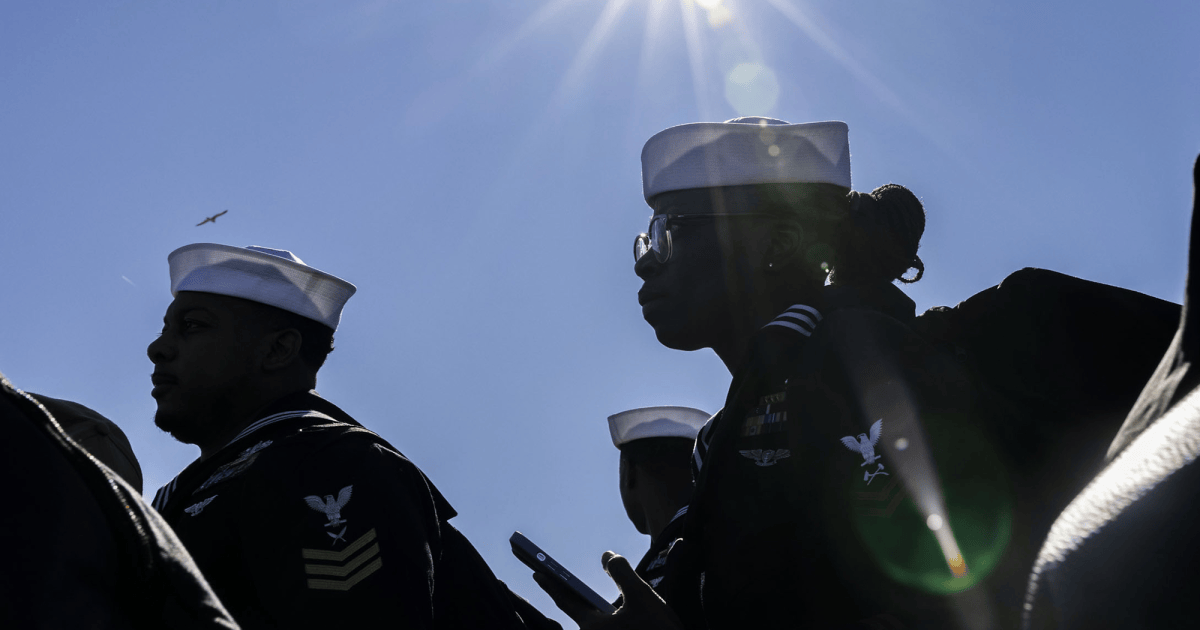
Sailors at Naval Station Norfolk on Jan. 17, 2024, after disembarking the USS Gerald R. Ford from an over eight-month long deployment, in Norfolk, Virginia. Kendall Warner/The Virginian-Pilot/Zuma Get your news from a source that’s not owned and controlled by oligarchs. Sign up for the free Mother Jones Daily. Early voting is about to close this Saturday in Virginia’s second congressional district, where Republican incumbent Jennifer Kiggans and Democrat challenger Elaine Luria are facing off in a closely watched House race. The candidate who wins the district, which Cook Political Report recently updated from a “toss up” to “lean Democrat,” could have a significant impact on the 2027 Congressional makeup—as well as for the future of military operations. For over a decade, the coastal district, which encompasses Virginia Beach and Hampton Roads and borders Norfolk, has been on the frontline of climate change-induced sea-level rise, experiencing everything from “sunny-day” flooding to significant land sinking (making coastal areas even more vulnerable to flooding). Home to several of the nation’s largest military installations, including the world’s largest naval facility Naval Station Norfolk, the region has been a flashpoint for what happens when rising tides potentially jeopardize military readiness. Or, as the Biden administration’s Department of Defense put it, Naval Station Norfolk is a “unique example of how the nation’s defense can be affected by the environment.” In Virginia’s 2nd congressional district, defense issues heavily shape election debates. But climate change sentiment might also play a part in this race, where 57 percent of adults believe that global warming affects sea level rise, and 55 percent believe that it also contributes to flooding, according to Yale’s Climate Opinions Map. Despite the tendency for Democrats to engage in what has been called “climate hushing,” which is to publicly subordinate the importance of climate change as an issue, almost half of voters in VA-2 believe climate change should be a high or very high priority for the next Congress. And while the district’s future House rep may not be able to reverse the Trump administration’s insistence that climate change is a “hoax,” the winning candidate could push the administration on climate resilience initiatives through mechanisms like defense appropriations, oversight hearings, and constituent advocacy. Democrat Elaine Luria, a veteran Navy officer, previously served as the district’s representative from 2019 to 2023, when she was defeated by Kiggans. During her last congressional term, Luria, along with five other Democratic representatives, sent a letter to Biden pushing for the Department of Defense to coordinate climate resilience efforts in Hampton Roads. Now, one of Luria’s top campaign priorities is, as she has written, to “Protect Hampton Roads and the Chesapeake Bay” from the impacts of climate change and sea-level rise. “When I’m elected again, I’ll continue to lead efforts to combat the economic and national security impacts of climate change on our local community, invest in energy projects that create jobs and lower prices, and protect clean air and water,” Luria said in a statement to Inside Climate News in August following the state’s primaries. The article also noted Luria’s support for the Coastal Virginia Offshore Wind (CVOW) project near Hampton Roads and her membership on the New Democratic Coalition Climate Change Task Force. Incumbent Jennifer Kiggans, also a Navy veteran, voted in January to fund the FY 2026 appropriations package, which she said would deliver clear investments for her district. “These commonsense investments improve military readiness and ensure our ports, roads, waterways, and military installations have the resources they need to keep our region moving,” she wrote in a press release. Like Luria, Kiggans demonstrated support for the construction of the CVOW as well as the buildout of renewable energy projects. In January 2026, after Trump attempted to pause construction of the offshore wind project, Kiggans signed on to a letter to Defense Secretary Hegseth and Interior Secretary Doug Burgum denouncing the president’s move. “Naval Station Norfolk is probably one of the most at-risk large Navy or military installations when we look at climate change.” “Naval Station Norfolk is probably one of the most at-risk large Navy or military installations when we look at climate change,” said retired Rear Admiral Jonathan White, who previously directed the US Navy’s Climate Change Task Force and was the Navy deputy to the National Oceanic Atmospheric Administration under President Barack Obama. “Climate change impacts readiness: the ability to get a job done, to keep ships up and running, and get them to where we want them to be in time. It all makes a difference.” In 2023, the naval base was designated as the first pilot site for a federal climate resilience program. Now, the pilot program has been stagnant under the Trump administration, which has deleted most mentions of climate change across federal websites, and whose Secretary of Defense, Pete Hegseth, wrote on X that his war machine “does not do climate change crap.” “As a coastal installation, Naval Station Norfolk routinely plans and prepares for flooding, severe weather and other environmental conditions that may affect installation operations,” a Navy official who wished to remain anonymous wrote in an email. “The installation incorporates these considerations into infrastructure planning, emergency preparedness and operational procedures to minimize disruptions and maintain its ability to support fleet readiness.” But when I asked White how the Trump administration’s animosity towards all things climate affects resilience planning, he said efforts have languished. “Everything is being shelved. I’ve become totally frustrated.” On the state of the country’s national security more widely, White told me the United States is “just falling farther and farther behind. If we don’t have strong leadership in the White House and Congress to push these issues forward,” he said, “it really impacts our national and global security.” Apart from the service members who are stationed on military installations like Naval Station Norfolk, the entire workforce that helps keep bases running are affected by rising seas. Every job, “from driving trucks around the bases for basic deliveries,” White said, “to welders and machinists,” contributes to how effectively a base operates. But if your street at home gets flooded and you can’t drive to work? “As people become more and more stressed and impacted by weather conditions, we see an impact on the ability of people to actually get to work and do their jobs.” Of course, climate change effects extend far beyond the military bases to the communities living in and around them. “The naval base is in the heart of this region,” said Quentin Scott, Federal Policy Director at the Chesapeake Climate Action Network (CCAN). “A lot of the sailors and naval personnel who live in the area are impacted” as are their families.” According to the US Census Bureau, VA-2 is also home to over 88,000 veterans. One of CCAN’s current campaigns focuses on sea-level rise, and the organization advocates for funding flooding solutions in Virginia through the Community Flood Preparedness Fund. “Flooding is overwhelming our systems here. People are driving boats through the middle of the neighborhood. There’s a ‘No Wake Zone’ sign in the middle of a school playground,” Scott added. “These are the everyday experiences that people are adapting to.” Scott’s organization has publicly endorsed Luria, who he feels is “willing to speak up and push back against this administration.” But he acknowledges that during her time in office, Kiggans “did stand up for clean energy as they were talking about repealing the Inflation Reduction tax credit.” However, she later voted to repeal the same tax credits in 2026, which Scott said was a “stab in the back.” Kiggans “portrayed herself as a champion of renewable energy” but then “voted in favor of Republican legislation to gut clean energy tax credits,” AP reported at the time. “Climate change is one of the biggest national security threats,” Scott said. “Consistently, we hear that the best way to communicate with this administration is through national security. If you can find a way to connect your issue to national security, hopefully they will listen.” For both White and Scott, climate change is on the ballot this election, whether Virginia voters know it or not. “The people who believe that healthcare, vaccines, and medicine are important to our society, also believe that climate change is important,” White said. Scott is even more direct about the link. “The two things that are driving people in this district to vote are data centers and flooding,” he said. “Both of those issues, whether they know it or not, are directly related to climate change. So that’s a big yes.”
Two Navy Veterans, One Flooding District: Why Sea-Level Rise Matters in Kiggans vs. Luria
Full Article
Original Source
Read the full article at Motherjones →KhanList aggregates and links to publicly available news content. We do not host full articles from third-party sources. Always verify important information with original sources.