
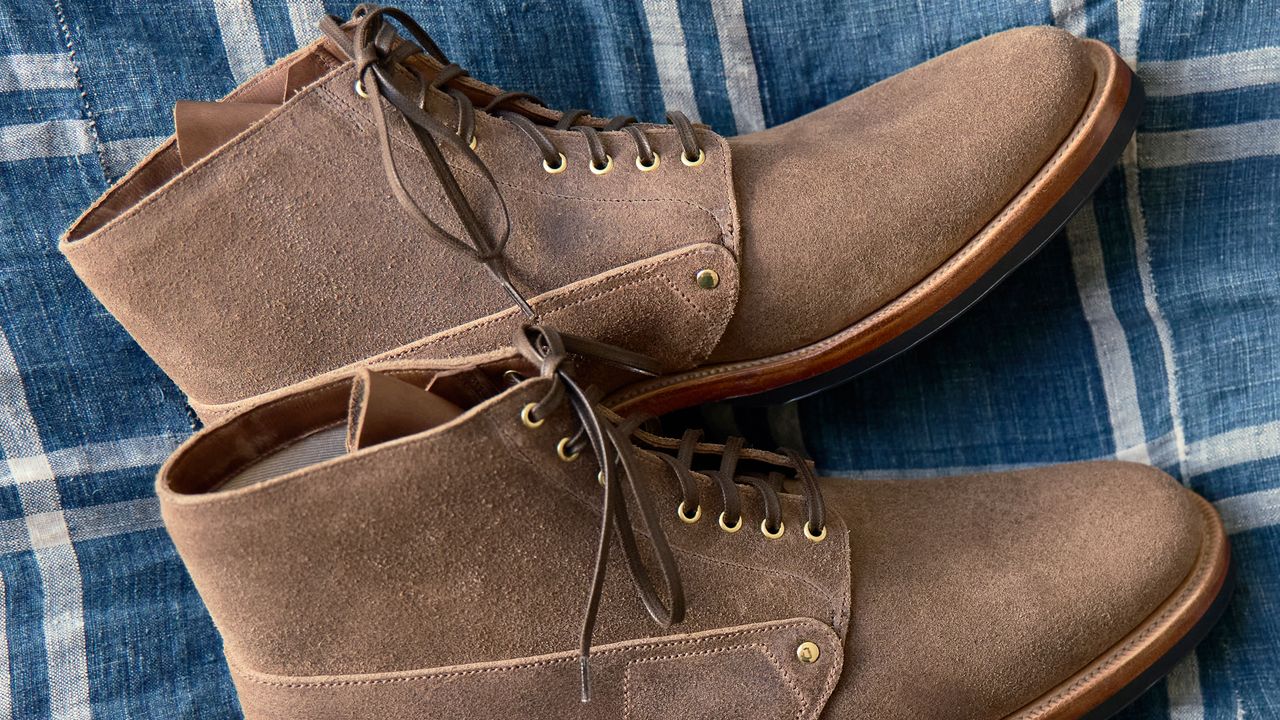
Viberg teamed up with vintage savant Gauthier Borsarello to reimagine a legendary WWI-era boot.Say you wanted to create the perfect pair of vintage-style military boots. First, you’d need a designer with impeccable taste and encyclopedic knowledge of vintage workwear; then you'd need a bootmaker with the requisite skills to produce it at the highest level. If everything went right, the result would be something like the Modèle 1917, a new collaboration between famed Parisian creative director Gauthier Borsarello and renowned Canadian bootmaker Viberg.In basic terms, the Modèle 1917 is a pair of boots based on the French Army’s 1917 “brodequin,” a design used by soldiers in the trenches of WWI, available in soft brown suede (Mud) and glossy textured black leather (Pavement). But there’s nothing basic about them. The design comes courtesy of Borsarello, a top-tier collector of vintage workwear and the creative mind behind Gersaint Paris and L’Etiquette magazine. Viberg, a third-generation, family-owned boot specialist, got its start making footwear for forestry crews in British Columbia, and it still builds every pair in its Vancouver Island workshop. While it doesn’t make boots for smokejumpers and loggers anymore, old-school shoemaking techniques like a channeled insole Goodyear welt and stitchdown construction ensure their footwear retains its heirloom-level durability.Courtesy of VibergThe backstory of the “brodequin” begins with the Mdl. 1893, a hobnail-soled marching boot created for French infantrymen in the late 1800s that remained in use until the 1950s. In the First World War, the brodequin’s iron-studded soles and sturdy uppers proved ideally suited to the muddy conditions of the trenches, and American troops soon adopted them in place of their inferior M1904 Marching Shoes. “To me, it’s the blueprint for many combat boots across different countries after WWI,” says Borsarello. “I love the idea that France inspired others after fighting side by side in the trenches. They’re very simple, yet instantly recognizable at the same time.”For all of its strengths in the field, the original brodequin—whose nickname pays tongue-in-cheek homage to a medieval torture device—wasn’t what you’d call a comfortable boot, especially by modern standards. “They were so stiff that they were almost impossible to walk in,” Borsarello admits. This created something of a design challenge.Gauthier Borsarello To stay as true as possible to the original, Borsarello and Viberg designed the boots on a period-correct “pied haricot” (bean-shaped) last, with a cotton twill lining, solid brass hardware, and reinforced panels that support the midfoot so the forefoot can move freely. To make the Modèle M1917 something you’d actually want to wear, they replaced the hobnailed soles with rubber ones and swapped the original roughout leather for supple American-tanned Horween. The result is a pair of boots that are as comfortable as they are durable, not to mention surprisingly versatile. In other words, exactly what you’d expect from a meeting of these formidable talents.Sign up for Show Notes to get news on the latest runway shows, parties, and insider events on the international fashion circuit.Jeremy Freed writes about style, culture, and watches for GQ. His work also appears in Puck, The Globe and Mail, and The Wall Street Journal, among other fine publications. His favorite sandwich is the #19 at Langer’s. He is also the author of American Style: The Look and Legacy of ... Read More
Two Menswear Darlings Just Made the Most Covetable Boots of 2026
Full Article
Original Source
Read the full article at Gq →KhanList aggregates and links to publicly available news content. We do not host full articles from third-party sources. Always verify important information with original sources.