
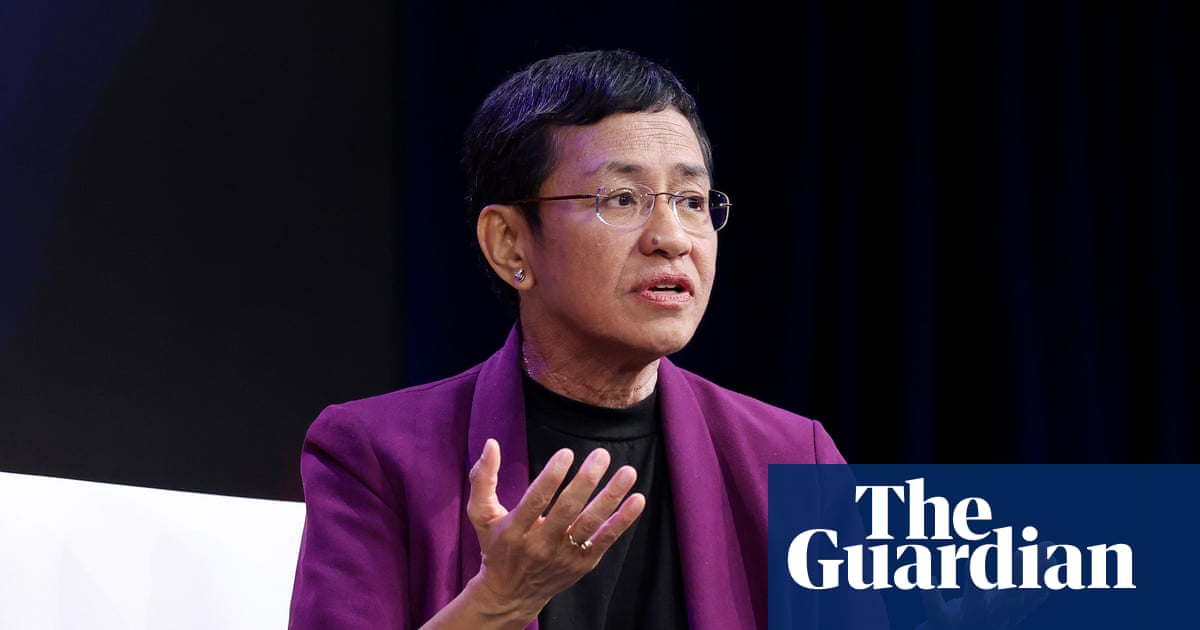
Maria Ressa keeps apologising. “Sorry, I’m hyper, too much coffee!” she says at one point. “Sorry, I can rant for a long time, so you have to stop me!” she says at another.Ressa can be forgiven for firing on all cylinders. The Nobel peace prize laureate has just been to a screening in Britain of The Social Reckoning, which offers an unflattering portrayal of the tech titan Mark Zuckerberg, a man she regards as a “dictator”. Now she is speaking to the Guardian at a hotel in Washington’s Dupont Circle a few days before Americans vote in critical midterm elections.Ressa, a 63-year-old, 5ft 2in force of nature, reflects: “I feel like the train is coming at us in slow motion and we’re standing on the train tracks.”The Filipino and American journalist has been sounding alarms for a decade. In 2016 she warned Zuckerberg and other Silicon Valley executives that an authoritarian disinformation model being tested in the Philippines would soon be exported to the west. Like Cassandra, she was not believed. Now, with Donald Trump in the White House and tech billionaires actively reshaping the US state, Ressa has a new cri de cœur.The Fight Back: A Citizen’s Guide to Standing Up to Dictators is a survival manual for confronting the convergence of authoritarian governance and tech oligarchy. It finds democracies facing a crisis of truth (the breakdown of facts and shared reality), a crisis of order (the breakdown of law and international rules) and a crisis of accountability (institutions are captured, the law is weaponised and the most powerful economic and tech actors operate without democratic oversight).Ressa’s warnings are rooted in experience. She spent nearly two decades as an investigative reporter and bureau chief for CNN in Manila and Jakarta, covering terrorism, ethnic conflict and the precarious transitions of post-authoritarian societies across south-east Asia.In 2012, convinced that digital technology offered a tool to empower citizens and demand transparency, she co-founded Rappler, an independent, digital-first news organisation in the Philippines. Blending hard-nosed investigative journalism with data science and community engagement, Rappler quickly established itself as a vital watchdog in a fragile democracy.When Rodrigo Duterte was elected president in 2016, Ressa found herself at the front line of a terrifying global experiment. As Duterte unleashed a bloody extrajudicial drug war that claimed thousands of lives, his regime weaponised social media to silence critics, deploying state-backed troll armies to poison public discourse and wage psychological warfare.Philippines president-elect Rodrigo Duterte speaks to journalists in Davao City in June 2016. Photograph: Manman Dejeto/AFP/Getty ImagesRappler’s reporting exposed the machinery of manufactured outrage, making Ressa the authoritarian government’s public enemy number one. She endured an onslaught of online harassment, including rape threats and death threats, and an aggressive legal offensive by the state, with 11 cases filed against her, including charges of cyber libel and tax evasion.Rather than flee or capitulate, she posted bail 10 times and turned her courtroom battles into an international campaign for press freedom. In 2021 she was awarded the Nobel peace prize, alongside Russian journalist Dmitry Muratov, for safeguarding the freedom of expression that underpins democracy.The personal toll has been immense. “I wish I could get more sleep,” she says matter-of-factly. “I worked in war zones and the only difference is you’d walk into conflict and stay two weeks to a month and then you could come out and decompress for a month. This is a decade of non-decompression.”Ressa’s experience in the Philippines informs The Fight Back, but she argues that the threat is now much wider. A report published earlier this year by the V-Dem Institute, a Swedish research centre that measures the health of democracies worldwide, found that democracy had fallen back to 1978 levels for the average global citizen, with three-quarters of the world’s population living under autocratic rule.In the US, the level of democracy had fallen to its lowest point since 1965. The report contained a sentence that Ressa had to read three times and still haunts her: “The speed with which American democracy is currently dismantled is unprecedented in modern history.”Early in Trump’s second term, comparisons with authoritarian leaders such as Duterte in the Philippines and Viktor Orbán in Hungary were commonplace. But it soon became apparent that the US president was moving with a scope and speed that would leave even those autocrats envious.Donald Trump hosts a bilateral lunch Hungarian PM Viktor Orbán in November last year. Photograph: Jonathan Ernst/ReutersRessa writes: “What took Hungary’s Orbán four years, Serbia’s Vučić eight years, India’s Modi and Turkey’s Erdoğan a decade, Trump accomplished in one year. Legislative constraints lost one-third of their value in 2025, the lowest in more than one hundred years. As in the Philippines, Congress has effectively abdicated its oversight role. At least 55% of the 320 objectives set out by the far-right Heritage Foundation’s Project 2025 have already been achieved.”The rise of technology has become a driving force behind democratic decay. Ressa writes: “There are two dictators in my story: Duterte and Zuckerberg. This is not hyperbole. This is a statement about power, accountability – and impunity – in the 21st century.”The fusion of state power and oligarchy was symbolised on 20 January 2025, inauguration day, when tech leaders including Zuckerberg, Elon Musk, Jeff Bezos, Sundar Pichai, Sergey Brin, Tim Cook and Sam Altman were given prominent seats ahead of Trump’s cabinet nominees as he took the oath of office.The symbiotic relationship operates through mutual self-interest: autocrats require tech platforms to distribute propaganda and paralyse public opposition, while tech oligarchs require state deregulation, tax relief, military contracts, and protection from international antitrust enforcement.Which poses the bigger threat, Trump or big tech? Ressa has no hesitation in answering: “The big tech, because they themselves, the CEOs, are now saying: stop us. That’s kind of performative. You can stop yourself! You’re the one building this.”Even Rappler was built as a digital-first newsroom that partnered with platforms and engineered tech. Wielding her phone, Ressa acknowledges: “We’re frenemies. I like tech. Rappler is a partner of every tech company. We build tech.”Maria Ressa pictured in Manila in 2018. Photograph: Richard James Mendoza/NurPhoto via Getty ImagesBut when she begged tech companies to “prioritise facts”, she realised facts have never been part of the AI equation. “It’s a probabilistic machine, which actually discounts facts. When you put that as the operating system of public information you create what we’re living through now. Then they made it worse because they added algorithms that will keep you scrolling longer so that means fear, anger, hate. It is the worst of who we are.”She regards big tech as predatory and extractive. Their monopolies built valuations by ingesting journalism without compensation. “The raw material is the world’s knowledge. It is what we write that is expensive. They just scrape it.”And by engineering algorithms for sensationalism and “outrage machine”, platforms altered human psychology, Ressa argues. “The incentive structure of our world changed with big tech. I always say to my friends who have kids: imagine if you keep telling your child, ‘Lie. I’m going to keep rewarding you, and then keep lying and I’m going to keep rewarding you.’ What kind of adult does your child become? That’s the world we’re creating.”The new generation of tech overlords are, in her view, dictators. “They make decisions for us without our inputs, without any accountability, and it impacts all of us. This is a public safety issue. It’s like taking the lead out of your water. Every day that governments do not regulate, they lose more and more of their power.”No figure illustrates this surrender more starkly than Elon Musk, who poured hundreds of millions into electing Trump, ran the “department of government efficiency” (Doge) and weaponised X: “Look at Elon Musk. He now has the architecture of the information ecosystem. He runs public information through X and he has political power and yet he’s accountable to no one. He just decides to stop Starlink for Ukraine. What happens to Ukraine?”For Ressa, the central problem is not merely the power of these companies but the absence of accountability. She argues that, while institutions such as the international criminal court exist to bring political leaders to book for crimes against humanity, there is no equivalent system of accountability for tech executives who shape the information consumed by billions of people.“Rodrigo Duterte was arrested in March 2025 and his trial at The Hague for crimes against humanity begins November 30. So at some point, we still have a system that demands accountability for states.“For tech? Mark Zuckerberg has just gained more power, has taken the same culture of move fast, break things and brought it to the frontier models, and he has been appointed to President Trump’s council of advisors on science and technology. He’s gained more power and the impunity continues.”In January 2025, Meta ended third-party factchecking in the US. Ressa calls this cutting a vital “lifeline to reality” as Trump returned. She says: “He stopped fact-checking in America. Think about that. We still have fact-checkers in the Philippines. Imagine, why did he do this in America? Is that to curry favour with Trump?”Zuckerberg with Trump at the White House in September. Photograph: Kevin Lamarque/ReutersRessa had initially been struck by what she saw as the passivity of US society in the face of Trump’s assault on democratic norms. She says: “Americans stayed like deer in headlights longer than Filipinos. I thought, maybe it’s because we actually did get rid of a dictator: we had a People Power revolt in 1986.“But [here there is] American exceptionalism, the American idea that, ‘We’re not manipulated.’ I was worried until Minneapolis. When push comes to shove, that actually defines who you are.”This is a reference to the early 2026 immigration raids that led to the killings of Renée Good and Alex Pretti. Citizens responded with mutual aid networks, car horns and volunteer “constitutional observers”. Ressa compares Stella Carlson, who filmed Pretti’s death, to Aika Rey, a 24-year-old reporter who livestreamed Ressa’s arrest in Manila in 2019. In The Fight Back’s prologue, Ressa writes: “Courage isn’t the absence of fear; it’s the decision that something matters more.”The Fight Back provides readers with practical steps, beginning with simple habits: track phone screen time for seven days to understand exposure to algorithmic manipulation, then delete the one social media app that makes you angriest. A few days after this interview, midterm voters delivered a resounding vote of no confidence in Trump despite another cash influx from Musk.But the ebullient Ressa keeps talking like she’s running out of time. “I feel like we have months,” she says. “I’m going to keep sprinting, and it’s been a decade of sprinting. If we don’t get this right in the next few months, the French elections are in April; we already saw what’s happening in Germany.“If we don’t get this right, the world will fundamentally change and it will be far more difficult to claw back rights. In which case, I’m going to go be a hermit somewhere.”
‘Two dictators in my story – Duterte and Zuckerberg’: Nobel peace prize winner’s warning for democracy
Full Article
Original Source
Read the full article at Theguardian →KhanList aggregates and links to publicly available news content. We do not host full articles from third-party sources. Always verify important information with original sources.