
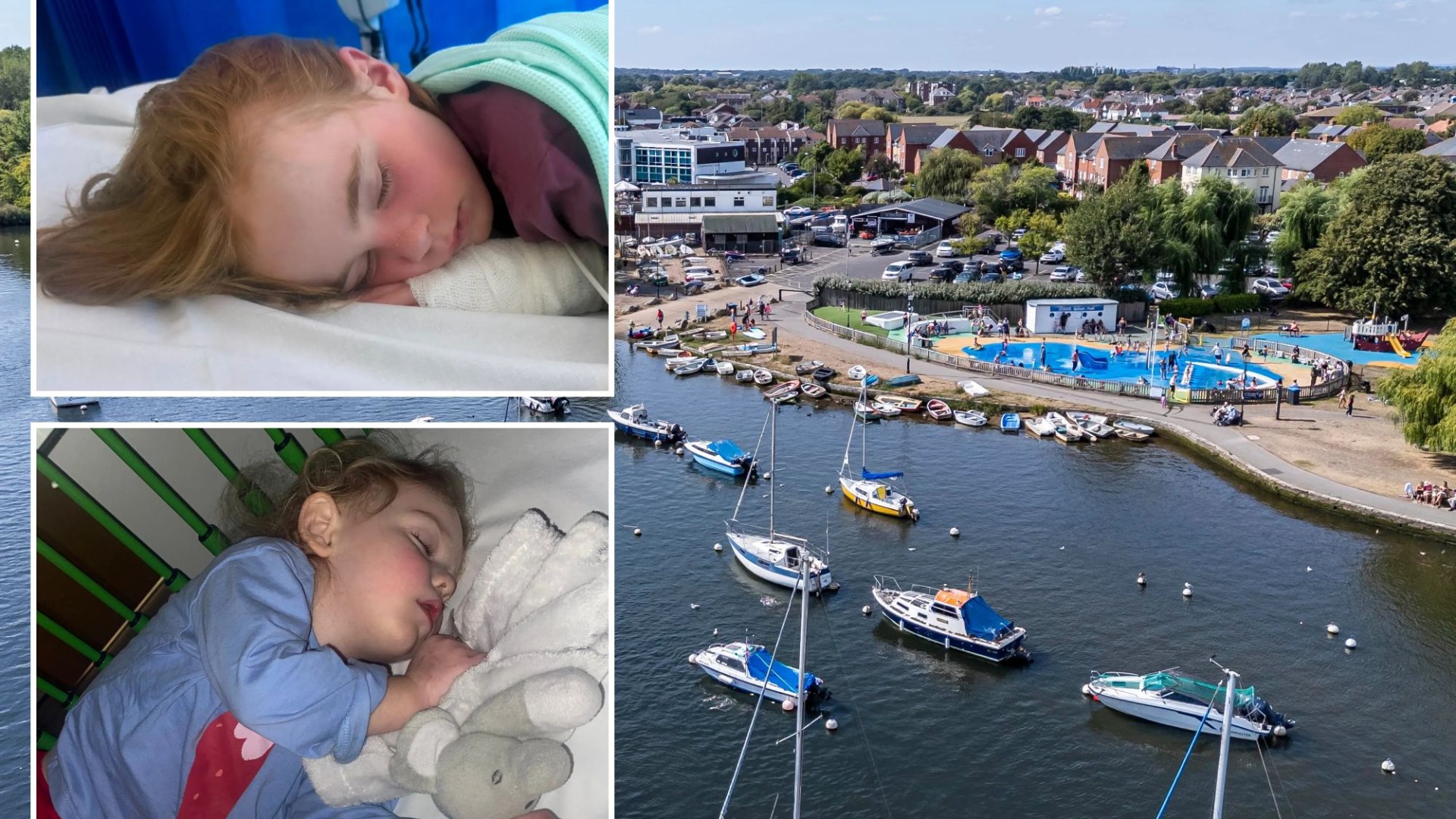
TWO young children have been hospitalised after swimming at a UK seaside town. Three-year-old Ivy Foster fell ill after paddleboarding in Christchurch Harbour in Dorset with her mum, while Keeva Hollow, eight, swam off Avon Beach, which is close to the entrance to the harbour. Ivy Foster, 3, fell ill with E.coli poisoning after paddleboarding in Christchurch Harbour Credit: BNPS Keeva Hollow was also rushed to hospital Credit: BNPS While Ivy, who had E.coli, has now been discharged, Keeva remains in hospital with the bacterial infection campylobacter. Both bugs can be caught from swimming in, or swallowing, water that is contaminated with faeces. Sign up for the Health newsletter Thank you! The parents of both children have released photographs of them in hospital to highlight ongoing pollution concerns with Christchurch Harbour. The harbour has been described as the ‘toilet bowl of Bournemouth’ as two rivers – the Stour and Avon – drain into it. Ivy’s mum Kimberley said she is disgusted at the state of the harbour. She said: “We were at Mudeford Quay paddleboarding and when the tide went down we noticed this horrendous smell and we got out of the water, it was disgusting. “We went home and a few days later Ivy became really poorly. “The doctor said she probably caught this because of the water. Most read in Health Ivy was hospitalised twice Credit: BNPS Kimberley Foster said the water at Christchurch Harbour was disgusting Credit: BNPS Ivy endured two spells in hospital as the infection was resistant to several different antibiotics. She suffered from vomiting, diarrhoea, abdominal pain and a temperature and at one stage her family feared she was going to die. Thankfully, doctors were able to get the infection under control and she was discharged from Poole Hospital on August 25. Kimberley, a 34-year-old hairdresser, said: “Before her second admission to hospital she really went down hill. “She had abdominal pain, sickness, a temperature of 39.2C and diarrhoea. “She couldn’t hold anything down so they put her on an IV drip and gave her fluids. “It was a scary, horrendous time and I thought she was going to die. “The doctors are confident that this latest course of very strong antibiotics seems to be working, and Ivy is finally coming back to her lovely self.” Keeva is still not fully recovered a month later Credit: BNPS Volunteers identified high levels of E. coli in Christchurch Harbour Credit: BNPS Meanwhile Keeva was hospitalised with the bacterial infection campylobacter. She swallowed some water when she was hit by a wave, and within 24 hours was ill with a high temperature and diarrhoea. She was rushed to A&E and she was placed on an IV drip. She lost a lot of weight and is still not fully recovered a month later. The River Stour runs around the back of heavily populated Bournemouth and Christchurch, passing agricultural land with cattle, building sites and sewage treatment plants. The mouth of the harbour is very narrow, meaning pollutants struggle to flow into the sea before the tide rises. Last week, volunteers who regularly test Christchurch Harbour for pollution revealed they had recorded high levels of E.coli in the water. E.coli levels for safe bathing and swim water are meant to be at no more than 1,000 Colony Forming Units (CFUs), according to an EU directive. But Martin Stewart, chairman of the Christchurch Harbour & Marine Society (CHAMS), said their readings for August 15 were 130,000 and rose drastically to 370,000 by August 19. CHAMS chairman Martin Stewart testing the water for E.coli Credit: BNPS Readings for August 15 were 130,000 CFUs and 370,000 by August 19 Credit: BNPS A watersports club in Christchurch Harbour was last week forced to cancel its on-water events, following news of the children’s hospitalisations. It’s thought a woman also fell ill after coming into contact with the water in the harbour. On Tuesday, 500 concerned residents flocked to a public meeting to discuss the state of the local waterways, where they challenged representatives from Wessex Water, the Environment Agency and the National Farmers’ Union. Following the meeting, Kimberley said: “I’m disgusted because I live in Mudeford and the beach is normally our first port of call as a family. “But after this I’m not taking my children there any more and I would tell people to stay out of the water.” Mr Stewart said: “Anyone who is using the harbour has to be very careful not to ingest the water or expose any cuts to the water. Symptoms of E.coli typically present as severe stomach cramps, diarrhea, nausea and fatigue Credit: Getty E. coli symptoms Escherichia coli, also called E. coli, bacteria live in the intestines of people and animals. Most types of E. coli cause no harm or mild illness. But a few strains, such as E. coli O157:H7, can cause bad stomach cramps, bloody loose stools and vomiting, called diarrheal infection. Symptoms of E. coli diarrheal infection most often begin three to four days after contact with the bacteria. But symptoms can start as soon as one day after contact. Or they can begin more than a week later. Symptoms of E. coli diarrheal infection may include: Loose stools, which may range from mild to serious and from watery to bloody. Stomach cramping, pain or tenderness. Upset stomach and vomiting. “It is a serious situation, somebody is going to die from this.” Mr Stewart and his colleagues have been testing the water for nitrates and phosphates for four years but started checking for E.coli last year. They mostly take samples from both rivers about 300 metres from the harbour. The Environment Agency said their most recent sampling found E. coli levels to be ‘within the range expected’ for Christchurch Harbour. An Environment Agency spokesperson said: “Our officers’ sampling showed E. coli levels to be within the range we would expect to see in Christchurch Harbour. “We have thoroughly checked water company discharges and investigated other potential sources of pollution linked to the elevated E. coli readings and are yet to identify a source. “Bacterial levels in natural waters can vary significantly due to factors such as weather, tides water conditions and time of day. “The harbour is also subject to a large range of bacteria sources including birds, urban run-off, agriculture and private treatment systems.” A Wessex Water spokesperson said: “Last month’s reported high E. coli readings in the Stour did not relate to Wessex Water or its assets. “Christchurch Harbour is a catchment serving a largely rural area where water quality can be influenced by wildlife, agricultural run-off, private sewage sources and numerous other factors. “Environment Agency data does not identify discharges from water industry assets as the reason for the harbour not achieving a higher ecological status.” Comment now
Two children fighting for their lives in hospital pictured after swimming in “disgusting” water at UK seaside town
Full Article
Original Source
Read the full article at Thesun →KhanList aggregates and links to publicly available news content. We do not host full articles from third-party sources. Always verify important information with original sources.