
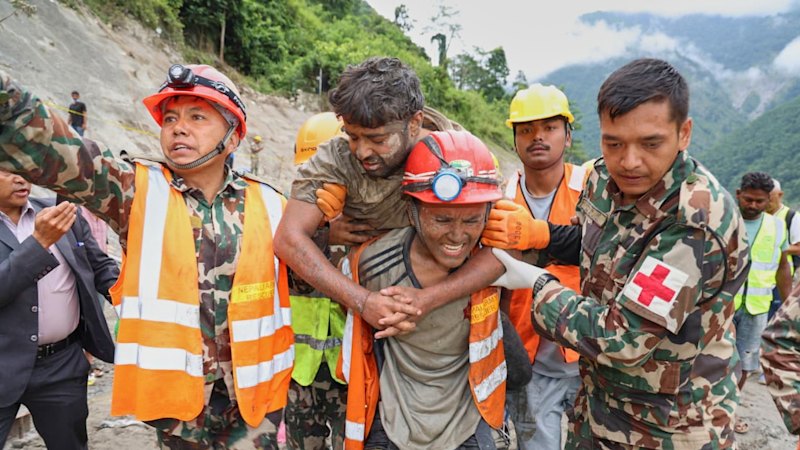
September 4, 2026 — 5:05pmSydney/Kathmandu: Two more Australians have been found safe in Nepal as two workers were pulled alive from a hydropower project tunnel, nine days after an ice, rock and mud slide swept through a Himalayan valley, killing more than 1200 people and displacing tens of thousands.The two unidentified Australians, who were previously uncontactable, confirmed they were well and did not require consular assistance, taking the number of citizens still unaccounted for down to 36.Sanjay Sah, a mechanical foreman, was carried out on the back of a worker to a rescue tent, his face covered in mud.Nepal Army via APKabir Maharjan, a mechanical supervisor, was pulled out of a hole in the ground amid cheering bystanders and put on a stretcher.Nepal Army via AP“Two more Australians were located overnight, that would be a huge relief to [their] loved ones,” Treasurer Jim Chalmers told ABC TV on Friday. “We still have very serious concerns for the 36 we haven’t been able to locate yet.”The two rescued workers were identified as Sanjay Sah, a mechanical foreman, and Kabir Maharjan, a mechanical supervisor, at the Upper Trishuli 3A Hydropower Station. They were among about 900 workers missing from Nepal’s 12 hydropower projects, with about 500 believed to be trapped in tunnels.Videos and photos made public by Nepali authorities showed Maharjan being pulled out of a hole in the ground amid cheering bystanders and put on a stretcher.The other man, Sah, was carried out on the back of a worker to a rescue tent, his face covered in mud. A team of army doctors attended to Sah at a tent near the tunnel, fitting what appeared to be an oxygen mask around his mouth and checking his vital signs, in one of the videos.Maharjan could not move his hands and legs, but Sah’s injuries were not critical, an aide to the energy minister said.Amir Maharjan, Kabir’s brother, said he had been told to go to the hospital. “I have been hearing from the news that my brother has been found. The entire family is very happy,” Amir said.Nepalese Communication Minister Bikram Timilsina said officials remained hopeful that more workers would be rescued.Last Wednesday’s flash flood wiped out towns and villages and killed more than 1250 people, with more than 4200 still missing, including at least 583 foreign nationals.Prime Minister Anthony Albanese said on Friday that he had spoken by phone to Nepal’s Prime Minister Balendra Shah, extending Australia’s deepest condolences. He is understood to have expressed his gratitude for efforts to search the last known locations of missing Australians.“Australia stands by Nepal and is providing help where it’s needed most through humanitarian supplies, equipment and specialised capabilities,” Albanese posted on X.“The loss of life and destruction is devastating, and we will keep doing everything we can to find the Australians still unaccounted for. Our thoughts are with the families and loved ones of those Australians who are still missing.”A 15-member Australian Disaster Assistance Response Team, made up mostly of drone pilots from state emergency services, was deployed following a request from Nepal’s government.“We are still holding out hope that people might still be surviving in ... some locations and hopefully this team can help to locate any of those people,” Fire and Rescue NSW commissioner Jeremy Fewtrell told reporters at Sydney Airport on Friday.“Predominantly, the team is made up of pilots for our specialist drones,” he said, adding that they were able to survey large areas from the air and navigate confined spaces that might be inaccessible to rescuers.Seven Australian Federal Police disaster victim identification specialists are due to arrive in Nepal on Saturday.On Thursday, Foreign Minister Penny Wong confirmed that local authorities would conduct searches in areas where many Australians were believed to have been staying.“We continue to work around the clock to ascertain as much information as we can and provide it to the families of missing Australians,” Wong told reporters.Some relatives of missing Australians have travelled to Nepal to conduct their own searches.As well as the human toll, Nepal’s disaster authority has estimated that property, housing and infrastructure worth at least 387.5 billion Nepalese rupees ($3.56 billion) was lost in the catastrophe.Nepal would need to rebuild about 20,000 houses in flood-ravaged areas, National Disaster Risk Reduction and Management Authority chief Dharma Raj Upreti said.In the first four months of early recovery, the estimated cost to build roads and temporary shelters, provide drinking water and restore power would be about $73 million, Upreti said.“These are estimated amounts. We have calculated this in co-ordination with different concerned agencies and departments,” he said, adding that a detailed assessment would be done soon.Australians have donated more than $4 million to the Emergency Action Alliance to support recovery efforts. The federal government will provide a further $3 million to match public donations, bringing the ongoing humanitarian support package to a total of $11 million.Aid supplies aboard a Royal Australian Air Force plane arrived in Kathmandu on Wednesday. More than 1400 hygiene kits, 2200 solar lights and phone chargers were among the items on board.More than 9300 Nepalese army troops have been deployed to the affected areas of Timure in Rasuwa, Nuwakot, Dhading, Chitwan and Nawalparasi East, co-ordinating search-and-rescue operations, helping to recover bodies, clearing blocked roads, and providing emergency medical treatment.A Nepalese army officer who spoke on condition of anonymity said the search was continuing with experts from India, South Korea and China for the hundreds of workers believed to be trapped in the hydropower plant tunnels.“The search-and-rescue operation will continue as long as there is any hope of finding survivors,” he said. “Even if there are no survivors, we will recover the dead bodies.”Search-and-rescue teams at the exit tunnel of the Chilime Hydropower Station near Syabrubesi, where workers are believed to be trapped.Kate GeraghtyA man amongst debris and destroyed buildings in Betrawoti, which was severely affected by the flash flood.Kate GeraghtyAuthorities were also working to restore regular routines as much as possible, with a focus on getting children into makeshift schools. More than a week after the flood, at least 22,000 children urgently needed safe drinking water, sanitation and hygiene support, UNICEF said in a statement.Meanwhile, China had sent a third batch of aid to Nepal, including tents, blankets, medical protective suits and satellite communication equipment, the Foreign Ministry said, adding that the weather offices of the two countries were in contact.“China will continue to provide emergency assistance based on Nepal’s needs and carry out international rescue co-operation,” Foreign Ministry spokesperson Guo Jiakun said at a daily briefing.Reports on the rescue efforts in Tibet, largely provided by Chinese state media as foreign reporters’ access to the region is restricted, have slowed a day after the main road leading to the site was reopened.Since Wednesday morning, rescue teams have been able to enter the site where the Gyirong border crossing complex once stood, bringing excavators and specialised equipment with them.From our partners
Two Australians found safe in Nepal as two trapped workers rescued from tunnels
Full Article
Original Source
Read the full article at Smh →KhanList aggregates and links to publicly available news content. We do not host full articles from third-party sources. Always verify important information with original sources.