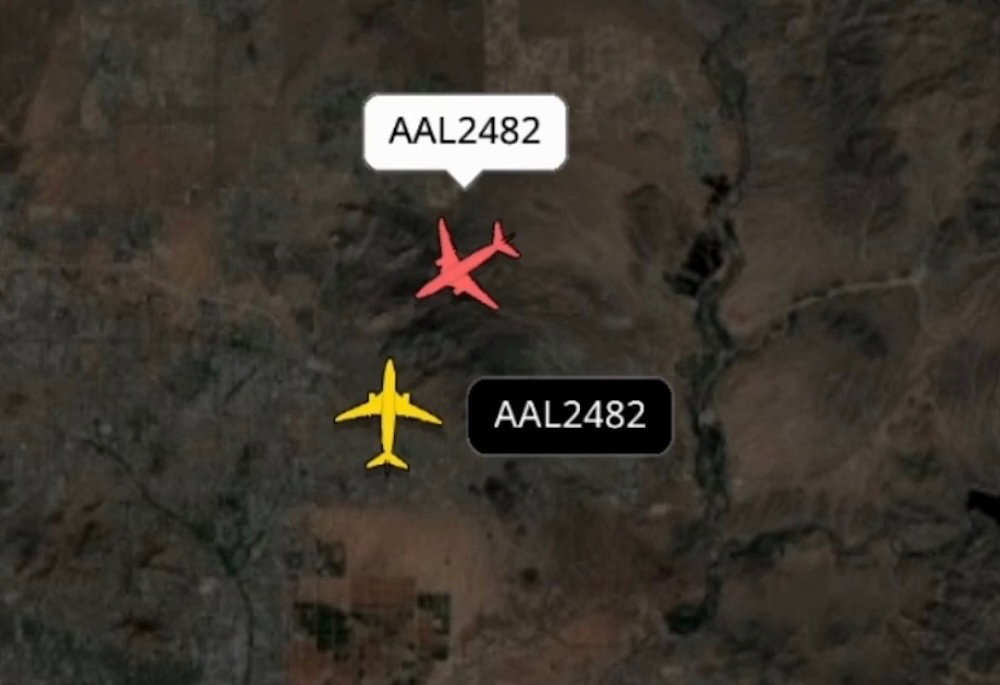
Two American Airlines jets with exactly the same callsign ended up on the same air traffic control frequency, basically flying toward one another. This is very odd, and one wonders how exactly this happened (thanks to Hans for flagging this). American flight AA2482 double trouble in PhoenixHow did this American callsign situation get messed up?Bottom line American flight AA2482 double trouble in Phoenix Every flight has a callsign that’s used with air traffic control, and for commercial aircraft, that’s generally going to be the generic airline callsign plus the flight number. Callsigns are of course unique to a particular flight, because that’s the way that air traffic control communicates with pilots. That brings us to what happened very late last night (Thursday, August 13, 2026), in Phoenix. AA2482 is a flight number used by American between Chicago (ORD) and Phoenix (PHX). The flight number is actually used in both directions of travel, which isn’t that uncommon, with both flights being operated by Boeing 737-800s. However, things got a little strange last night, because it’s not necessarily the same plane that flies in both directions (since American has many 737s in Phoenix that it can swap around). Last night: AA2482 from Chicago to Phoenix landed at 12:13AM, well behind the scheduled 10:43PM arrival AA2482 from Phoenix to Chicago took off at 11:58PM, roughly on-time, given its scheduled 11:45PM departure What happened is that both planes ended up on the same Phoenix air traffic control frequency at the same time, with the same callsign. You can see the visualization of that below, along with the air traffic control audio. As you can hear, the air traffic controller says “I’ve been working air traffic for 25 years, I’ve never seen two aircraft pretty much merge with the same callsign, that’s pretty incredible.” He handled this like a champ, making it clear to pilots of both planes that there was another plane with the same callsign on the frequency. He was great about speaking clearly, and clarifying “American 2482 on the arrival” vs. “American 2482 on the departure.” The pilots of both planes also deserve credit, because they were (understandably) paying extra close attention. How did this American callsign situation get messed up? As I mentioned above, on the surface, it’s not unusual to see the same callsign used for multiple flights, and in theory, it’s possible the two planes are in the air at the same time. However, in situations where that’s the case, what typically happens is that one of the planes takes on a different callsign, even if it’s something as simple as adding a letter to the end of the flight number, “like American 2482 bravo,” or something. One thing I’m not sure of is who would typically be responsible for ensuring that? Is that something that a company’s operations department is supposed to take care of, does air traffic control somehow do that, or something else? In other words, who wasn’t doing their job here? This is definitely unusual, though, as it’s kind of wild how the two planes ended up on the same frequency, basically heading for one another. What are the odds of that? Bottom line Two American Airlines planes ended up on the same air traffic control frequency with the same callsign, basically heading straight for one another. Ultimately the flight number is used for both directions of travel between Chicago and Phoenix, but in this case, the Chicago to Phoenix flight was delayed, while the return flight operated on time, obviously with a different aircraft. I think the air traffic controller said it best — in his 25 years on the job, that’s the first time he saw something like that. What do you make of this odd air traffic control situation?
Two American Planes With Same Callsign End Up On Same Frequency, Heading Straight For One Another
Full Article
Original Source
Read the full article at Onemileatatime →KhanList aggregates and links to publicly available news content. We do not host full articles from third-party sources. Always verify important information with original sources.