
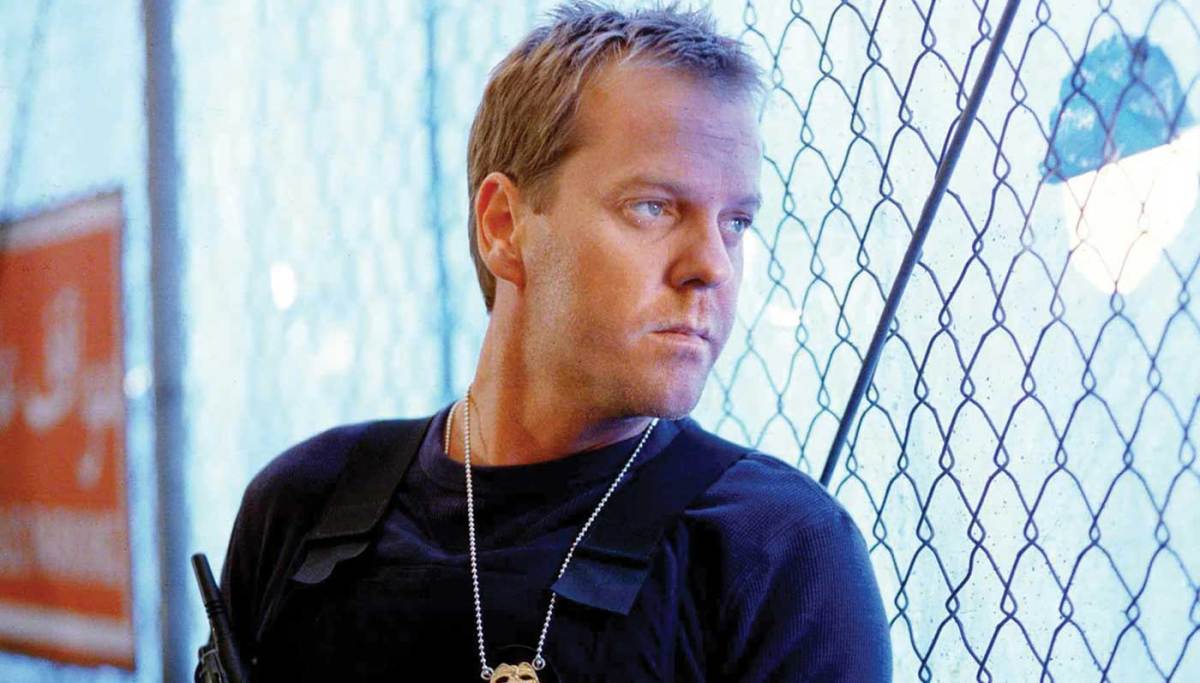
We are a different country than we were a quarter-century ago, when federal agent Jack Bauer first stayed up all night in our service. For one thing, around 90 million of us weren’t born in time for the November 2001 premiere of Fox’s 24. Another 10 million current Americans hadn’t immigrated yet, to say nothing of our countrymen who have since died or the post-2001 arrivals who have yet to officially join the team.Yet, compositional metrics aside, today’s nation is different in kind than the one that turned 24 into a hit in the months and years after 9/11. Twenty-five years on, it’s hard to describe how hungry we all were for some unapologetic ass-kicking on the part of Uncle Sam. The question then wasn’t whether Bauer (Kiefer Sutherland) should torture suspected jihadis but how foolish various bureaucratic-managerial types would look trying to stop him. Made today, a middlebrow counterterrorism saga like 24 would be diffident, morally ambiguous, and vaguely embarrassed to show its characters saving American lives. (Or it would just throw up its hands and be in Arabic.) Fox’s show at its peak was anything but. If Bauer and friends were on the job, the United States wouldn’t just come out ahead. We would deserve to.Intriguingly, 24 was never meant to be a show about Muslim terrorism. Season one, already filmed and edited before the events of 9/11, concerned the kidnapping of Bauer’s wife, Teri (Leslie Hope), and daughter, Kim (Elisha Cuthbert), in conjunction with an attempt on the life of presidential nominee David Palmer (Dennis Haysbert). Not until season two (2002-2003) did creators Joel Surnow and Robert Cochran explicitly align their series with the zeitgeist, crafting the first of several “bomb-is-ticking” plot lines that would come to define both 24’s tone and Bauer’s methods. That season, in which Islamists attempt to detonate a nuclear bomb in Los Angeles, actually featured a white villain: the Californian bride-to-be of an apolitical Arab Muslim. But that little irony fooled no one. America was at war with terrorism, and President George W. Bush’s “religion-of-peace” protestations notwithstanding, it was clear enough whence that terrorism came. Kiefer Sutherland on “24.” (Fox/Everett) If 24’s subject matter was an ideal fit for its day, the show’s technical construction was even better. Unfolding in (modulated) real time, the production’s two dozen episodes per season each tracked an hour of its protagonist’s day from hell. And, wouldn’t you know it, Bauer tended to encounter some mission-threatening obstacle around the 55-minute mark each week. The result was a series that felt custom-made for the then-new “binging” era of TV. Sure, you could watch 24 when it aired each week, but it was so much more satisfying to let half a season pile up on the DVR and then race through.The reader will permit me a personal reminiscence. My wife and I were first introduced to 24 two years after its debut, while staying with family our age. In that childless nirvana, armed with full box sets, we must have knocked out 10 episodes at a time, pausing only to eat the junk food our bodies could then withstand. More than two decades later, we all have teenagers, busy careers, and endless other demands on our time. It is not too much to say that I look back on that 24 weekend the way certain older men recall a summer in Haight-Ashbury before shipping off to Vietnam.Need I even state that the Left hated the show with a passion, seeing in its machinations all the purported brutish jingoism of George W. Bush’s America? Writing in 2005, Salon’s Spencer Ackerman complained that the series was “war-on-terror porn” featuring “ridiculously capable agents.” Harper’s magazine groused the next year that Bauer had “personally” tortured or killed 38 people during the show’s fifth season. (Fact check: They all deserved it.) What is perhaps more surprising is how much credence the series lends, in retrospect, to the New Right’s disdain for geopolitical intrigues. Season one’s troubles are the direct result of then-Sen. Palmer’s intervention in Serbian affairs, while Season five sees American leaders instrumentalizing foreign policy to make a buck. Maybe we haven’t become so different a country after all?24 was, and remains, easy to mock. Despite their omnicompetence, our finest counterterrorism agents could seemingly do nothing until a colleague “open[ed] up a socket,” a techno-babble exhortation that must have been uttered a thousand times across the show’s eight seasons. Notwithstanding Sutherland’s season-five acting Emmy, the series’ performances ranged from decent to terrible, with dishonorable mention going to whisper-mumbling Carlos Bernard as Bauer’s subordinate, boss, rival, friend, and foe Tony Almeida. What the show had, beyond a sense of the cultural moment, was outrageously good pacing and tonal control, qualities lacking in nearly every other network series, then and now. Whether one watched one episode or a dozen, 24 was guaranteed to hit its beats, look terrific, and leave one wanting just a little more.IN A NEW VERSION OF STEPHEN KING’S CLASSIC, WE GET THE ‘CARRIE’ WE DESERVE As other critics have remarked, Fox’s show helped pave the way for an American president of color, featuring in Haysbert’s Palmer a black Democrat with wisdom, grit, moral courage, and basically no ideology at all. Thank you, President Obama, for living up to that standard! I may be the first writer to see in William Devane’s ostentatiously butch Defense Secretary James Heller, from seasons 4 to 6, early rumblings of War Secretary Pete Hegseth. There, too, the comparison is unkind. Perhaps the best verdict is that 24 was for the Right what The West Wing (1999-2006) was for the other side: a through-the-looking-glass fantasy in which all our dreams came true and all our intellectual priors were confirmed. Like most great shows, Fox’s production worked on an emotional and spiritual level, not just a rational one.Indeed, one could argue that 24 was something less than rational from the start, contending as it did that those watching over us are capable, unflinching, and desirous of our good. If the last 25 years haven’t cured you of that delusion, nothing ever will.Graham Hillard is the TV critic for the Washington Examiner magazine.
Twenty-five years later, looking back on Fox’s classic ‘24’
Full Article
Original Source
Read the full article at Washingtonexaminer →KhanList aggregates and links to publicly available news content. We do not host full articles from third-party sources. Always verify important information with original sources.