
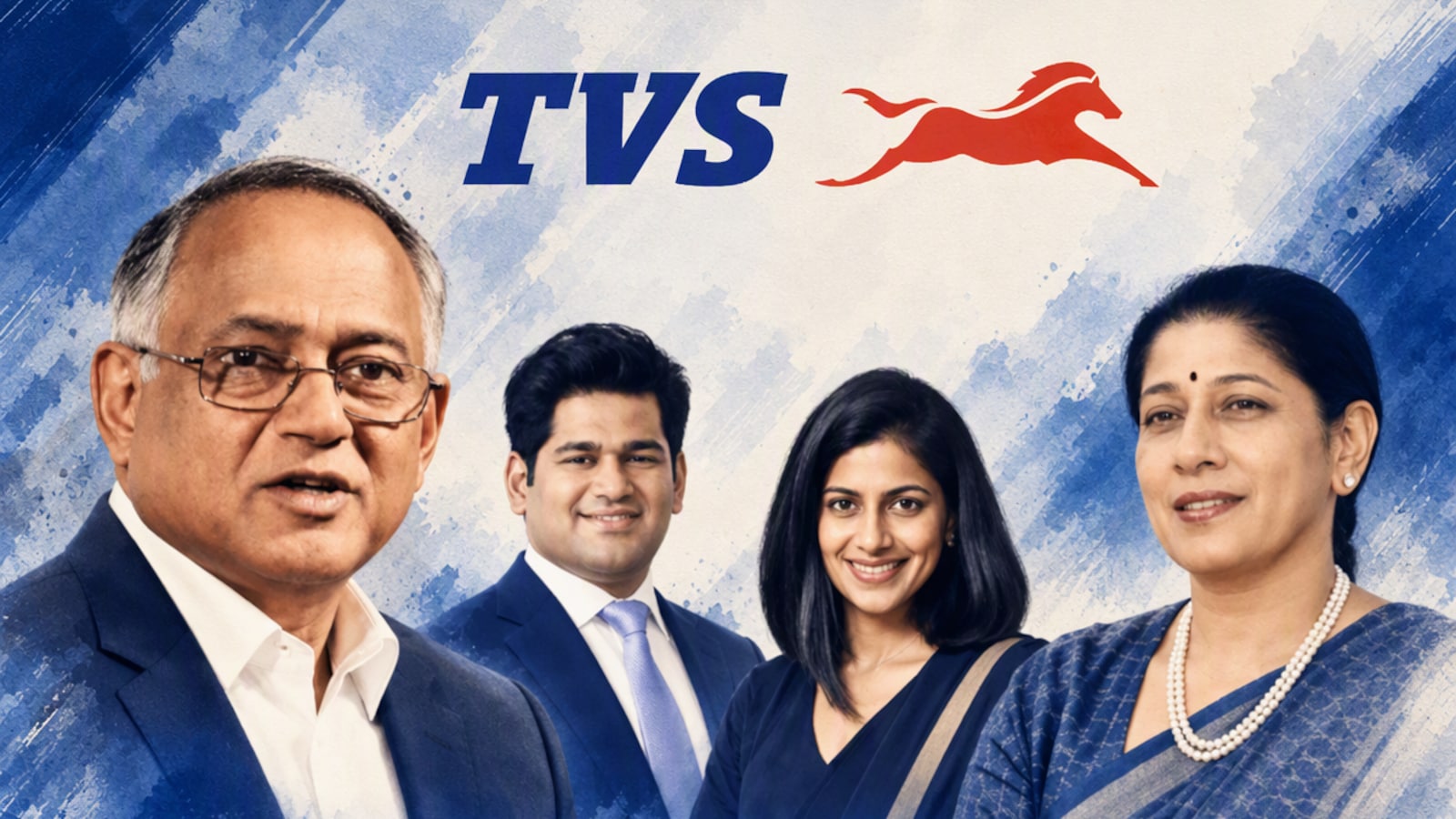
A family that has built a business empire over generations can face a difficult question when it is time to pass on the wealth: does handing over the management of a company also mean transferring its ownership? This question is at the centre of a succession dispute in the family of Venu Srinivasan, chairman emeritus of TVS Motor Company, one of India's largest two-wheeler manufacturers. Advertisement - Scroll to continue The disagreement has pitted Venu and his son, Sudarshan Venu, against his wife, Mallika Srinivasan, and daughter, Lakshmi Venu, over how the family's assets and business interests should be divided.The dispute has also drawn attention to the difference in the market value of the businesses associated with the two siblings. Here's a breakdown of the family, the businesses involved and what the two sides are arguing.Advertisement - Scroll to continueWho Is Who In The TVS Family Dispute?The dispute centres on four members of the Venu Srinivasan family.Venu Srinivasan: A prominent industrialist and chairman emeritus of TVS Motor Company. He is the father of Sudarshan and Lakshmi. He has argued that the division of businesses between his children was carried out in the family's best interests and that the arrangements have been concluded.Mallika Srinivasan: Venu's wife and chairperson and managing director of Tractors and Farm Equipment Ltd (TAFE), a major tractor manufacturer. She has backed Lakshmi's demand for a fair and transparent settlement of the family's economic interests.Sudarshan Venu: The couple's son. He is chairman and managing director of TVS Motor Company and managing director of TVS Holdings. His business interests are associated with the group's two-wheeler and three-wheeler operations.Lakshmi Venu: The couple's daughter. She is managing director of Sundaram-Clayton and vice chairperson of TAFE. She and her mother argue that being entrusted with management responsibilities does not settle her economic ownership rights in the family's wealth.The disagreement has broadly divided the family into two camps: Venu and Sudarshan on one side, and Mallika and Lakshmi on the other.Lakshmi Venu, Vice Chairman - TAFEPhoto Credit: TAFE Motors and Tractors LimitedWhat Is The TVS Succession Dispute About?At its heart, the dispute concerns whether the allocation of businesses to the two siblings also settled their respective claims to the family's wealth. According to reports, Sudarshan was entrusted with TVS Motor Company, while Lakshmi was associated with Sundaram-Clayton. Both siblings have management responsibilities in their respective businesses.But the two sides disagree over what this arrangement means for ownership. Venu's position is that the businesses and assets belonged to him and that he had the liberty to distribute them in a manner he considered appropriate. He has said the division was made to give the next generation ownership and control while they were young enough to build their enterprises. His side has also maintained that the family arrangements were based on valuations at the time and were implemented after taking the family's views into account.Mallika and Lakshmi reject the claim that an economic settlement has been completed. They say there was no transparent valuation, negotiated division of assets or mutual consent to settle the family's economic interests. In their view, the allocation of management responsibilities does not establish who owns the underlying wealth. They also argue that the economic interests of both children must be recognised fairly.This is the central distinction in the dispute: one side says the succession arrangements have been settled, while the other says the division of economic ownership remains unresolved.What Happened In The 2020 TVS Family Split?To understand the current disagreement, it is important to distinguish the dispute within the Venu Srinivasan family from an earlier division of the wider TVS Group. The TVS Group was founded by TV Sundaram Iyengar more than a century ago. Over generations, different branches of the founding family became associated with different businesses.In 2020, the wider group underwent a family settlement that divided business interests among different branches of the founding family. The arrangement involved corporate restructuring and financial obligations between the branches. Venu's branch retained the flagship automotive businesses associated with TVS Motor Company. The settlement also involved liabilities of around Rs 2,000 crore payable to other family branches, according to reports.However, the current dispute is not simply about that wider division.Venu's side argues that the subsequent arrangements within his immediate family were part of a succession process that had already been agreed upon and implemented.Mallika and Lakshmi say the 2020 settlement among the wider TVS family cannot be treated as a settlement of the economic interests within the Venu Srinivasan family.In other words, dividing businesses among different branches of the larger family and dividing wealth between Venu's two children are two separate questions.Mallika Srinivasan, TAFE, Chairman & Managing DirectorPhoto Credit: TMTL websiteWhat Is The 2024 Family Agreement, And Why Is It Important?A memorandum of understanding signed by the four family members on March 21, 2024, has become a major point of contention. The agreement included provisions relating to the use of the TVS brand and restrictions on competing in specified business segments.Under the reported terms, Sudarshan agreed to restrictions involving the use of the TVS brand in the die-casting business and competition in the tractors and farm equipment sector.Mallika and Lakshmi also agreed to restrictions on using the brand or entering specified sectors, including two-wheelers, three-wheelers, financial services and real estate, for defined periods.Venu's side views the agreement and subsequent arrangements as part of the broader division of family businesses and assets.Mallika and Lakshmi, however, say the MoU was limited to brand usage and non-compete obligations. According to them, it did not establish a final division of the family's economic interests. They have specifically rejected the suggestion that the 2024 agreement can be described as a completed settlement of the family's wealth.Notably, an agreement setting out which businesses family members can enter, or how they can use a common brand, does not necessarily establish who owns the shares and other assets held within the family. The two sides disagree not only over the fairness of the arrangement but also over what the agreement actually settled.Why Has The Division Of Wealth Become A Flashpoint?The dispute has gained attention because the businesses associated with the two siblings have very different market valuations.TVS Motor Company had a market capitalisation of around Rs 1.83 lakh crore, while Sundaram-Clayton's market capitalisation was around Rs 24,000 crore at the time.The difference is substantial. But the market value of two listed companies alone does not establish the value of each family member's total wealth or the fairness of a succession arrangement. The companies have different business operations, ownership structures and financial obligations. Their valuations can also change significantly over time.Venu's side has argued that the division was based on valuations prevailing when the arrangements were made. It has also maintained that subsequent changes in business performance or market value should not, by themselves, be grounds to reopen an agreed settlement.Mallika and Lakshmi, on the other hand, say there has been no transparent valuation process or mutually agreed division of the family's economic interests.This leaves a fundamental question unanswered: if one sibling is associated with a business worth substantially more than the other, what other assets, liabilities, ownership interests and commitments must be considered before deciding whether the overall division is equitable?Without a clear account of the assets and liabilities covered by the arrangements, market capitalisation figures alone cannot answer that question.Sudarshan Venu, Chairman and Managing Director, TVS Motor CompanyPhoto Credit: TVS websiteWhat Role Do TVS Holdings And Family Trusts Play?The dispute is also complicated by the way the family holds its interests through trusts and holding companies. TVS Holdings is a key entity because it owns a controlling stake in TVS Motor Company. According to recent reports, TVS Holdings owns 50.26 per cent of TVS Motor.The ownership structure of TVS Holdings is also significant. A family trust, VS Trust, holds 66.55 per cent of TVS Holdings, while other family holdings and trusts account for additional stakes.Venu Srinivasan is the sole trustee of VS Trust, according to a report by the Hindustan Times. This gives the trust a central role in the family's ownership structure.The dispute intensified after reports about company filings identifying Venu and Sudarshan as significant beneficial owners following share transfers through VS Trust.Lakshmi has said she was surprised by the disclosures and sought clarity about the family's ownership arrangements.Mallika and Lakshmi argue that the existence of a trust or the allocation of management roles cannot, on its own, settle the question of the economic interests of individual family members.A trust may hold shares in a company, a holding company may own shares in an operating business, and a family member may manage that business. These are separate legal and financial relationships.Determining who ultimately benefits from the assets requires examining the relevant ownership documents, trust arrangements and any valid agreements governing the distribution of economic interests.Where Does TAFE Fit Into The Dispute?TAFE adds another layer to the discussion because it is associated with Mallika Srinivasan and her family's business interests.Mallika is TAFE's chairperson and managing director, while Lakshmi is its vice chairperson. Venu's side has cited Mallika's intention to pass on TAFE's ownership and control to Lakshmi as part of the broader succession arrangements.Mallika and Lakshmi have pushed back against the way TAFE is being used in the debate. They maintain that TAFE belongs to a separate business group and should not be treated as proof that the economic interests within the Venu Srinivasan family have been settled.Mallika's role at TAFE, they argue, cannot substitute for a transparent settlement of the assets and ownership interests at issue in the TVS succession dispute. This is another reason why the controversy cannot be reduced to a simple comparison of which child received which company. The businesses have different ownership structures, and the family members' interests in them must be assessed separately.What Happens Next?Mallika and Lakshmi have called for an amicable resolution based on transparent valuation, negotiations and recognition of the legitimate economic interests of all parties.The disagreement has reportedly been simmering for around 18 months, with attempts at mediation failing to resolve the differences. Reports have also indicated that the parties have consulted lawyers as the possibility of a legal dispute looms.The TVS dispute highlights a problem that extends well beyond one industrial family. Siddharth Maurya, Founder and Managing Director of Vibhavangal Anukulakara, told NDTV that succession planning must go beyond the transfer of wealth. "A succession plan for family owned businesses is not just about the transfer of wealth but is about continuity, good governance, and clarity with respect to ownership and leadership," Maurya said.He said disagreements can arise over asset valuation, leadership and wealth distribution if succession is not handled properly. "A succession plan with professional advice will avoid any disputes in the future. It is extremely important in case of big family firms," Maurya added.
TVS Succession Row Explained: Why Venu Srinivasan's Family Is Divided Over Wealth
Full Article
Original Source
Read the full article at Ndtv →KhanList aggregates and links to publicly available news content. We do not host full articles from third-party sources. Always verify important information with original sources.