
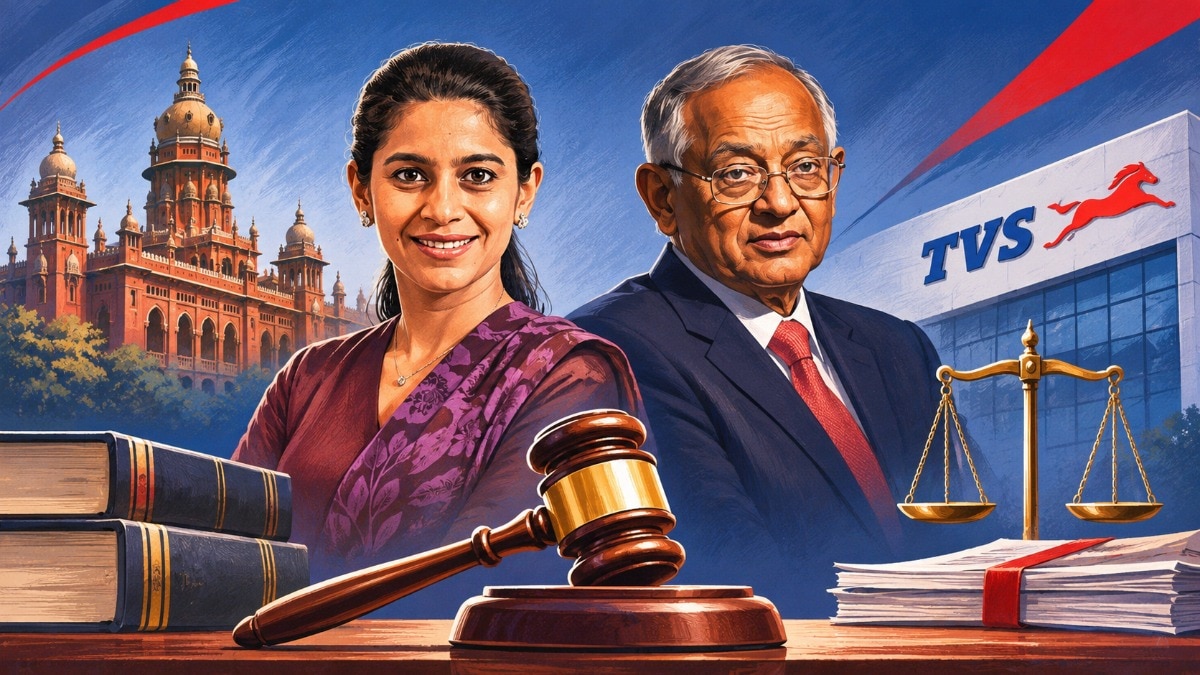
Inheritance disputes are not uncommon among India's large business families, where the division of family assets, ownership and control can sometimes become a source of conflict across generations. We are witnessing another such dispute, this time within the TVS family.Lakshmi Venu, daughter of TVS patriarch Venu Srinivasan, has approached the Madras High Court seeking a partition of the joint family assets belonging to her father's branch. She is also seeking access to financial records and documents relating to these assets, arguing that she needs clarity on their ownership and distribution to establish her rights.At the heart of the dispute is a proposed division under which Lakshmi would receive 5% of the family property, while her brother, Sudarshan Venu, would get 95%, according to her lawyer, C. Aryama Sundaram.Lakshmi believes the joint family assets should be divided equally, a position her lawyer says she tried to resolve through discussions with her father for around 18 months before taking the legal route. "She dearly loves and respects her father," Sundaram told India Today, adding that Lakshmi and her mother, Mallika Srinivasan, had made repeated efforts to reach an amicable settlement.WHAT DOES LAKSHMI VENU WANT?Lakshmi is seeking a fair and lawful partition of the joint family assets belonging to the Venu Srinivasan branch of the TVS family. She wants her share in these assets to be determined and allotted. The assets under consideration include interests held through VS Trust and other holding entities in businesses such as TVS Holdings, TVS Motor Company, TVS Credit Services and Sundaram-Clayton.She is also seeking access to documents and financial information that could establish the nature, extent and ownership of these assets. Her position is that without knowing how the assets are held and how the beneficial interests are distributed, she cannot properly establish or protect her rights.The case is not a demand to divide the day-to-day operations of TVS companies or interfere with their management. It concerns the ownership and partition of family assets.The 5:95 division is a major point of contention. Sundaram told India Today that the proposed allocation left Lakshmi with 5% and her brother with 95%."I can't see too many people accepting a division of joint family property of 5% to them and 95% to the other," he said.He argued that the assets in question are coparcenary property and should be divided equally. This is Lakshmi's legal position; the court will have to determine the nature of the assets and the rights of the family members.WHY HAS SHE TAKEN HER FATHER TO COURT?According to Sundaram, Lakshmi did not want the dispute to become a legal battle. She first sought an explanation from her father about the proposed division and tried to resolve the matter through discussions.He said Mallika also made efforts to help the family reach an understanding over around 18 months.Lakshmi eventually sent a formal partition notice to her father on November 16, asking him to facilitate a fair division of the property. The response, according to a statement issued on her behalf, did not recognise her claims or lead to progress towards a settlement.Sundaram said the family had hoped that discussions could continue even after the response, but there appeared to be no willingness from the other side to revisit the earlier arrangements.The disagreement became more public after senior advocate Abhishek Manu Singhvi, who represents Venu Srinivasan, said there was no scope for further mediation, adding that "that ship has sailed".Sundaram, however, told India Today that Lakshmi remained open to an out-of-court settlement."As of this minute, as I speak to you, Lakshmi Venu is most open to have this matter amicably resolved. The last thing she wants is to go to court," he said.He added that if her father or brother agreed to sit down and discuss the matter, she would be willing to return to the negotiating table.THE DISPUTE OVER THE 2017, 2020 AND 2024 FAMILY ARRANGEMENTSA major question before the court will be whether earlier family arrangements had already settled the ownership of the assets.The disagreement goes back to 2017, when Venu Srinivasan's side says a family settlement was reached. Venu's lawyer, Singhvi, has argued that the agreement dealt with ancestral assets and the dissolution of the Hindu Undivided Family (HUF).His position is that the family had already settled the relevant issues and there was no undivided property left to partition.In 2020, the wider TVS family entered into a restructuring arrangement to reorganise business interests among different family branches. The family settlement was based on a memorandum dated December 10, 2020, and took effect from February 4, 2022.Lakshmi's side argues that this was a division among the larger TVS family branches. It did not partition the assets that came to her father's branch among the members of his immediate family.Another agreement followed in March 2024. Venu, Mallika, Lakshmi and Sudarshan signed a memorandum of understanding dated March 20, with execution completed on March 21.The disclosure made by Venu to TVS Holdings said the MoU was an additional understanding among the family members, including arrangements on the use of TVS brands and restrictions on competing business activities.Lakshmi's side argues that these arrangements dealt with business responsibilities, brand usage and restrictions, but did not amount to a final division of the underlying family assets. Venu's side, on the other hand, maintains that the agreements were part of a series of consensual arrangements through which the family settled its differences.Sundaram told India Today that, according to Lakshmi's case, there had been no partition of the properties that came from the larger TVS joint family into the Venu Srinivasan branch."Courts will decide," he said, acknowledging that the two sides have different interpretations of the earlier arrangements.WHY DOES THE HINDU SUCCESSION ACT MATTER?The legal dispute also brings into focus the rights of daughters in ancestral joint family property.The Hindu Succession Act, 1956, was amended in 2005 to give daughters the same rights as sons in coparcenary property in a Mitakshara Hindu Undivided Family.Under Section 6, a daughter becomes a coparcener by birth and has the same rights and liabilities in coparcenary property as a son. The Supreme Court, in its 2020 ruling in Vineeta Sharma v Rakesh Sharma, clarified that a daughter's right is by birth and does not depend on whether her father was alive when the 2005 amendment came into force.However, the law does not mean that every asset owned by a father automatically becomes joint family property or that every daughter has an automatic equal claim over all his assets. The nature of the property and the legal effect of any earlier partition or settlement matter.That distinction is central to the TVS dispute. Lakshmi's side says the assets are coparcenary property in which she has equal rights. Venu's side disputes this, arguing that the earlier family settlement changed the position and that the arrangements should not be reopened.The court will have to examine these claims and determine whether the property remains joint family property and whether the earlier arrangements legally settled the matter.The suit has been filed before the Madras High Court, which is yet to decide the dispute. Lakshmi is seeking partition and access to financial records, while her side has also indicated that it intends to seek interim protection over the disputed assets.For now, the disagreement remains between two sharply different interpretations of the family's past arrangements. One side says the property has already been settled through earlier agreements. The other says the assets were never partitioned within Venu Srinivasan's immediate family and that Lakshmi's rights remain to be recognised.Despite the court battle, Sundaram said Lakshmi was still willing to resolve the matter outside court if her father agreed to talk."She would run to him to sit and talk to him. That's all she's been asking for," he said.- Ends
TVS inheritance battle: Why Lakshmi Venu has taken her father to court
Full Article
Original Source
Read the full article at Indiatoday →KhanList aggregates and links to publicly available news content. We do not host full articles from third-party sources. Always verify important information with original sources.