
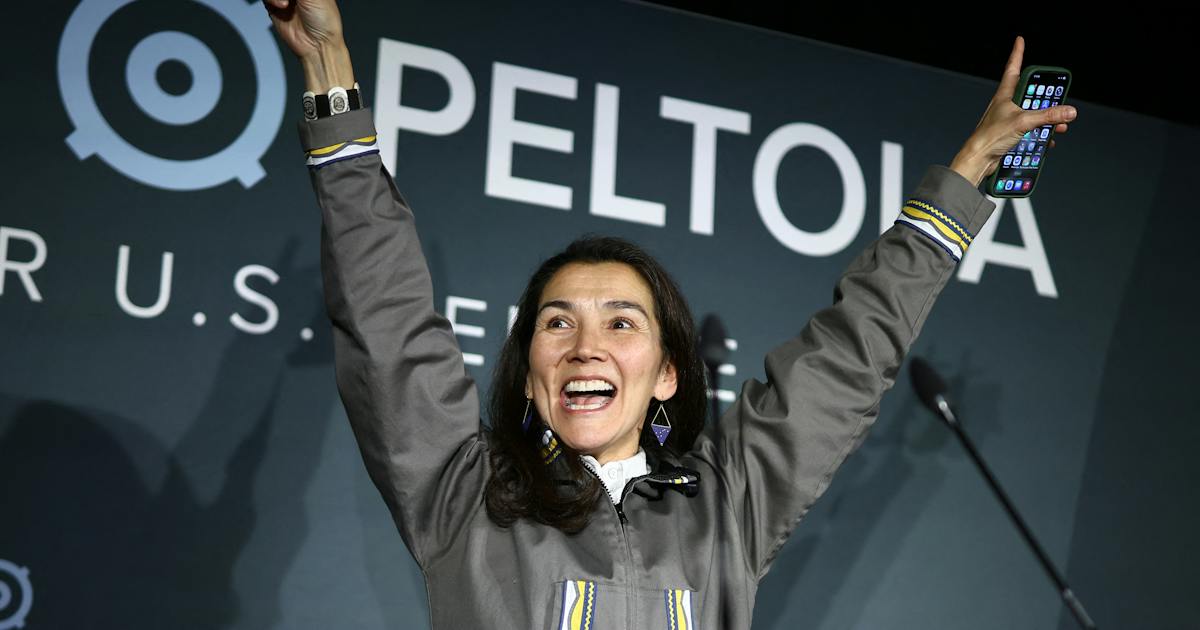
The results for the Alaska Senate race are in, and Senator-elect Mary Peltola would have won even if independent candidate Dan Sullivan Jr. hadn’t thrown his hat in the race.Earlier this month, Donald Trump floated the eyebrow-raising idea that votes cast for Sullivan Jr. should be tacked onto the vote count for incumbent Republican Senator Dan S. Sullivan. But as it turns out, that wouldn’t have mattered one bit.Peltola won the Last Frontier State with a whopping 50.1 percent of the vote, besting the Republican incumbent (who received 45.8 percent of the vote) by more than four percentage points and hitting the threshold to avoid counting ranked votes. Sullivan Jr., meanwhile, amassed just 1.7 percent of the vote.Whether Sullivan Jr., a retired schoolteacher, decided to enter the midterms of his own accord was speckled in doubt. The New York Times reported late last month that he was recruited by individuals connected to Peltola’s campaign. Days later, CBS News reported that the political independent had left his hometown and flown to Anchorage. In his own words, Sullivan Jr. wrote on Facebook in June that he entered the race because he was “unhappy with the 12 year record of the current Senator” and felt that “we need a change.”“It’s that simple,” he wrote.But Republicans didn’t buy it. Party leaders spent months accusing Democrats of election fraud and of attempting to sow confusion about the ballot ahead of Election Day. In a final Hail Mary effort to upend the ballot, party leaders patronizingly suggested that Alaskans would not be able to read the word “incumbent” beside the Republican candidate’s name.Alaskans, in turn, argued that they were not confused by the situation at all. Prior to Election Day, one Anchorage resident told CNN that the controversy had not shaken his vote, informing the network that you can “absolutely” tell who’s who on the ballot.“And I don’t even have my glasses on,” he quipped. “It’s pretty clear. It’s in black and white.”But the Trump administration trudged forward with attempts to change the record, anyway. In other panicked missives, Trump called for criminal prosecution of Peltola and directed the Justice Department to sue Alaska and its election officials in a flagrant attempt to block the certification of the vote if the Republican Sullivan lost. To that end, the DOJ issued letters to a number of prominent Democrats informing them that they could be targets of a federal investigation.House Democrats elected Hakeem Jeffries on Wednesday to be the next House Speaker. Jeffries, 56, won the secret ballot vote 251-11, cementing his bid to be the first Black speaker in the House of Representatives. At least two members missed the vote: Representative Bennie Thompson, who was attending the Homeland Security Committee annual worldwide threats hearing, and Representative Lou Correa, who is out recovering from a medical procedure related to a recent heart attack.The New York Democrat faced no direct challenger, but heard stark criticism from voters who were eager for change after the Democrats issued a stunning rebuke of President Donald Trump in the midterm elections. Some were concerned that Jeffries, who was elected as minority leader in 2023, was not an effective enough opposition leader against Trump’s creeping authoritarian takeover. Jeffries’s strangely conciliatory comments regarding whether the new Democratic Congress would retaliate against Trump’s unchecked corruption and lawless rule following the midterms hasn’t inspired much faith, either. Voters were also concerned about his perceived coziness to corporations and the American Israel Public Affairs Committee. One Change.org petition for a new House speaker garnered more than one million signatures. Jeffries and his team were able to aggressively fend off any challenges, and make support for the speaker appear practically unanimous. Even the House’s stalwart progressive, Alexandria Ocasio-Cortez, publicly supported Jeffries. There are certainly those who believe he was exactly the right person to take on a more progressive mandate.Following the vote, progressive Representatives-elect Darializa Avila Chevalier, Adam Hamawy, Frederick Haynes, Melat Kiros, Donavan McKinney, Chris Rabb, and Claire Valdez released a joint statement saying they had been among those who had opposed Jeffries’s bid. The group of lawmakers said they had worked to secure commitments from Jeffries on a progressive mandate to secure Medicare for All, get money out of politics, and end ICE terror and the genocide in Gaza. “While we have seen meaningful progress, there is still work to be done to ensure that the direction this party takes this coming Congress reflects what our constituents are demanding of leadership,” the group said.Wednesday’s vote selected the Democrats’ nominee for speaker, but Jeffries will still have to win a formal election in the full House at the start of a new term in January. Democrats will control the chamber, currently holding 257 seats to Republicans’ 171 (218 races have yet to be called).This story has been updated.Read more about Jeffries:Former CEO of Nvidia Jensen Huang has agreed to testify before the Senate Banking Committee—but it may not be under oath.The committee’s chair, Republican Senator Tim Scott, formally requested that Huang and Commerce Secretary Howard Lutnick appear before the panel. Scott has warned that Huang may be subpoenaed if he does not come voluntarily. However, it’s unclear whether Huang’s testimony would be under oath, meaning that he would not swear to tell the truth, and could not be charged with perjury if he lied, although there are still legal consequences for lying to Congress, oath or not.When CNBC host Joe Kernen asked Scott whether Huang would testify under oath, Scott initially evaded the question.“We’re asking voluntarily, but we have the power of subpoena if they don’t come voluntarily. So there’s no question, we’re asking them to tell the truth, the whole truth, and nothing but the truth, so help them God,” Scott said.“But not under oath,” Kernen clarified. “We haven’t decided that yet,” Scott admitted. Banking Chair Tim Scott says he wants Lutnick and Jensen Huang to testify, but not necessarily under oath 🤔 https://t.co/7r7bvhbN85— Aaron Rupar (@atrupar) November 18, 2026 Huang’s multiple affairs, including one with Alice Huang, an executive at Singaporean company Megaspeed who some officials believe may be a Chinese spy, have gotten him the boot at Nvidia. They’ve also raised national security questions about whether Chinese companies were able to gain access to semiconductor chips through Huang’s association with the Chinese businesswoman.Commerce Secretary Howard Lutnick is also being called to testify for his role in the Nvidia scandal: opposing restrictions on foreign chip sales, and allowing Megaspeed to buy chips despite warnings from U.S. intelligence that Huang was having an affair with a Megaspeed executive suspected of being a Chinese spy. Lutnick also would not necessarily be testifying under oath, according to Scott.Scott requested Huang appear before the committee on December 3, probably because when January hits, there’s going to be a new sheriff in town: Democratic Senator Elizabeth Warren.“Jensen Huang’s decision to resign from NVIDIA does not absolve him, other executives, or the company as a whole of responsibility for putting our national security at risk or for any potential violations of our laws,” Warren posted on X last week.“They still owe Congress answers.” More on Huang and Nvidia:President Donald Trump’s weaving waddle is raising red flags for health experts. In a recent interview with political commentator David Pakman, Dr. Frank George, a psychologist and cognitive neuroscientist who writes The Gaslight Report on Substack, said that Trump’s walking pattern is consistent with signs of dementia. George observed that Trump has been spotted swerving in an S-shaped stride whenever he tries to walk in a straight line. “There are a few different motor disturbances that you can attribute that to, anything from stroke to vestibular abnormalities,” he said. Multiple videos of Trump walking along the grounds of the Malacañang Palace in Manila on Tuesday appeared to show the president’s legs buckling on the red carpet like a newborn foal’s. .@POTUS and President @bongbongmarcos walk along the grounds of Malacañang Palace in Manila 🇺🇸🇵🇭 https://t.co/KFgGnxUt9S— Rapid Response 47 (@RapidResponse47) November 18, 2026 But Trump’s new walk is perhaps clearest in this video from October, where the president appeared unable to control his swerving stride as he walked to his newly installed White House helipad.Wow. Seeing Trump struggle to board Marine One, now I get why Trump was obsessed with building a new helipad. Walking on grass is an obstacle for him. See the difference? https://t.co/hpqzgIfHLw— Christopher Webb (@cwebbonline) October 17, 2026 George suggested that Trump’s new walk was consistent with the doctor’s long-standing suspicions: that the president is possibly suffering from behavioral variant frontotemporal dementia. “When I see that as part of that overall constellation of symptoms, and I don’t see other symptoms associated, let’s say, with Parkinson’s or with tardive dyskinesia, you eliminate those because you don’t see that pattern of multiple symptoms,” George said. “I don’t eliminate [frontotemporal dementia] because it does fit the pattern.“And so for me, these things start to become just more and more evidence that that’s what’s progressing,” he said. “You do see that type of S-walking with frontal cortex degeneration.”George distinguished Trump’s new swerving from his other strange mannerisms, including dragging his right leg, and his habit of tapping his thigh while he walks. There has also been speculation that the president wears hidden leg braces beneath his trousers. George had previously suggested that as Trump’s apparent dementia worsens, the president will become more disinhibited, giving way to his malignant narcissistic personality. Donald Trump started a $10 billion lawsuit against the BBC, and now a federal judge has determined that he must formally participate to finish it.U.S. District Judge Jeffrey Kuntz of the Southern District of Florida declared Tuesday that the president must sit for a deposition in January to advance the case, which centers on how the British Broadcasting Corporation edited the speech he delivered on January 6, 2021, for use in a documentary.“It is Trump’s case, so he should expect to be deposed,” Kuntz wrote in a four-page order.And Trump appears to be very willing, informing the court that he would be available for deposition between January 11 and January 22—a marked delay from the previous trial schedule, which gave Trump a deposition deadline of December 11. As a result of Trump’s proposed dates, the judge also revised the trial timeline, shifting the trial ready date from April 6 to May 3.Trump sued the British broadcasting network for defamation, pinpointing the Panorama documentary “Trump: A Second Chance,” which spliced together comments that Trump originally made 35 minutes apart.The BBC recognized and even apologized for this error but refused to pay him $1 billion for a tape that he claimed caused him “overwhelming financial and reputational harm.”In a letter to the White House released last week, BBC chair Samir Shah said that both he and the entire network were “sorry for the edit of the president’s speech” and acknowledged that the editing choices created “the mistaken impression that President Trump had made a direct call for violent action.” At the same time, the letter laid out an abject refusal to take Trump’s legal threats further. “While the BBC sincerely regrets the manner in which the video clip was edited, we strongly disagree there is a basis for a defamation claim,” the letter read.But Kuntz did not agree, and last week decided against the BBC’s motion to dismiss by allowing Trump’s lawsuit to move forward.“On its face, the editing may independently establish the plausibility of actual malice,” Kuntz wrote. “BBC tries to frame this editing as ordinary editing done to condense a seventy-minute-long speech into twelve seconds. But the Court is not persuaded.”Read more about the lawsuit:
Turns Out, Second Dan Sullivan Made No Difference in Alaska Race
Full Article
Original Source
Read the full article at Newrepublic →KhanList aggregates and links to publicly available news content. We do not host full articles from third-party sources. Always verify important information with original sources.