
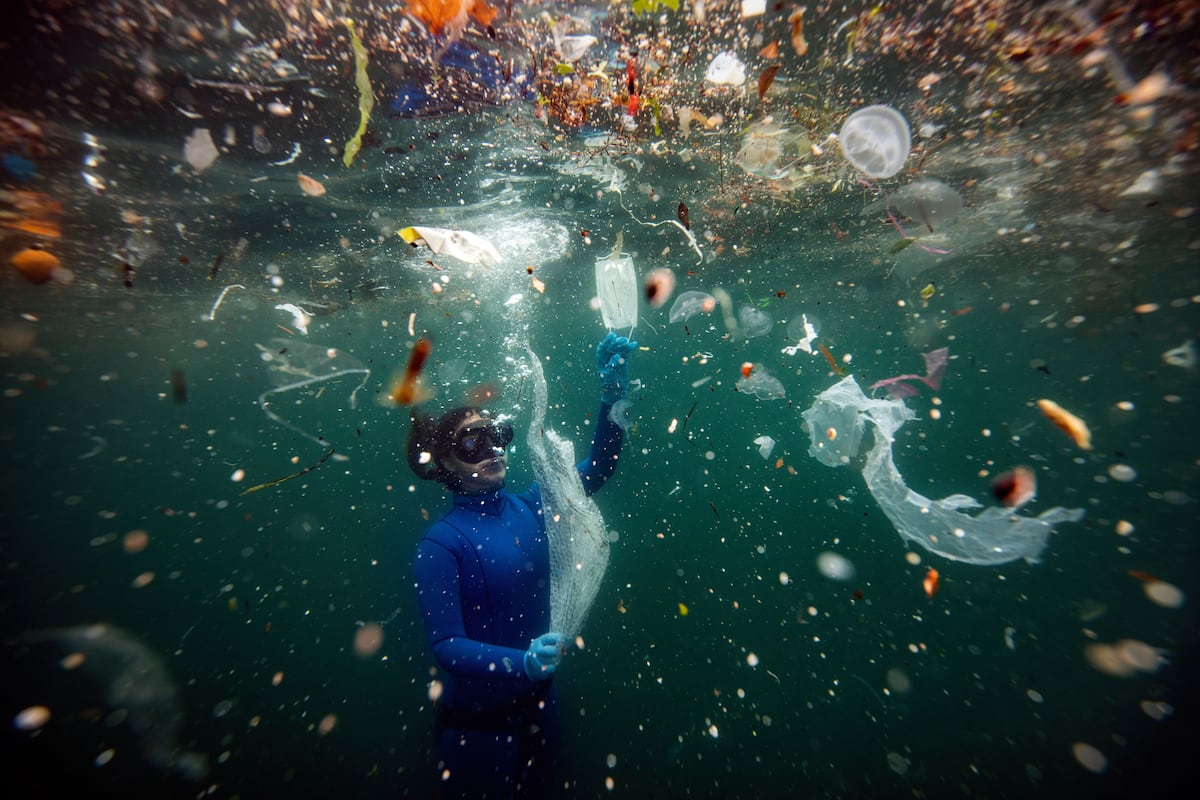
The Turkish government, host of this year’s COP31 climate summit in the city of Antalya, has identified waste reduction and reuse through the circular economy as one of the conference’s 10 priorities. In the latest draft agreement for the summit, which Turkey is co-chairing with Australia, there is a provision referring to the so-called Zero Waste Initiative, a voluntary proposal on the “circular economy” that highlights the sector’s potential “to contribute to reducing methane emissions.” The initiative, which operates alongside the U.N. system and is therefore non-binding, sets a goal of “halving the projected increase in annual global waste generation by 2035.”Yet even as Turkey has championed that commitment, the country has also become the leading destination for waste exports from the European Union, using those materials as feedstock for a range of recycling-dependent industries. According to environmental organizations, the sector has some positive aspects, but also many troubling ones.“Our main priority should be to move away from a ‘use-and-discard’ culture built on disposable products. The fact that about 7 billion tonnes of the 9.2 billion produced worldwide since the 1950s have become garbage shows the cost of that mindset. Moreover, that burden is not distributed evenly around the planet,” Turkey’s first lady, Emine Erdoğan, said as she presented the ideas of the Zero Waste Movement at the UN General Assembly last September. She described the movement as “a moral stance that reminds us of our limits and responsibilities” and a transformation for which Turkey, she said, “is preparing.”The first lady has been trying since 2017, through a foundation she chairs, to promote policy and practice changes to reduce waste and encourage recycling. And, according to her husband Recep Tayyip Erdoğan, who has governed Turkey for nearly a quarter of a century, this has led to “90 million tonnes of waste being recycled in the past eight years, contributing 365 billion lira [about €6.5 billion] to the Turkish economy.” Data from the Zero Waste Foundation indicate that in the last decade recycling rose from 13% to 35%, although the European Environment Agency, which applies stricter criteria, held that Turkey’s recycling rate was still 12% in 2021.The problem, aside from the growing generation of waste in a growing economy, is that Turkey also imports it. In 2025 it imported 12.8 million tonnes of waste from the EU and for a decade—since China and other Asian countries began banning or restricting waste imports—it has been the primary destination for the Twenty-Seven’s exports, receiving roughly 40% of the total shipped outside Europe. Scrap, plastic, tires and rubber, paper and cardboard and even used clothing and textiles discarded by European citizens are bought cheaply by Turkey to feed its recycling industry.“Turkey’s proximity to Europe and its commercial integration through the Customs Union, combined with its low processing costs and the high demand for secondary raw materials, created this significant trade flow after the Asian restrictions,” explains Berk Butan, a Greenpeace activist and expert in social and economic processes. “However, framing it as merely a business opportunity ignores its systemic repercussions. This trade perpetuates external dependencies instead of encouraging the development of national systems for waste collection and processing.”Scrap, ships and plasticsWith 10 million tonnes in 2025, the main imported waste material is scrap—mostly iron and steel, from dismantled cars to construction beams or appliance sheet metal—because it is the primary raw material for Turkey’s steel industry. Among the world’s major steel producers, Turkey stands out for proportionally producing the most recycled steel (85%). That is certainly progress, since the steel industry currently accounts for at least 7% of global CO2 emissions.Producing steel from scrap, however, significantly reduces costs and environmental footprint, using up to 70% less energy than production from iron ore and coal. The problem is that in recent years major European steelmakers have pressured Brussels to restrict scrap sales to their competitors in Turkey, so, according to an investigation by EL PAÍS, Turkey has begun seeking scrap in alternative markets, including conflict-affected countries such as Libya, Syria and Ukraine.Although it is a recycling process that makes efficient use of most residues, it is not without risks: in some cases radioactive materials can be imported through certain war waste, hospital equipment or petrochemical pipelines, which can contaminate an entire plant if undetected.Another way Turkey obtains scrap for recycling is shipbreaking. According to data from the NGO Shipbreaking Platform, in 2025 Turkey dismantled 15 vessels linked to EU companies and, the previous year, at least 28. The figures could be higher because many ships change ownership or flag before their final voyage.The dismantling takes place in Aliaga Bay in Izmir. “End-of-life shipbreaking poses a serious danger both to the environment and to workers, because these vessels contain all kinds of hazardous materials and waste. Asbestos is certainly one of the most well-known and worrying elements, but it is not the only one: lead, various heavy metals, paints, fuels and all kinds of oils are also present. All these pollutants can be exposed to the environment and to workers,” explains Ekin Sakin, an activist with Shipbreaking Platform who advocates carrying out such dismantling in “contained facilities,” because some of those hazardous materials end up in the sea.“The import into Turkey of waste intended for storage, hazardous materials or nonrecyclable waste is strictly prohibited. Only clean waste, separated at source and intended for use as raw material in industry, processed in authorized facilities, is permitted. Inspections of facilities and entities that violate environmental law continue under a zero-tolerance policy,” the Turkish government’s office against disinformation recently said in a statement.However, the Basel Convention, of which Turkey is a signatory, considers ships for dismantling to be “hazardous materials.” As early as 2012 a FAO study detected high levels of heavy metals in the waters of Aliaga bay, and later studies have only confirmed this contamination and that of various persistent toxic compounds. Sakin also says high rates of respiratory disease and the presence of lead in workers’ blood have been detected among industry employees.European responsibilityThe most controversial imported material, however, is plastic. Over the last decade Turkey has imported 5.5 million tonnes of plastics—equivalent to the plastic waste generated by all of Spain in two and a half years. Sixty percent of that plastic comes from EU countries and is sent to recycling industry clusters concentrated mainly in Adana province in southern Turkey. “A significant portion of imported plastic waste consists of film plastics and food containers,” explains Sedat Gündogdu, a marine biologist at Çukurova University (Adana). “Because these materials arrive heavily contaminated with organic residues and contain various colorants and complex structures, recycling them is not easy and generates large volumes of waste during processing. For every 100 kilos of imported plastic, up to 60 kilos can end up as unusable waste.”The problem with these residues is that due to their high contamination and low calorific value they are usually not accepted at incineration facilities, so, environmental activists say, many plants dispose of them by dumping them in nearby land, rivers or sewers. “The real consequences were evident in summer, when large quantities of plastic waste, including imported materials, were illegally dumped and carried by the Seyhan river out to the Mediterranean Sea,” Butan explains.Since July 1, 28 facilities in six provinces have been shut down for illegal dumping, which, the Greenpeace activist argues, highlights the magnitude of the problem that negatively affects fishing, agriculture and tourism, as well as local public health: “Uncontrolled disposal, large-scale storage or low-temperature thermal treatment of residual materials release persistent organic pollutants, heavy metals and microplastics into the air, soil and water. As plastics fragment into micro- and nanoparticles, they continue contaminating ecosystems for decades.” For this reason, environmental organizations and experts call for Turkey to ban plastic imports, as Asian countries did earlier, and focus on managing and recycling the more than 3 million tonnes of plastic waste it generates annually.They also demand that the EU take responsibility. “This trade brings no benefit to Turkish society and constitutes a form of colonialism that produces profound environmental imbalances and dependencies. While operators of certain plants may obtain private profits, society at large bears the ecological and economic costs,” Gündogdu says. “The European Union, despite presenting itself as a global benchmark in sustainability, is shifting the cost of its high consumption patterns to Turkey instead of accepting responsibility for its own ecological footprint.”Sign up for our weekly newsletter to get more English-language news coverage from EL PAÍS USA Edition
Turkey: an emerging recycling power or Europe’s dump?
Full Article
Original Source
Read the full article at English →KhanList aggregates and links to publicly available news content. We do not host full articles from third-party sources. Always verify important information with original sources.