
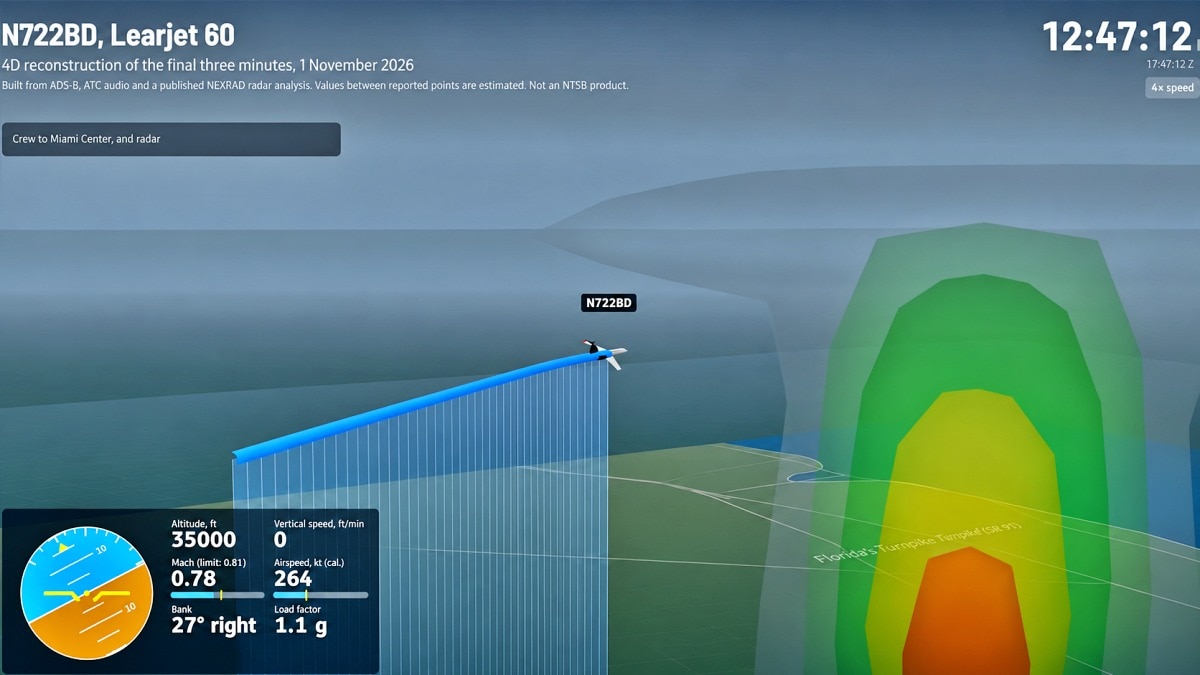
A Learjet 60 crew reported ice and turbulence before declaring an emergency over Florida. Investigators are examining whether severe weather contributed to its fatal crash.Weather maps from the period show extensive cloud cover and precipitation across Florida. (Photo: X/elteslaengineer)New Delhi,Nov 2, 2026 11:50 ISTThe final radio transmissions from the cockpit of a Learjet 60 that crashed in Florida have raised questions about whether rapidly developing thunderstorms, turbulence and icing contributed to the aircraft’s catastrophic loss of altitude.The aircraft, registered as N722BD, crashed near Greenacres in Palm Beach County on November 1, killing all nine people on board. It was flying from Austin, Texas, to North Eleuthera in the Bahamas when it encountered deteriorating weather conditions over Florida.“We have light, clear ice that is manageable and moderate turbulence,” the pilot told Miami Air Route Traffic Control Center, according to recordings of the exchange.The Learjet 60 that crashed in Palm Beach County today went from 35,000 ft to the ground in 76 seconds. I rebuilt the last 3 minutes in 4D from ADS-B, ATC audio, a NEXRAD analysis and dashcam video, then ran the engineering. Here's what the data says, and what it doesn't. https://t.co/9VMIT6qs3R— El Tesla (@elteslaengineer) November 2, 2026The crew also reported an outside air temperature of minus 47 degrees Celsius. The aircraft was experiencing turbulence significant enough to cause altitude deviations, and the pilots asked whether there was a smoother route ahead. The situation then deteriorated rapidly. After reporting precipitation and requesting permission to climb to 37,000 feet, the crew declared an emergency.“We’re descending 8,000 – mayday, mayday – we’re descending 10,000 feet per minute,” the pilot radioed. Moments later, the pilot reported an overspeed condition and a descent rate of 20,000 feet per minute, warning: “We’re going to crash into the ground.”DID THE LEARJET FLY INTO A THUNDERSTORM? Weather maps from the period show extensive cloud cover and precipitation across Florida, with clusters of stronger thunderstorms over the Gulf of Mexico, the state's west coast and parts of southern Florida. The aircraft's route took it across a region experiencing unsettled weather.A preliminary analysis by meteorologist Matthew Cappucci, published by MyRadar, suggests a developing thunderstorm was present near the aircraft's location shortly before the crash.The storm's cloud tops reportedly grew from just under 33,000 feet to around 48,300 feet in approximately 20 minutes, a sign of powerful atmospheric updrafts.Slow motion video of the plane crash in Palm Beach Florida moments ago. Learjet 60 https://t.co/cwH8thiKtm— Brian Krassenstein (@krassenstein) November 1, 2026Such rapidly growing thunderstorm cells can produce severe turbulence. They can also transport supercooled liquid water to high altitudes, potentially creating hazardous icing conditions.This could be significant because clear ice forms when supercooled water droplets freeze on contact with an aircraft's surface. It can alter the shape of wings and other aerodynamic surfaces, affecting lift and aircraft handling.However, the reported minus 47-degree temperature also makes the precise icing environment an important question for investigators. Conditions inside a vigorous thunderstorm can differ sharply from those in the surrounding air.WEATHER A POSSIBLE FACTOR, NOT A CONFIRMED CAUSEThe National Transportation Safety Board (NTSB) is investigating the crash, with assistance from the Federal Aviation Administration.Investigators will examine the aircraft's flight data, weather radar, cockpit recordings, maintenance history and crew actions.For now, the weather evidence raises important questions but does not establish why the Learjet entered its steep descent.Whether icing, turbulence, a loss of control or a combination of factors triggered the emergency will have to be determined by the investigation.- Ends
Turbulence, ice build-up, -47°C temp: Did weather play a role in Learjet crash?
Full Article
Original Source
Read the full article at Indiatoday →KhanList aggregates and links to publicly available news content. We do not host full articles from third-party sources. Always verify important information with original sources.