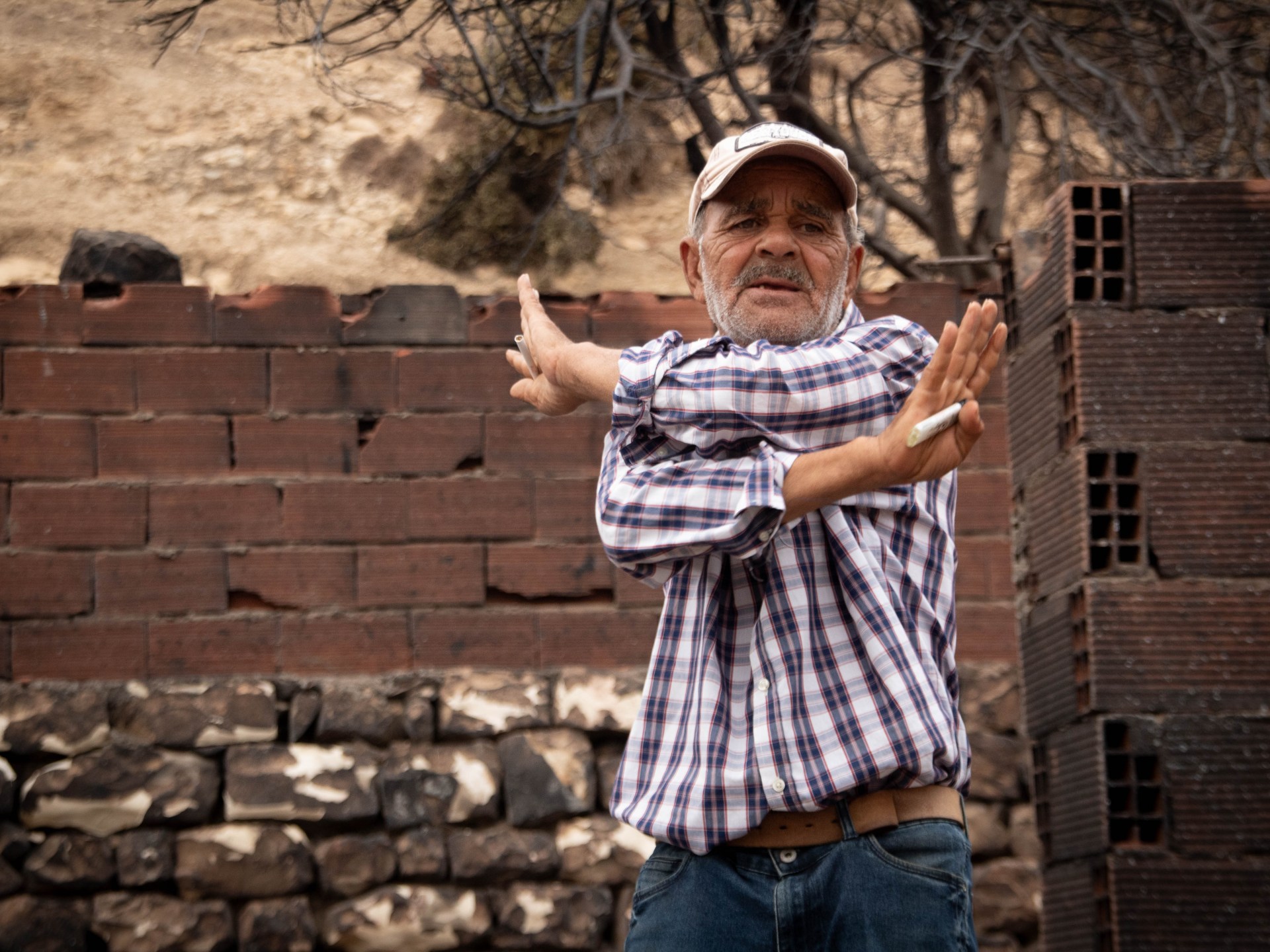
Sakiet Sidi Youssef, Tunisia – Smoke still lingers over the blackened hills surrounding the village of el-Gol near the town of Sakiet Sidi Youssef in Tunisia’s mountainous Kef governorate, days after one of the worst wildfires to hit the region this summer.Standing outside the charred remains of his farm near the Algerian border, 70-year-old Mongi Abdeli struggles to put into words the scale of what has been lost.Recommended Stories list of 3 itemslist 1 of 3Tunisia’s body politic is in crisislist 2 of 3Five years after Saied’s power grab, Tunisians are no better offlist 3 of 3Tunisians mark fifth year of emergency rule with calls for Saied to goend of listThe wildfire killed 10 of his sheep while two more died the following day from smoke inhalation. It also destroyed his beehives, more than 100 olive trees and every almond tree on his land.“The fire was scorching … and came from every direction,” Abdeli told Al Jazeera. “They kept telling us there was no water to extinguish it. All they could do was evacuate us.”Some of his flock managed to escape into the surrounding hills, but Abdeli said he now has little means to keep them alive.“What are we going to feed them now?” he asked. “Even the price of hay has gone up. Our lives have come to a halt.”Abdeli has worked this land throughout his life to provide for his family.“For 70 years I’ve lived in these mountains, relying on myself,” he said. “I’ve never asked the state for anything.”Walking through the remains of his stables, Abdeli worried that the livestock he had left could now be stolen because he no longer had a shelter to keep them in at night.“They only remember us on February 8,” he said in reference to the anniversary of the bombing of Sakiet Sidi Youssef in 1958, when French warplanes attacked the town during Algeria’s war of independence.The charred remains of Mongi Abdeli’s farm In Kef governorate, Tunisia [Ghaya Ben Mbarek/Al Jazeera]The blaze that swept through Abdeli’s farm was one of dozens that have erupted across Tunisia this summer during a heatwave that pushed temperatures close to 50 degrees Celsius (122 degrees Fahrenheit) in parts of the country.The wildfires, which began in June and peaked in mid-July, were among the most destructive in years. Civil Protection said firefighters responded to nearly 600 fires within 48 hours during the peak.The largest blazes erupted in the northern governorates of Kef, Beja and Bizerte, where mountainous terrain hampered rescue operations even after military units were deployed to assist firefighters.Civil Protection Lieutenant Colonel Khalil Mechri told the Mosaique FM radio station that the scale of the wildfires was “unprecedented” and they were “among the most violent recorded in Tunisia, both by their intensity and by the extent of the destroyed surfaces”.He also asserted that human negligence or “criminal acts” caused 95 percent of the blazes.‘Everything has fallen apart’For families in the area already grappling with years of drought, poor harvests and the rising cost of living, the fires were yet another blow.Near her burned land, Mahjoub Chouakhia told Al Jazeera that the emergency did not end once the flames were brought under control.“We had no idea the fire would engulf us that quickly,” she said. “By the time Civil Protection reached us, everything was gone.”The family lost livestock feed, chickens and hunting dogs, leaving them with nothing but a single room where six family members now live.While firefighters gradually brought the flames under control, climbing temperatures pushed electricity demand to record levels.“On the day of the fire, we asked for the restoration of the electricity and water supply, but we were refused,” Chouakhia said.By that point, the state-owned electricity and gas company STEG had announced daily rationing aimed at preventing a wider collapse of the country’s ageing grid.In statements to local media, STEG said exceptional electricity demand, driven largely by widespread air-conditioner use during the heatwave, had pushed the national network close to its operational limits. The company said controlled power cuts were introduced to preserve the stability of the grid and prevent a nationwide blackout. STEG did not respond to Al Jazeera’s request for comment.Across the country, prolonged power cuts disrupted factories, water-pumping stations and life in homes, leaving many residents without air conditioning, refrigeration or running water.“I’ve suffered millions in losses over the past three weeks,” Abderrazek, a poultry vendor in the northern Tunis suburb of L’Aouina, said in the middle of yet another power outage.“Who will compensate me for all of this?” he asked. “Everything in this country has fallen apart.”Hills blackened by wildfires in the village of el-Gol, Sakiet Sidi Youssef in Kef governorate [Ghaya Ben Mbarek/Al Jazeera]The crisis has also highlighted longer-term challenges facing Tunisia’s energy sector.The country generates most of its electricity from natural gas, much of which it imports from neighbouring Algeria, making it increasingly vulnerable to supply disruptions and fluctuating global prices.Sahar Mechmech, a political economist and inclusive economies manager at the Tahrir Institute for Middle East Policy, said the power cuts were the result of years of underinvestment rather than an unexpected surge in demand.“We’ve already witnessed major power cuts in previous years, so saying this came as a surprise is surprising,” she said. “The problem is in the supply of electricity and the extent to which Tunisia has invested the necessary resources to maintain energy security and the production and distribution of electricity.”The government has failed to invest enough in electricity production and the grid, she said, noting the country’s last major power station was built in 2019. A financial crisis at STEG also limited the expansion and maintenance of the network, she added.MP Maher Kettari said during a recent Finance Committee hearing in parliament that the government owed the utility company nearly 3.5 billion dinars ($1m) in unpaid energy subsidies.President Kais Saied called the electricity and water cuts “unacceptable” during a meeting with senior ministers and the heads of the country’s electricity, water and Civil Protection bodies.He ordered the swift restoration of services and for authorities to ensure residents are informed in advance whenever interruptions become necessary.That reaction was likely the result of timing. The crisis unfolded days before Tunisia marked the fifth anniversary of Saied’s July 25 power grab, during which he dismissed the prime minister and his government, suspended parliament and began ruling by decree. The power and water crisis has renewed scrutiny over the state’s ability to provide essential services during emergencies under the president’s watch.‘Basic means to exist’While authorities deployed firefighters and emergency crews across the country, residents interviewed by Al Jazeera said they were often left to rely on neighbours who were the first to respond as flames neared their homes.For Tunisians, the fires are another reminder of how vulnerable many communities have become.As heatwaves grow longer and more intense, many said they are being left to cope with disasters that are becoming more frequent while the country’s infrastructure and public services struggle to keep up.“I am not asking for too much. My life is already behind me. I will not live any longer,” Khatma, one of the residents that spoke with Al Jazeera, said. “But what I hope is that my children and grandchildren get to live in comfort with the basic means to exist.”
Tunisian wildfires expose failing infrastructure, community vulnerabilities
Full Article
Original Source
Read the full article at Aljazeera →KhanList aggregates and links to publicly available news content. We do not host full articles from third-party sources. Always verify important information with original sources.