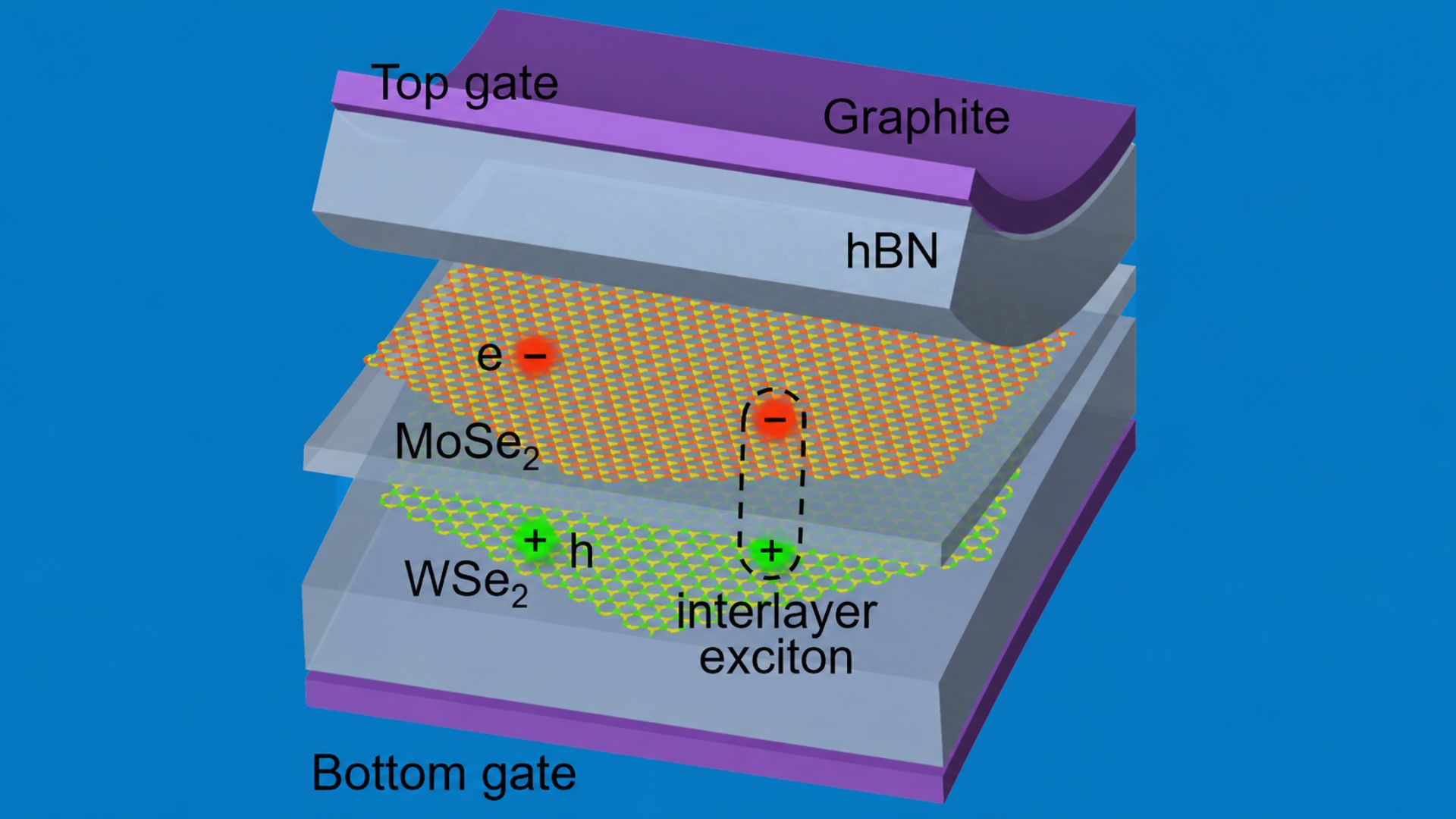
Researchers at the Lawrence Berkeley National Laboratory in the US have observed a tunable Bose-Einstein Condensate (BEC) of excitons in an atomically thin semiconductor. Contrary to popular assumptions among scientists that BECs do not have individual identities, the researchers found that the condensate has an internal structure that is tunable with a magnetic field. A BEC is a coherent quantum state where many particles come together and act as one coherent object. Scientists also refer to them as the fifth state of matter because the particles lose their individual identities and behave as one. For more than six decades, scientists have been working to generate BECs using excitons or electron-hole pairs. This has been particularly difficult in semiconductor devices because optically generated excitons have extremely short lifespans, lasting no more than a billionth of a second. “While previous studies have shown that electrons and holes can bind into excitons, there wasn’t an easy way to determine whether those excitons formed a condensate, nor could they ascertain what kind of internal quantum order that condensate has,” explained Feng Wang. Senior scientist in Berkeley Lab’s Materials Sciences Division. “Our work provides a way to access that hidden structure directly.” Excitons in ground state Excitons are quasiparticles formed by a bound pair of an excited electron and a positively charged hole. In most experiments, excitons are created using light and exist in their short-lived excited states. In their research, Wang and his team engineered a two-dimensional semiconducting device where excitons are seen in the ground state. The device is built with two atomically thin layers of semiconductor material, namely molybdenum diselenide (MoSe2) and tungsten diselenide (WSe2). MoSe2 acted as the top layer in this setup, hosting electrons, while the bottom WSe2 layer hosted electron holes. A layer of hexagonal boron nitride (hBN), no more than a few atoms thick, separated the two layers, while also allowing them to attract strongly to generate excitons. Under cryogenic conditions, the researchers used magneto-optical spectroscopy to cool the device down to temperatures near absolute zero and measured how the electron and hole components responded to small magnetic fields. The excitons performed collectively as one would predict. However, researchers continued to see condensate signatures at upto 2 Kelvin. While these temperatures are extremely cold, they are still millions of times warmer than BEC demonstrations seen in ultracold atomic gases. Equilibrium quantum fluid In atomically thin semiconductors, electrons and holes are not just carriers of charge and spin, but also of a quantum property called as ‘Valley’. This is tied to their motion or degrees of freedom inside the crystalline material, which also confers multiple flavors or spin patterns to the excitons. In their work, Wang and colleagues found that Bose-Einstein Condensates are not just one flavor quantum state but have two components, each with different flavors of internal spin-valley structures. This results in multiple condensate phases that are not just distinct but can also be switched on by a magnetic field. Excitons in such a setup are not just short-lived particles but form an equilibrium quantum fluid that can be tuned electrically and magnetically. This is because it is not just a condensate but has internal structures that scientists can control. The research paves the way for the development of a new platform where quantum fluids in solid materials can be studied. This will aid in the development of fields such as next-generation telecommunications and computing using quantum technologies, as well as exciton-based devices, the press release said. The research findings were published in the journal Nature. Recommended ArticlesGet the latest in engineering, tech, space & science - delivered daily to your inbox.Ameya is a science writer based in Hyderabad, India. A Molecular Biologist at heart, he traded the micropipette to write about science during the pandemic and does not want to go back. He likes to write about genetics, microbes, technology, and public policy.
Tunable Bose-Einstein condensate found in Berkeley’s 2D semiconductor research
Full Article
Original Source
Read the full article at Interestingengineering →KhanList aggregates and links to publicly available news content. We do not host full articles from third-party sources. Always verify important information with original sources.