
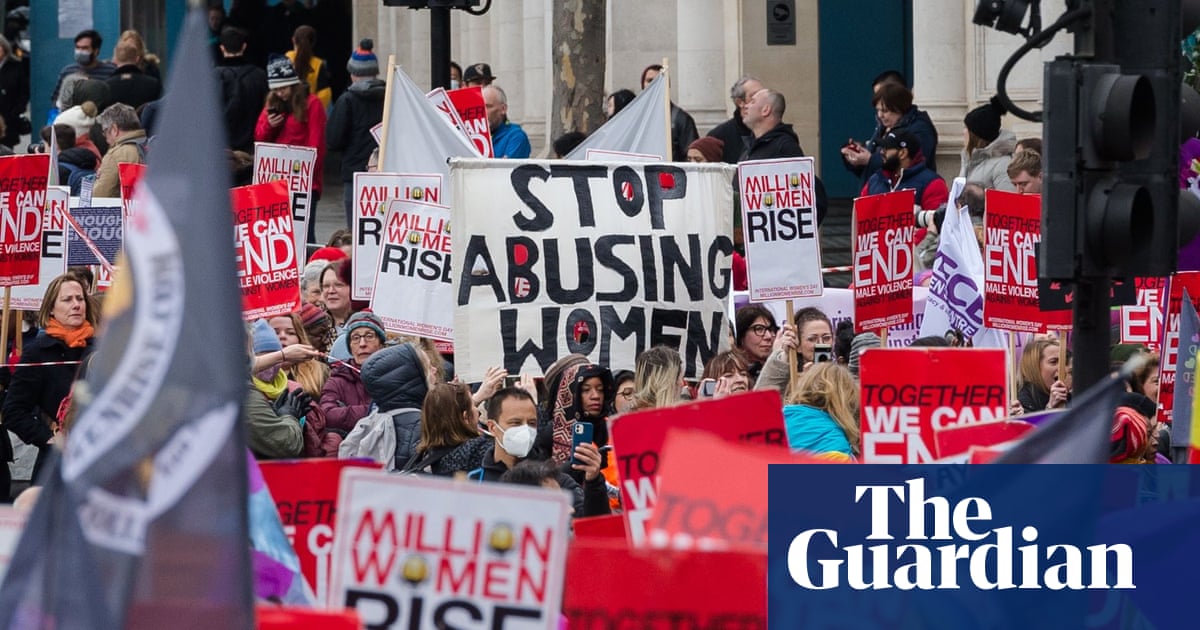
Good morning. Violence against women and girls, in all its myriad forms – physical and mental, blatant and insidious – is a global challenge. It reaches back through millennia and, lately, it has been turbo-charged by technology, which offers abusers new ways to shame, harass and monitor victims. What would it take to eradicate it?Scotland’s first minister John Swinney wants to find out. Today, he will set out his programme for government (the Holyrood equivalent of the King’s speech), and Swinney surprised many when he pledged to put ending violence against women at the heart of his government’s ambitions for the coming year and beyond.But haven’t we been here before? Scotland has produced a raft of radical strategies, as well as legislation hailed as the international gold standard on domestic violence. So what hasn’t changed? For today’s newsletter, I spoke to equalities campaigner Talat Yaqoob, who co-chaired the Scottish government’s National Advisory Council on Women and Girls after four years until last month. I asked her what government – and societal – action constitutes meaningful change, and what other countries can learn from Scotland. But first, the headlines.Five big stories Nepal-Tibet | Rescue teams are working to reach more than 900 missing hydropower workers, who are thought to be trapped in underground areas in Nepal, after the devastating flash floods. Iran | The new US sanctions campaign is expected to push many Iranians into deeper poverty as food inflation soars. UK | The British Museum privately hosted Palantir founder Peter Thiel in a private viewing of the Bayeux tapestry, the Guardian understands. Slavery | Countries are legally obliged to consider reparations for the transatlantic slave tried, and address the legacy racial discrimination, a UN committee has said. US news | A Las Vegas jury has found former South Side Compton Crips gang leader Duane Keith Davis guilty of the murder of Tupac Shakur, bringing the case to a close nearly 30 years after the famous rapper was gunned down. In depth: Why Scotland’s pioneering laws aren’t enoughThe context for Swinney’s pledge is bleak. Photograph: Murdo MacLeod/The GuardianWe’ll find out later today the detail of the measures John Swinney is proposing, but the SNP leader’s preliminary talk has been big: pledging his personal leadership, acknowledging that alongside resources to protect those most at risk of violence right now, his government needs to address underlying economic inequalities – and hinting at the need for focused prevention when he says that lasting change requires all of society to play our part.The context for Swinney’s vow is bleak: a steady increase in misogyny and violence against women and girls across the world.In Scotland, both domestic abuse and sexual crimes are on the rise – crimes recorded by Police Scotland including rape and attempted rape, sexual assault and communicating indecently were up 10% last year and are now at their highest level since 1971. Rape Crisis Scotland has pointed out that these figures reflect a significant rise in historic offences and that, despite the best efforts of Reform in Scotland to link them with immigration, the vast majority are perpetrated by people known to the victim.Moreover, as Yaqoob tells me, technological advances have “enabled an entirely new field of violence against women and girls – deepfakes, ‘revenge porn’, online coercion and control of women through things like GPS tracking” – while the now-quotidian misogyny of the manosphere is saturating playgrounds and classrooms. A survey of Scottish secondary school boys last year found a third believed that girls who wear revealing clothing were “asking for trouble”, while a third of female teaching staff, in a separate study, reported sexist abuse from children as young as eight years old.“We also know that when there is recession, when there is poverty, there is a rise of the far right, there’s a rise of anger, and women are often the victims of that anger,” Yaqoob says. The Guardian’s own research last year found that two out of every five people arrested after participating in the 2024 summer riots had been previously reported to the police for domestic abuse.Recession hits funding too: many services are on their knees, according to campaigners, while the post-pandemic court backlog and ongoing crisis in the legal aid system continues to deny victims access to justice.Haven’t we been here before?When I returned to Scotland to report for the Guardian just over a decade ago, there was a new female first minister, Nicola Sturgeon, one of three women heading the main political parties at Holyrood, and you could taste the change in the air.This visibility of women in top jobs – necessary, of course, but never sufficient – was accompanied by a raft of ambitious strategies and bills. Equally Safe, launched in 2014, was a plan across central and local governments to act together on tackling gender-based violence. The National Advisory Council on Women and Girls, established by Sturgeon in 2017, brought forward radical proposals to offer two months of paid paternity leave and establish a world-leading process for complainants of sexual violence.In 2018, the Scottish parliament passed legislation to criminalise coercive control for the first time, hailed by international experts at the time as “the gold standard”, and three years later added further powers with domestic abuse prevention orders.There’s been funding for sexual violence prevention programmes in schools and universities, and a national advocacy service to support victims as they navigate the justice system. And, in 2025, a landmark justice reform bill abolished the Scottish verdict of “not proven” – a global legal anomaly thought to be a key factor in the country’s significantly lower convictions rate for rape and sexual assault.These offer a useful case study of what Yaqoob describes as “the implementation gap”. While the 2018 Act was undoubtedly radical, campaigners say it hasn’t achieved its full potential because the institutional change demanded of police and prosecutors – including the training of officers and shifting of mindset over charging decisions – hasn’t happened. Only 4% of domestic abuse crimes were prosecuted under the new legislation last year. Meanwhile, many of the 2021 powers are gathering dust because poor drafting has rendered them too difficult to implement.“There is a theme here,” says Yaqoob. “There’s no shortage of inspiring rhetoric and in some cases good strategy and legislation. What there isn’t is the priority and resources when it leaves the desk of the Scottish government and that means a lack of tangible change in women’s lives.”What needs to happen now?A demonstration outside New Scotland Yard, reflecting the number of Metropolitan police officers who have been, or are now, under investigation for allegations of domestic abuse or violence against women and girls. Photograph: Aaron Chown/PARemoving this block between declaration and delivery doesn’t have to be onerous, Yaqood argues. Partly it’s about making gender equality a priority across the public sector. “Gender equality is always on the periphery of interventions. Until it’s at the centre, you can have as many big commitments as you want, but it will not make a difference enough to women and girls’ lives”.And placing gender equality at the centre is the beginning of the systemic change demanded of the police and prosecution service, as well as resourcing the tailored, often grassroots, projects that can make a difference in schools and communities – especially those designed by and for men – like the Many Good Men project which takes the conversation into football clubs.“We don’t have to reinvent the wheel,” says Yaqoob. “There are years of well-evidenced practice that we need to scale up.”Credit where it’s due: Police Scotland has done some very decent work in recent years with Don’t Be That Guy – a campaign that has young men talking directly to their peers about problematic behaviour. But the force has struggled to take on misogyny and racism within its own ranks.In recent years in Scotland, the discussion around violence against women has been dominated by arguments around women-only spaces – the UK’s most influential gender critical group, For Women Scotland, is based in Edinburgh – and unfounded claims that Scotland’s asylum population is responsible for an increase in sexual violence.Yaqoob is clear: “Anyone who tries to position themselves as protectors of women and girls, but does not have an agenda that is focused on tackling poverty, putting money back into communities for women and girls, or the need for consent and sexuality education in schools, is selling you a lie.”(For more, that broader agenda of tackling gender inequality in all its forms is the subject of a new book of essays, co-edited by Yaqoob.)The solution is global – and also localA global problem demands, in part at least, a global solution. As I’ve written in previous First Editions, change at street levels demands that all of us engage in small acts of solidarity.Yaqoob puts it this way: “Whether you’re calling out misogynistic language in the pub or you’re the leader of a local council allocating resources, there are so many different facets of society where people need to take more responsibility for the space they occupy.”So much of this conversation applies beyond Scotland, but back at Holyrood it’s fair to say that, while there’s a bit of eye-rolling as yet another male politician “discovers” violence against women and some head-scratching over precisely what reforms he intends to unveil, there’s also wary optimism to hear this focus at the beginning of the SNP government’s five year term.skip past newsletter promotionafter newsletter promotionAs one campaigner told me yesterday: “This is an opportunity to kick the door down for bigger changes”.What else we’ve been enjoying‘The US is being sold for parts, or just handed over to the oligarchy,’ writes Rebecca Solnit, of Trump’s plan to sell off parts of Yosemite. Photograph: Anadolu/Getty Images Rebecca Solnit is on form in this column lambasting Donald Trump’s plan to “sell off” chunks of Yosemite national park. “The US is being sold for parts or just handed over to the oligarchy,” she writes. Charlie Lindlar, newsletters team I found Ben Quinn’s acute analysis of what’s gone wrong for Reform this summer a useful primer ahead of their party conference later this week. Libby I loved this perceptive piece from Tanya Aldred on the short shelf life of football shirts. For more from Tanya on the intersection of climate change and sport, sign up to The Hotspot. Charlie The story of how Jackson Pollock’s masterwork Blue Poles became Australia’s most controversial painting takes in Gough Whitlam, the Shah of Iran and Paul Hogan – and Guardian Australia’s political editor, Tom McIlroy, tells it brilliantly in this Full Story podcast. Libby Our Laura Snapes’s music coverage is indispensable, yet not even her Taylor Swift opus can compete with this vital piece against the term “picky bits”. “It’s the Boaty McBoatface of dinner time,” she correctly argues, “exposing our once-repressed nation’s surprisingly twee core and total disregard for shame”. Charlie SportLionel Messi after Argentina’s defeat to Spain in the 2026 World Cup final. Photograph: Paul Ellis/AFP/GettyFootball | Argentina’s Lionel Messi announced his retirement from international football, following his father’s death and the World Cup defeat by Spain.Tennis | Carlos Alcaraz beat Roman Safiullin 6-4, 6-4, 6-4 in the first round of the US Open in his first match since April.Football | Bukayo Saka scored the only goal of the game as Arsenal held off a much-improved Aston Villa to make it two wins from two in the Premier League.The front pages Photograph: The Guardian“Public control of utilities is key to growth – Burnham”, is the Guardian’s front page today. The Times leads with “Healey: I’ll prove I’m no hypocrite on defence”, the Telegraph writes “SAS chief: Army witch hunts put UK at risk”, and the Mail has “Kemi gets Tories battle ready with ruthless reshuffle”.The i Paper’s splash is “Killer kitchen dust: victims’ loved one to receive higher compensation”, the FT says “Crunch warning for consultants as clients harness AI to cut IT spending”.The Express has “Million OAPs hit with top-rate tax bills”, and the Sun’s headline is “Prem’s £10m crypto cash frozen”. The Mirror leads with “Maxwell to beg Trump for freedom”, and Metro’s front page is “Dad’s gift of life”.Today in FocusPeople shelter inside a subway station during an air raid alert, amid Russia’s attack on Ukraine, in Kyiv. Photograph: Alina Smutko/ReutersWar of words: my language lessons in UkraineFor Charlotte Higgins, the Guardian’s chief culture writer, visiting Ukraine and meeting the artists, novelists and poets under fire changed her life. “It was even before I went home that I decided I needed to learn some Ukrainian,” she tells Helen Pidd. She talks about why she was inspired to learn Ukrainian and what it taught her about its people.Cartoon of the day | Ben Jennings Illustration: Ben Jennings/The GuardianThe UpsideA bit of good news to remind you that the world’s not all bad‘On a trip with no podcast diversions, my mind flooded with ideas, plans and insights’ … Rachel Aroesti on a train. Photograph: Alicia Canter/The GuardianRachel Aroesti has always loved podcasts, especially the kind that can be described as ‘Two Men Talking (In Excessive Detail About Their Lives)“. Initially drawn to them for their humour, she began to find them hugely comforting – sometimes falling asleep listening to Adam and Joe’s BBC 6 Music show. But, as her consumption increased, she became aware that she used podcasts as a psychological crutch, to prevent being alone with her thoughts.After a silent, tech-free train ride across the East Anglian countryside, Aroesti felt she was undergoing a mental reboot. Her mind flooded with ideas, plans, insights and reflections at a speed and intensity she had not experienced for years. Nowadays, she savors silence and boredom, and has successfully reduced her listening by at least 80%. “I’ve given my mind permission to wander – both productively and pointlessly – again,” she writes.Sign up here for a weekly roundup of The Upside, sent to you every SundayBored at work?And finally, the Guardian’s puzzles are here to keep you entertained throughout the day. Until tomorrow. Quick crossword Cryptic crossword Wordiply
Tuesday briefing: Scotland has promised on violence against women – now it needs to deliver
Full Article
Original Source
Read the full article at Theguardian →KhanList aggregates and links to publicly available news content. We do not host full articles from third-party sources. Always verify important information with original sources.