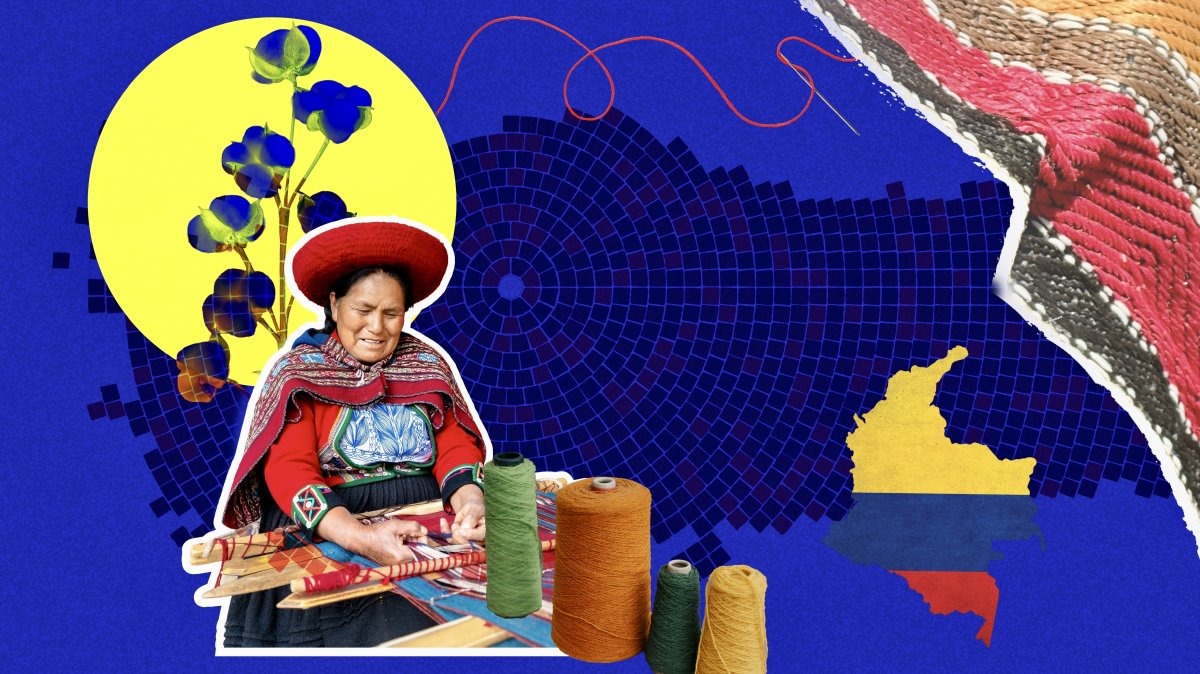
I’m going to tell you a 12,000-year story that shaped a nation's industry, and in doing so, its present and its future. Just as Türkiye has long served as the bridge between Asia and Europe, Colombia stands at the crossroads of the Atlantic and Pacific Oceans, connecting South America with Central America. For thousands of years, their extraordinary geographies have made Türkiye and Colombia natural bridges for continents, cultures and trade. However, similarities and the potential of both countries have not gone unnoticed. The Republic of Türkiye has maintained diplomatic relations with Colombia since 1959 and has operated an embassy there since 2010. In addition to its diplomatic presence, Türkiye has established regional offices for governmental institutions such as Turkish Airlines, the Turkish Cooperation and Coordination Agency (TIKA) and the Türkiye Maarif Foundation. Numerous presidential-level visits have led to the signing of a wide range of bilateral cooperation agreements, further strengthening the relationship between the two countries. The political relationship has been built over decades. The commercial relationship, however, still has a long way to go. Among all sectors, textiles may offer the strongest opportunity to transform this political goodwill into long-term economic cooperation. Colombian textile sector For thousands of years, different civilizations adapted their clothing to Colombia's diverse geography. The Muiscas designed wool and thick cotton garments suitable for the cold climate of the Andes. The Taironas produced light and comfortable clothing for the tropical Caribbean coast around Santa Marta. The Quimbayas adapted their textiles to the humid river valleys, while the Wayuu people developed light and breathable fabrics capable of protecting them from the intense sun of the Guajira Desert. The examples could be multiplied many times over, but one fact remains undeniable: These civilizations left Colombia not only a cultural heritage, but also an industrial legacy. Today, that legacy supports hundreds of thousands of Colombian families. The textile and apparel sector contributes nearly 9% of Colombia's industrial production and, according to industry projections, is expected to grow by more than 5% annually. According to the Colombian textile manufacturers' federation, the sector consists of more than 47,000 companies, around 12,000 of which specialize in design, and employs more than 400,000 people. Built upon centuries of accumulated know-how, the textile industry has become one of the pillars of Colombia's manufacturing economy. Colombia is much more than another export destination. With access to both the Atlantic and Pacific oceans, an extensive free trade network and one of Latin America's strongest fashion industries, it offers something many other countries in the region cannot: a regional platform. Building a strong presence in Colombia means gaining access to neighbouring markets across Latin America. Where does Türkiye stand? On the other side of the world, Türkiye also stands out for its textile industry, which is among the largest and most advanced in the world. Its ability to cultivate high-quality cotton, advanced manufacturing capabilities and strategic position between Europe and Asia have made textiles one of the cornerstones of our economy. Today, the Turkish textile sector employs more than 500,000 people, and accounts for nearly 8% of its gross domestic product (GDP) and approximately 10% of its exports. According to the Independent Industrialists and Businessmen’s Association (MÜSIAD), Türkiye is Europe's third-largest and the world's seventh-largest textile exporter. However, when we examine our position in Latin America, we encounter a striking contradiction. Despite our manufacturing capacity and international competitiveness, Türkiye's textile market share across Latin America barely reaches 0.5%. The interesting question is not why Colombia needs Türkiye. The real question is why Türkiye still has such a limited presence in a region of nearly 700 million people despite having one of the world's largest textile industries. If we ask the wrong question, we will continue looking for the wrong answers. The two countries are, in fact, complementary rather than competitive. Türkiye has built one of the world's strongest manufacturing capacities and advanced corporate maturity, while Colombia has become one of Latin America's leading fashion, apparel and distribution centers. One produces at scale; the other understands the regional market. This is exactly why cooperation makes more sense than competition. There may be many reasons behind our limited presence. We may not fully understand the business culture of the region. We may not sufficiently adapt our collections to local tastes, seasonal conditions or consumer preferences. More importantly, we still approach Latin America as a destination for occasional exports rather than as a region where permanent commercial presence, local partnerships and long-term investment are required. The reasons can be debated, but the conclusion remains the same: our current methods won't work. Showcase opportunity: Colombiatex Nearly 60% of Turkish textile exports are destined for the European Union, while almost 90% are concentrated within Europe, the Middle East and the Slavic region. Geopolitical tensions, slowing demand and regulations such as the Carbon Border Adjustment Mechanism are increasing the pressure on Turkish manufacturers every year. Diversifying our export markets is no longer simply an opportunity. It has become an economic necessity. The Colombian market, like many other Latin American economies, is witnessing the steady expansion of its middle class. These consumers are increasingly demanding products that are neither the cheapest nor the most expensive, but products that offer quality at a reasonable price. This has always been the strongest muscle of Turkish manufacturers. In this context, Colombiatex has been one of the most important textile exhibitions in Latin America for 40 years. This year, more than 600 companies, including 20 from Türkiye, participated in the exhibition, connecting with over 30,000 visitors from around the world. The fair is much more than a commercial exhibition. It is where manufacturers, designers, retailers and investors meet to understand where the Latin American market is heading. But the opportunity goes far beyond selling products. Many Turkish exporters still see exporting as loading containers and sending them overseas. If we want to establish ourselves in Latin America, we need to think beyond containers. Retailers and manufacturers across the region can benefit not only from our products, but also from our production know-how, technology, quality management and corporate experience. This is, in fact, the real value proposition of the Turkish textile industry. Colombia offers much more than another export market. It offers access to nearly 700 million consumers, one of Latin America's strongest textile ecosystems and a strategic partner for companies that want to establish themselves permanently in the region. The political relationship between our countries has already been built over decades. Now it is time to build the commercial relationship with the same determination. The opportunity is already there. The question is no longer whether Latin America matters for Türkiye. The question is whether Türkiye is ready to seize the opportunities that Latin America has to offer.
Türkiye's road to Latin America passes through Colombia
Full Article
Original Source
Read the full article at Dailysabah →KhanList aggregates and links to publicly available news content. We do not host full articles from third-party sources. Always verify important information with original sources.